
There is a problem sitting in the Gospel of Luke that church historians have seen, quietly noted, and walked past for centuries. It is not a minor textual curiosity. It is a contradiction embedded in the very chapter that introduces one of the most celebrated figures in all of Christian and Islamic tradition — the prophet the church calls John the Baptist and the Quran calls Yahya.
Once you see it, you cannot unsee it.
Luke 1:61 — The Verse That Should Not Exist
Luke chapter one, verse sixty-one.
Elizabeth has just given birth. Her husband Zechariah, struck mute by the angel of the Lord, cannot speak. The relatives gather around and assume the child will be named after his father, as was customary. But Elizabeth insists on a different name. And her relatives push back with a statement that, on careful examination, makes no historical sense whatsoever.
They say: “There is no one among your relatives who is called by that name.”
That single sentence is the problem.
The Greek word Luke uses for relatives is syngenia — συγγένεια. This does not mean the immediate household. It does not mean just the parents or siblings. Syngenia refers to the entire extended kinship network — the clan, the lineage, the family going back generations. Luke is telling us that no one in the whole extended family of Zechariah and Elizabeth had ever borne this name.
And Luke tells us the name was John. In Hebrew, Yohanan — יוֹחָנָן.
This is where the problem begins.
The Name Yohanan Was Everywhere
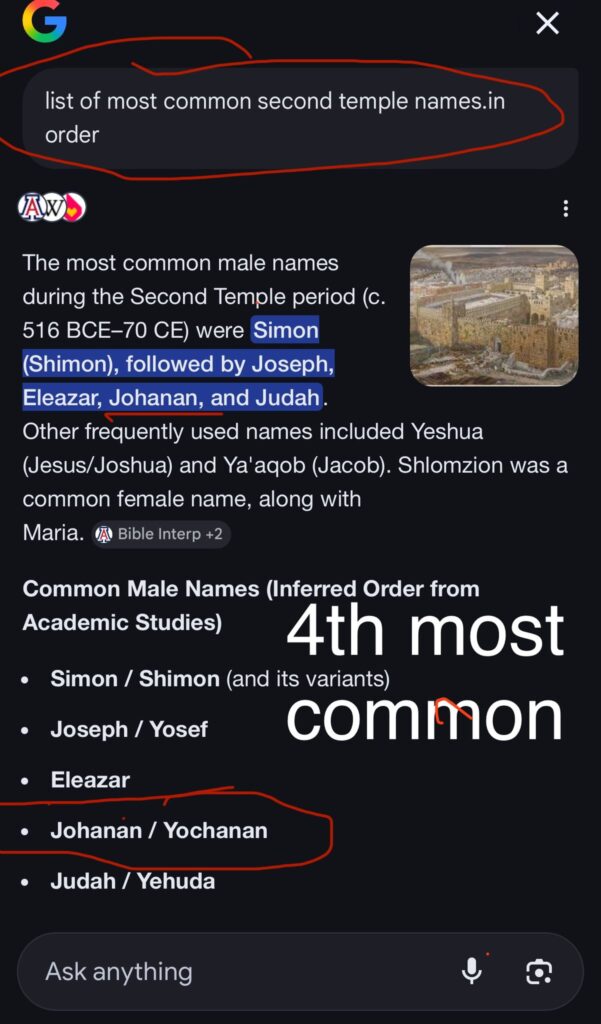
Yohanan was not an obscure name. It was not a rare coinage or an exotic import. By the Second Temple period, Yohanan had become one of the most common names in all of Jewish life — particularly among the priestly class.
Consider the evidence from scripture and priestly history alone:
- Nehemiah 12:22–23 lists a high priest named Yohanan — a direct ancestor in the Aaronic succession.
- Nehemiah 12:11 traces the high priestly line through generations, with Yohanan appearing explicitly in the chain.
- 1 Chronicles 6:9–10 records an Azariah son of Johanan in the Aaronic lineage of the temple priesthood.
- The Maccabean dynasty — itself of priestly Hasmonean descent — included John Hyrcanus, high priest and ruler, whose name in Hebrew was Yohanan.
- The Elephantine papyri from the fifth century BCE include a high priest of the Jerusalem temple named Yohanan.
This was a name woven into the fabric of Israelite priestly identity across centuries. It was practically a priestly surname.
Who Were Zechariah and Elizabeth?
Here is what Luke himself tells us about this family.
Luke 1:5 — “In the days of Herod, king of Judea, there was a priest named Zechariah, of the division of Abijah.”
The division of Abijah was one of the twenty-four priestly divisions established by King David in 1 Chronicles 24:10. These were not ordinary families. These were hereditary Aaronic priests — men who traced their lineage directly back to Aaron the brother of Moses, men whose family identity was inseparable from the temple priesthood.
Luke 1:5 continues — “And his wife was from the daughters of Aaron.”
Elizabeth was not merely a woman with priestly relatives. Luke explicitly identifies her as a daughter of Aaron — meaning her own bloodline ran through the Aaronic priestly line.
So we have on both sides of this marriage: Aaronic priestly heritage, going back generations.
Now ask the question Luke’s first readers should have asked immediately.
How is it possible that an extended priestly family of Aaronic descent, with documented ancestors bearing the name Yohanan going back to the days of Nehemiah and beyond, had never once in their entire clan produced a child named Yohanan?
The answer is simple: it is not possible.
If the name was Yohanan, Luke 1:61 is historically false. The syngenia of a priestly Aaronic family would have known that name intimately. The claim that no one in the clan bore it collapses the moment you open Nehemiah.
Luke’s text contains a contradiction it cannot resolve on its own terms. The name has to be wrong.
The Mandean Witness — Two Names Preserved Together
Before we arrive at the solution, we must stop at one of the most remarkable pieces of evidence in this entire discussion: the Mandeans.

The Mandeans are one of the oldest continuously surviving religious communities on earth. They are a first-century community — not a medieval sect, not a later movement — who regarded John the Baptist as their supreme prophetic figure, holding him in a reverence far exceeding anything in mainstream Christianity.
Crucially, the Mandeans preserved their traditions orally and in their own Semitic script, independently of the Greek gospel transmission. They were not reading Luke. They were not reading Matthew. They had their own liturgical texts, their own sacred histories, their own names.
When they refer to John the Baptist, they use two names together:

Iahia Iuhana.
Read that carefully.
- Iahia — the Semitic oral transmission of Yahya, built on the root ḥayy, meaning he lives.
- Iuhana — a transliteration of the Greek Ioannes, itself derived from the Hebrew Yohanan.
Two names. Two entirely different roots. Two entirely different transmissions.
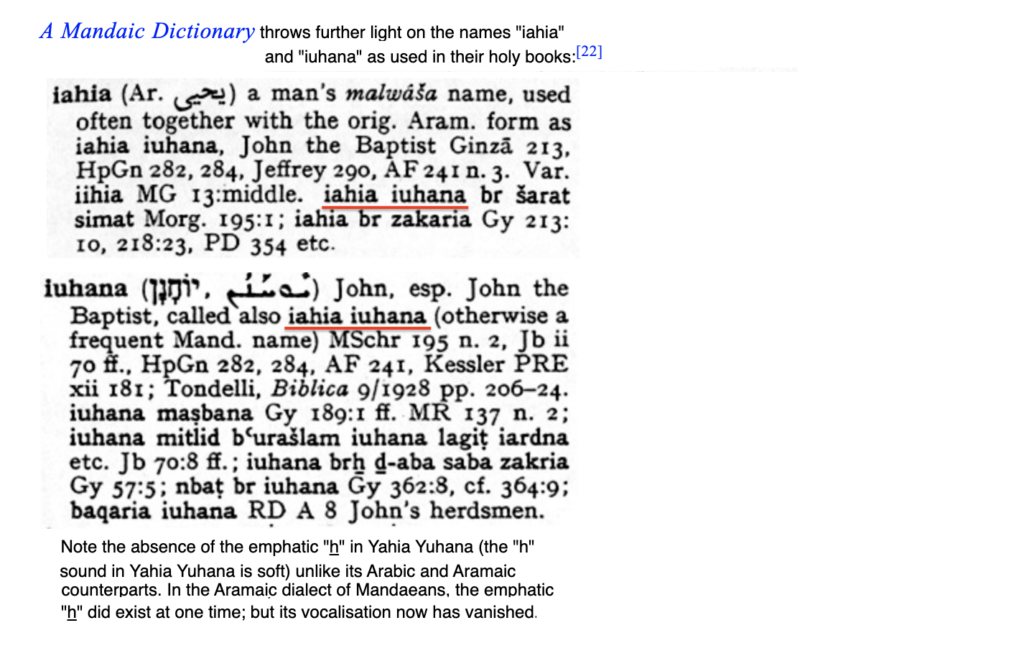
The Mandeans did not collapse these into one. They kept both precisely because they understood they were not the same name. They had inherited the Semitic name through their own oral tradition and the Greek name through contact with the surrounding world, and they preserved the distinction across two thousand years.
This is not a coincidence. This is a community standing at the crossroads of two transmission streams, holding both names and knowing they point to different things.
What Happened in the Greek Transmission
Once we hold the Mandean evidence, the mechanics of what happened become clear.
Yahya — built on the Hebrew-Arabic root ḥ-y-y (ח-י-י) meaning to live, to be alive — had no equivalent in the Greek priestly naming tradition. It was a name with no Greek counterpart, no familiar cognate, no easy rendering.
When Greek scribes or early translators encountered this name in oral reports about the prophet, they did what scribes have always done with unfamiliar names in unfamiliar languages: they reached for the nearest familiar equivalent.
And what was the nearest familiar priestly name in their register? Yohanan — Ioannes — John.
The substitution was understandable. The names share consonantal overlap in their opening sounds. Both are associated with a famous prophet. Both are Semitic. The reach was natural.
But the reach was wrong.
Yahya and Yohanan share no common trilateral root:
- Yohanan — root: ח-נ-נ (ḥ-n-n), meaning to be gracious, to show favor. It is a theophoric name: Yah + ḥanan = “Yahweh is gracious.” The divine name element Yah is embedded in it.
- Yahya — root: ח-י-י (ḥ-y-y), meaning to live, to be alive. It is not theophoric. It is a declarative name: he lives.
These are two different roots, two different meanings, two different names.
The Greek scribal tradition collapsed them into one. And for two thousand years, the collapse went unquestioned.
The Quran Confirms — And Names Him Correctly
Now with the problem fully established — Luke’s internal contradiction, the Mandean witness preserving two distinct names, and the linguistic proof that Yahya and Yohanan are entirely different words — now we can hear what the Quran says.
Surah Maryam, chapter nineteen, verse seven:
“O Zechariah, indeed We give you good tidings of a boy whose name will be Yahya. We have not assigned to any before him this samiyyan.”
The Arabic word samiyyan (سَمِيًّا) is dense with meaning. It derives from the root s-m-w — to be high, to be elevated, to be named. In this context it carries two converging readings:
- No one before him bore this name — it was unprecedented in the naming tradition of Israel.
- He had no equal — the name itself signals a distinction without parallel.
Both readings point in the same direction.
The Quran is not saying that Yohanan was an unusual name. The Quran is saying that Yahya — this specific name, this specific root, this specific meaning — had never before been given to anyone. It was a divine coinage. A name outside the existing register of Israel’s priestly families entirely.
Restore Yahya as the original name, and Luke 1:61 becomes historically coherent for the first time.
The relatives were not confused about Yohanan — a name they would have known from their own lineage for generations. They were astonished at Yahya — a name no one in their family, or in any family in Israel, had ever borne.
The contradiction in Luke dissolves. The Quran did not create this resolution. It preserved it.
The Critic Objects — And Falls Flat
At this point a critic of the Quran will raise an objection. They will say: if samiyyan means no one before bore the name Yahya, then the Quran can be disproved. They point to 1 Chronicles 15:24 and a figure called Yehiah — claiming this represents a Yahya-like name in the priestly record that predates the prophet, thus undermining the Quran’s declaration of uniqueness.
This objection collapses under basic manuscript scrutiny.
The supposed Yehiah of verse twenty-four is not an independent person with an independent name. The very same Levite appears three times in that same chapter:
- 1 Chronicles 15:18 — spelled Jehiel (יְחִיאֵל)
- 1 Chronicles 15:20 — spelled Jehiel (יְחִיאֵל)
- 1 Chronicles 15:21 — spelled Jehiel (יְחִיאֵל)
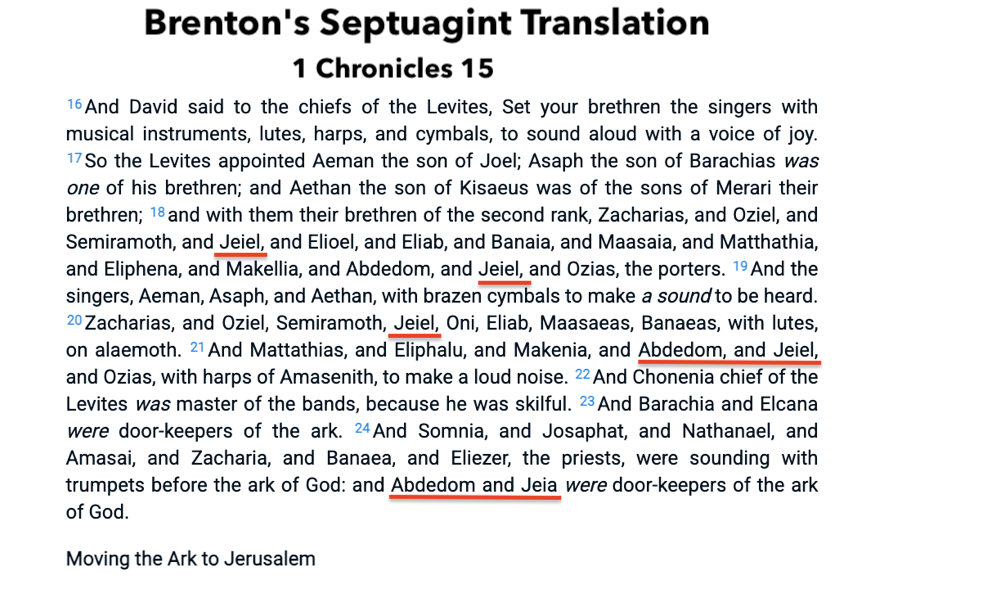
Three consistent occurrences across verses eighteen, twenty, and twenty-one. All Jehiel. The Yehiah in verse twenty-four is a scribal variant — a single copyist who rendered the same name differently in one verse. The majority of early manuscripts carry Jehiel there as well, consistent with every other appearance.
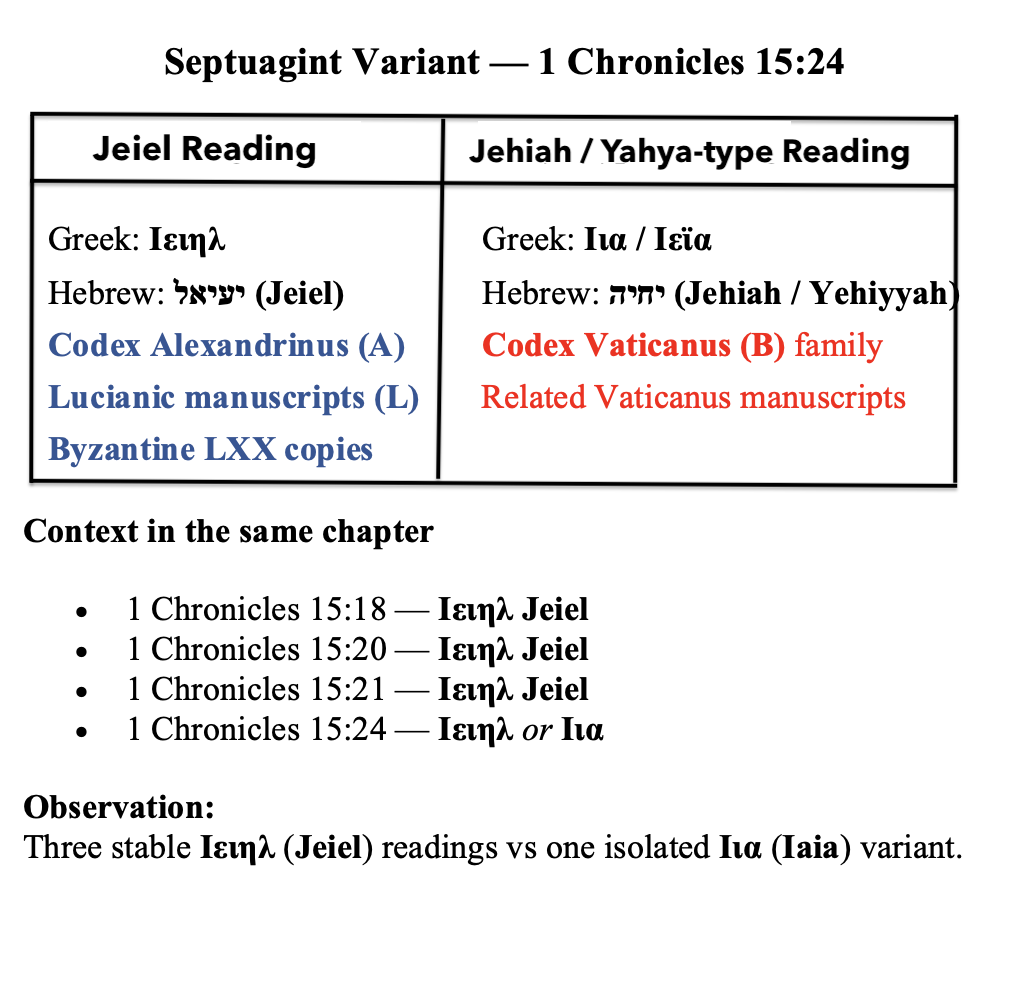
This is not an independent name. It is not a separate precedent. It is a copying error in a single manuscript tradition, and it does not survive comparison with the broader textual witness.
The critic’s only candidate is a scribal mistake. The Quran’s declaration of samiyyan stands unchallenged.
Matthew’s Testimony — Three Sources, One Verdict
There is one further thread that ties everything together.
Matthew 11:11 — Jesus himself is recorded saying: “Truly I tell you, among those born of women there has not risen anyone greater than John the Baptist.”
No one born of women surpassed him. That is an extraordinary declaration. It is the language of singular, unprecedented standing — the same register as samiyyan.
Now hold that beside Luke 1:61 — an entire family astonished that no one before had borne this name.
And hold both beside the Quran’s samiyyan — no one before him bore this name, no one had his equal.
Three sources. Three convergent testimonies about a singularity.
Matthew says no one surpassed him. Luke says the name was unprecedented — but records the wrong name. The Quran says the name was unprecedented — and records the right one.
The Quran did not borrow the story. The Quran completed it.
Conclusion — The Name He Was Always Called
The Gospel of Luke preserved the evidence of its own error. In Luke 1:61, the text records the astonishment of an entire priestly clan at a name they had never heard — and then tells us that name was Yohanan, which that very clan would have known across generations of Aaronic priesthood.
The Mandeans, standing outside the Greek transmission, preserved what the Greek scribes could not carry: Iahia alongside Iuhana. Two names. One oral, one textual. Both held with care across two thousand years, because the community that preserved them knew they were not the same.
The Quran, revealed in the seventh century, carried the name the Greek tradition lost — Yahya — confirmed that it was unprecedented, declared that the man who bore it had no equal, and preserved it with a precision that resolves every tension the Gospel record left behind.
Church historians saw the problem. They noted it. They moved on.
The Quran stopped, named it, and resolved it.
Yahya. He lives.
That was always his name.