The Qur’an does not merely mention rain clouds.
It describes a storm system forming in stages — in sequence — using language that remarkably mirrors what modern meteorology eventually discovered about the cumulonimbus cloud: the towering thunderstorm responsible for hail, lightning, violent rain, and severe weather.
The verse is Surah al-Nur 24:43.
“Have you not seen that Allah drives the clouds, then joins them together, then makes them a stacked mass, then you see the rain emerge from its midst? And He sends down from the sky, from mountains within it, of hail… and the flash of its lightning almost takes away the sight.”
— Qur’an 24:43
This is not random imagery.
It is a structured atmospheric process.
And every stage matters.
1. “Allah drives the clouds”
Allāhu yuzjī saḥāban
The verse begins with movement.
The Arabic verb yuzjī means to drive, propel, push along, or herd toward a destination.
Modern meteorology describes the beginning of major storm formation through atmospheric convergence — air currents driving scattered cloud systems together into developing storm zones.
This is not the language of static clouds floating overhead.
It is directional, active motion.
The cloud is being driven toward formation.
2. “Then He joins them together”
Thumma yuʾallifu baynahu
The verse then describes separate cloud bodies being combined into one larger system.
Meteorology now understands that thunderstorm systems are often formed through the merging and organization of convective cloud masses.
The Qur’an does not describe a single isolated cloud.
It describes clouds being gathered and united into a greater structure.
First: movement.
Then: joining.
The sequence is exact.
3. “Then He makes it a stacked mass” — the decisive phrase
Thumma yajʿaluhu rukāman
This is the heart of the verse.
The Arabic word rukām comes from the root r-k-m, meaning to pile up, heap together, stack layer upon layer, accumulate vertically.
This is extraordinarily specific.
The Qur’an is not merely saying the cloud became “big.”
It is describing vertical accumulation.
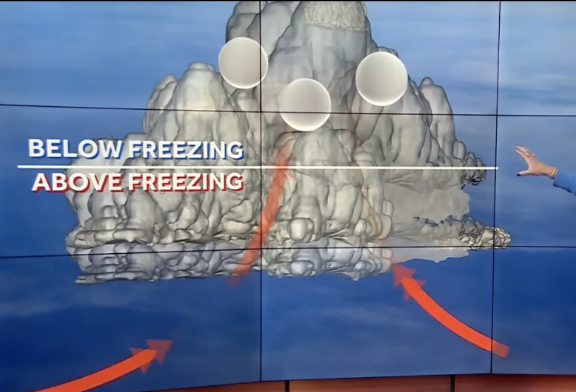
A cumulonimbus thundercloud — the storm cloud responsible for hail and lightning — is built exactly this way: powerful updrafts force moisture upward, stacking the cloud vertically into enormous towers reaching extreme altitudes.
Modern meteorology did not formally classify this cloud type until 1803, when meteorologist Luke Howard introduced the scientific cloud classification system and named the cumulonimbus.
Even today, meteorological organizations describe these clouds as mountain-like towers.
But the Qur’an did not merely describe appearance.
It described the mechanism:
stacking.
Accumulation.
Vertical build-up.
That is the significance of rukām.
4. “Then you see the rain emerge from its midst”
Fa-tarā l-wadqa yakhruju min khilālihi
The verse next describes rain emerging from within the cloud itself.
The Arabic khilāl refers to the inner parts, the interior spaces, the midst of something.
Again, the wording is striking.
The verse does not speak about rain falling “from beneath” the cloud in a simplistic observational sense.
It describes rain emerging from inside the stacked mass.
Modern meteorology confirms that thunderstorm precipitation develops internally within the cloud through complex condensation and circulation processes.
But the precision becomes even more remarkable when the next stage arrives.
Because the Qur’an places rain before hail.
Exactly as modern science does.
5. “From mountains within the sky, of hail”
Wa-yunazzilu mina l-samāʾi min jibālin fīhā min barad
“And He sends down from the sky, from mountains within it, of hail.”
This is one of the most astonishing descriptions in the Qur’an.
The verse describes mountains in the sky associated with hail formation.
Today we know something seventh-century people could not have scientifically known:
hail forms only in massive vertically developed storm clouds that rise high enough into the freezing regions of the upper atmosphere.
Ordinary clouds do not produce hail.
Flat clouds do not produce hail.
Only towering cumulonimbus systems reaching extreme altitudes can do so.
Why?
Because the upper atmosphere is intensely cold.
Water droplets are carried upward by violent updrafts, freeze, accumulate additional layers of ice, and eventually fall as hailstones.
This entire process depends on vertical atmospheric structure.
And that is precisely what the Qur’an describes:
- towering stacked masses,
- mountain-like structures in the sky,
- hail emerging from them.
The phrase is not accidental poetry.
It corresponds directly to the actual architecture of hail-producing storm systems.
And crucially:
human beings standing on the earth cannot naturally observe the freezing mechanics of the upper atmosphere.
That knowledge required centuries of atmospheric science.
6. “Its lightning almost takes away the sight”
Yakādu sanā barqihi yadhhabu bil-abṣār
The verse concludes by mentioning lightning emerging from the same storm system.
Modern meteorology identifies cumulonimbus clouds as the primary generators of both hail and lightning.
These are not disconnected phenomena.
They are linked through intense internal interactions involving ice particles, collisions, charge separation, and violent vertical circulation within the cloud.
The Qur’an presents the storm as one integrated system:
- driven clouds,
- joined clouds,
- vertically stacked clouds,
- internal rain formation,
- hail production,
- lightning generation.
One coherent atmospheric structure.
Exactly what modern science eventually discovered.
The Real Argument
Critics sometimes respond:
“People already saw storms.”
Of course they did.
That is not the argument.
The argument is not that ancient people saw clouds.
The argument is that the Qur’an describes the storm in a staged internal process matching the actual structure and development of the cumulonimbus cloud:
- movement,
- convergence,
- vertical stacking,
- internal precipitation,
- hail generation at altitude,
- lightning from the same system.
This goes far beyond surface-level observation.
The verse does not simply describe what storms look like.
It describes how they function.
And it does so in correct sequence.
The Historical Gap
Now place the timelines side by side.
The Qur’an was recited in seventh-century Arabia to an unlettered Prophet ﷺ living in a desert civilization without meteorological instruments, atmospheric physics, weather balloons, aircraft studies, or radar imaging.
Yet modern science would only later establish:
- formal cumulonimbus classification in 1803,
- atmospheric temperature decline with altitude across modern meteorological development,
- detailed internal hail formation mechanisms through twentieth-century atmospheric science,
- the integrated electrical dynamics of thunderstorm systems.
Roughly twelve centuries separate the revelation from the scientific confirmations.
That gap is the point.
The Qur’an spoke about the storm not merely as it appears to the eye — but as it truly is.
“We will show them Our signs in the horizons and within themselves until it becomes clear to them that it is the truth.”
— Qur’an 41:53
ToBeAMuslim.com — exploring the signs of the Qur’an.