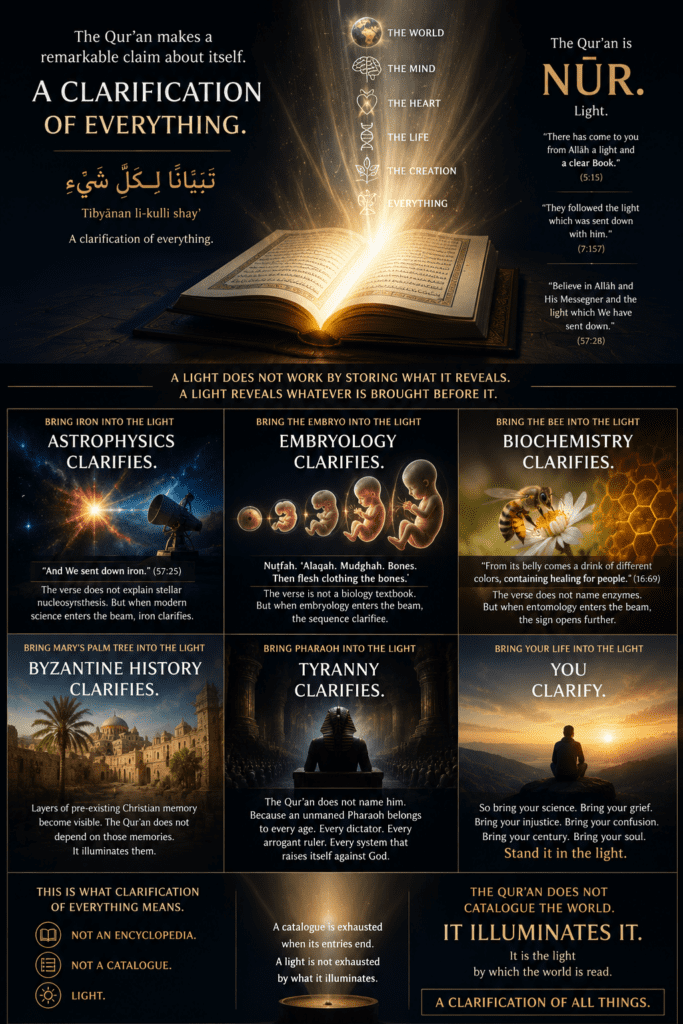
The Qur’an makes a remarkable claim about itself. In Sūrat al-Naḥl, Allah says:
Wa nazzalnā ʿalayka l-kitāba tibyānan li-kulli shayʾ
“We have sent down upon you the Book as a clarification of everything.”
— Qur’an 16:89
This is one of the most striking self-descriptions in any scripture. Clarification of everything. Not a section of things. Not a category of things. Everything.
To understand what this means, the Qur’an gives us another self-description. It tells us, repeatedly, what kind of Book it is.
Qad jāʾakum mina llāhi nūrun wa kitābun mubīn
“There has come to you from Allah a light and a clear Book.”
— Qur’an 5:15
Wa ittabaʿū n-nūra lladhī unzila maʿahū
“They followed the light which was sent down with him.”
— Qur’an 7:157
Fa-āminū billāhi wa rasūlihi wa n-nūri lladhī anzalnā
“So believe in Allah and His Messenger and the light which We have sent down.”
— Qur’an 64:8
The Qur’an is nūr. Light.
And once this is taken seriously as a self-description, the meaning of tibyānan li-kulli shayʾ opens up.
A light does not work by storing what it reveals. A light reveals whatever is brought before it. The coin on the floor. The face in the mirror. The wound on the arm. The star in the sky. The light is one. What becomes visible depends on what is placed in its beam.
This is the method of the Qur’an.
The Prophet ﷺ said:
“I have been sent with Jawāmiʿ al-Kalim.”
“the shortest expression carrying the widest meanings.”
The Qur’an does not catalogue every science. It does not list every law. It does not name every figure or specify every mechanism. Yet it clarifies all of these — because clarification is not the property of a catalogue. It is the property of light.
Iron
Allah says:
Wa anzalnā l-ḥadīd
“And We sent down iron.”
— Qur’an 57:25
The verse does not explain stellar nucleosynthesis. It does not describe supernova explosions or the cosmic forging of heavy elements. It names a reality: iron was sent down.
When modern astrophysics is brought before this verse, the reality becomes clearer. Iron is not native to Earth in any simple sense. It is forged in stars and delivered to our planet through cosmic processes. The verse did not need to become a physics textbook. It named the reality in a form capable of receiving later knowledge.
The fact enters the light, and the verse clarifies it.
The Embryo
Allah describes human development:
Nuṭfah — then ʿalaqah — then muḍghah — then bones — then flesh clothing the bones.
— Qur’an 23:12–14
The passage is not a textbook of embryology. It does not name chromosomes, somites, cartilage models, or myoblasts. It names stages.
When developmental biology is brought before the verse, the staged nature of human formation becomes more visible. The Qur’an gave enough to recognize the reality without reducing the verse to one century’s scientific vocabulary.
The science enters the light, and the verse clarifies it.
The Bee
Allah says:

Yakhruju min buṭūnihā sharābun mukhtalifun alwānuhū fīhi shifāʾun lin-nās
“From their bellies emerges a drink of varying colors, in which there is healing for people.”
— Qur’an 16:69
The verse does not discuss the honey stomach, enzymes, glucose oxidase, or the biochemistry of antimicrobial activity. It identifies the phenomenon: from within the bee emerges a drink of varied colors, and in it there is healing.
When entomology is brought before the verse, the sign opens further. Modern biochemistry deepens, but does not replace, the recognition the verse already gave.
The biology enters the light, and the verse clarifies it.
Mary
The Qur’an tells of Mary withdrawing, giving birth, and being directed toward provision at the palm tree, with water beneath her.
— Qur’an 19:22–26
The passage does not provide an archaeological map. It does not mention Byzantine pilgrimage routes or Marian devotional traditions of late antiquity.
But when the historical record is brought before the verse, layers of pre-existing Christian memory become visible — the Kathisma tradition, the palm-and-spring devotion preserved in Byzantine liturgy between Jerusalem and Bethlehem. The Qur’an does not depend on these sources. It illuminates them. It shows which memories carried truth and why they mattered.
History enters the light, and the verse clarifies it.
Pharaoh
The Qur’an does not name the Pharaoh of Moses.
That omission is not a defect. It is part of the illumination.
A named Pharaoh belongs to one dynasty, one reign, one mummy, one museum label. An unnamed Pharaoh belongs to every age. He becomes the archetype of arrogant power: the ruler who imagines himself ultimate, the state that crushes the weak, the tyrant pursued by the very waters he believed he commanded.
Every age recognizes its Pharaoh by the light of this verse.
The tyrant enters the light, and the verse clarifies him.
What Tibyān Means
This is what tibyānan li-kulli shayʾ means.
Not a catalogue of every fact. A light that clarifies every fact.
A catalogue is exhausted when its entries end. A light is not exhausted by what it illuminates. A catalogue belongs to the era that wrote it. A light travels across every era.
This is why the same Qur’an speaks to the seventh-century Bedouin and the twenty-first-century surgeon. To the ruler and the activist. To the grieving mother and the scholar. To the child and the mystic. Not because every situation is an entry in the text — but because every situation can be brought into its light.
The Qur’an clarifies not by becoming everything, but by illuminating everything.
The Architecture of Light
This also explains the Qur’an’s restraint.
The Qur’an often withholds names, mechanisms, dates, and unnecessary particulars. Pharaoh is unnamed. Noah’s drowned son is unnamed. Adam’s wife is unnamed. The People of the Cave are not counted. The Rūḥ is not dissected.
A light does not need to itemize every object it will illuminate. If the Qur’an had named every figure, explained every mechanism, mapped every location, and catalogued every discovery, it would have become a container — and containers age.
The Qur’an’s restraint allows it to remain light.
It reveals enough to guide.
It reserves enough to remain alive across centuries, sciences, civilizations, and human conditions.
What This Means for the Reader
Most books ask you to receive their contents. The Qur’an asks you to bring your reality before it.
Bring your science. Bring your grief. Bring your injustice. Bring your tyrant. Bring your confusion. Bring your century. Bring your soul.
Stand it in the light.
The Qur’an does not merely tell you about your situation. It clarifies your situation when you bring it before Allah’s words.
That is why fourteen centuries have not exhausted it.
The Book is finite.
The illumination is not.
The Qur’an does not catalogue the world.
It illuminates it.
It is the light by which the world is read.
Now Let’s Get Technical:
The Qur’an writes reality at the level where reality does not change
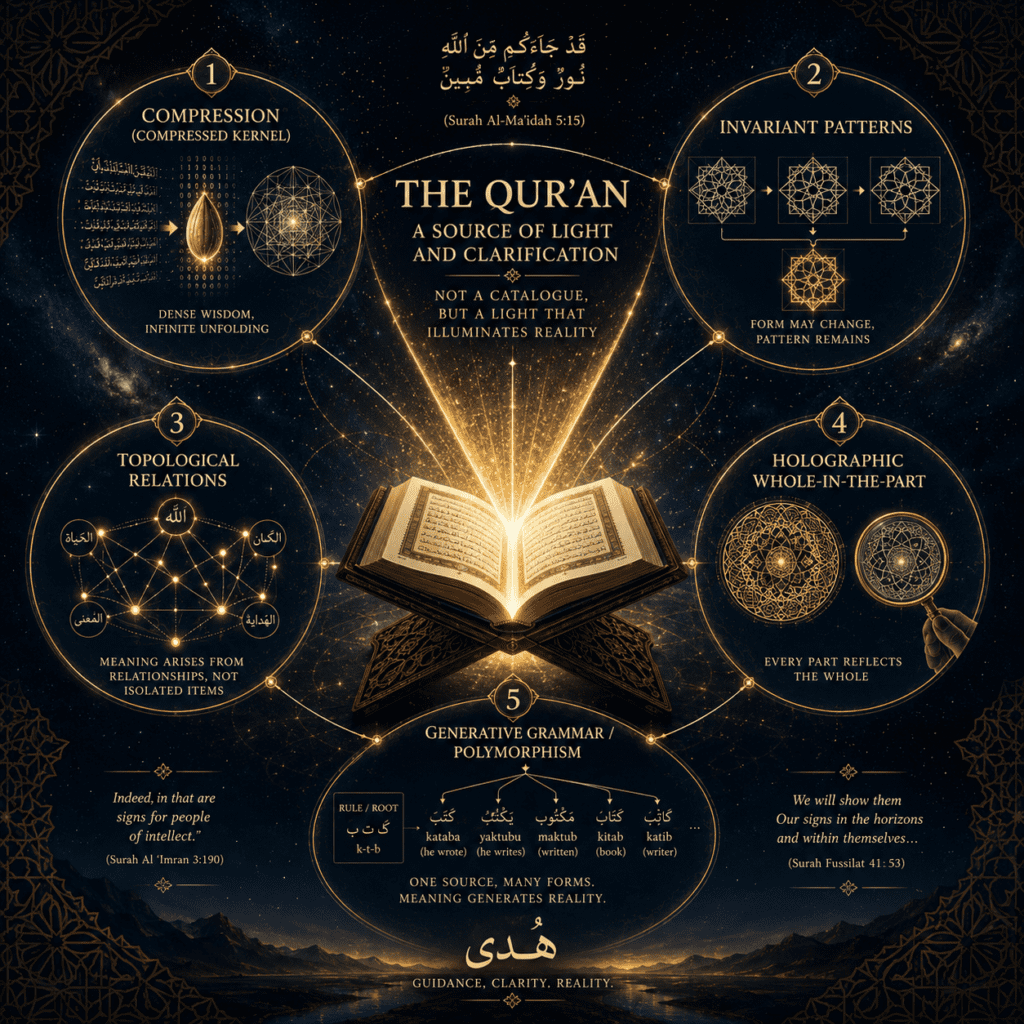
The Qur’an writes reality at the level where reality does not change. It compresses the invariant patterns beneath events into seventy-seven thousand words, leaves every changing variable open for future centuries to instantiate, and structures every coherent part to contain the whole pattern. Information theory, invariant theory, topology, holography, and generative grammar each describe one face of the same engineered object. It is the minimum description length of reality, in book form. That is what tibyānan li-kulli shayʾ actually means. Not a catalogue. A compressed invariant kernel. A prism. A light.
The mechanism named:
The Qur’an behaves as a maximally compressed invariant kernel — a finite structure that encodes the deep patterns of reality at a level of abstraction that survives every transformation of the variables.
There are at least five mathematical and philosophical frameworks that describe what this is. Each lights up a different facet of the same object.
1. Kolmogorov Complexity and Compression
In information theory, the Kolmogorov complexity of an object is the length of the shortest program that can generate it. The deeper the regularity, the shorter the program. A truly random sequence cannot be compressed. A deeply patterned reality can be compressed enormously.
A text optimized for compression of reality would look like the Qur’an does: finite, dense, generative, withholding all redundant specificity, retaining only the patterns from which the full reality unfolds.
The Qur’an behaves as if it were the minimum description length of the moral, theological, and historical structure of human existence. Seventy-seven thousand words encoding the generative kernel of fourteen centuries — and still unfolding.
A 7th-century author optimizing for compression at this level is doing something that information theory did not have a name for until the 20th century.
2. Invariant Theory
In mathematics, an invariant is a property that remains unchanged under a group of transformations. Rotate a circle: the area is invariant. Translate a triangle: the angles are invariant. Mathematicians prize invariants because they capture the essential structure beneath surface changes.
The Qur’an operates at the level of moral and ontological invariants. Tyranny, gratitude, surrender, betrayal, mercy, arrogance — these are not 7th-century phenomena. They are the invariants of the human condition under every cultural, technological, and historical transformation.
A text written at the level of invariants does not age because invariants are what does not change. When you change the era, the technology, the language, the science — the invariants remain.
The Qur’an’s strategic omission of names, dates, and mechanisms is not vagueness. It is the elimination of non-invariant variables. What’s left is the invariant kernel.
This is why the same words apply to Pharaoh and to every modern dictator: the verse was written at the level of the tyranny-invariant, not the Pharaoh-instance.
3. Topological Robustness — the Map of Relations
A topological space is defined not by distances but by relationships of nearness, continuity, and connection. You can stretch and deform a topological space radically — and as long as the relationships are preserved, the space is the same.
The Qur’an is topologically robust in this sense. It does not define things by essence — it defines them by relations:
- Creator ↔ creation
- Believer ↔ God
- Tyrant ↔ prophet
- Dunya ↔ ākhirah
- Gratitude ↔ blessing
- Corruption ↔ destruction
- Sign ↔ recognition
These are not facts. They are relations. Relations survive every transformation of the underlying objects. A 7th-century Bedouin and a 21st-century surgeon stand in the same relation to their Creator. The relation is invariant. The participants change.
A text built on relations rather than essences is a text engineered for survival across every era in which the participants change but the relations do not.
4. Holographic Encoding
In physics, the holographic principle states that the information contained in a volume of space can be encoded on the boundary of that space — at lower dimensionality and without loss. Every part contains information about the whole.
The Qur’an exhibits holographic structure. A single substantial surah — Yusuf, Maryam, al-Kahf — contains the full theological, ethical, eschatological, and metaphysical framework in compressed form. A reader who memorizes only Surah Yusuf can reconstruct most of the dīn from it.
This is why the early community could transmit the entire framework through memorization of portions. The whole was encoded in every coherent part.
The mechanism: each part contains the generative pattern that produces the whole. That is exactly the holographic property.
5. Generative Grammar with Underspecification
This is the framework Noam Chomsky developed for language. A grammar is a finite set of rules that generates an infinite set of well-formed expressions.
But the Qur’an does something more subtle than ordinary generative grammar. It is a grammar with strategic underspecification — meaning the grammar’s rules are deliberately incomplete in specific positions, and the underspecified slots are where context fills in.
This is exactly how modern programming languages with polymorphism work. The function signature specifies the structure of the operation, but the specific type can be filled in at runtime by whatever context calls the function.
The Qur’an’s verse “the unnamed Pharaoh” is a polymorphic function. Its argument is “tyrant.” The argument is filled in by whatever century, whatever situation, whatever reader brings their tyrant to the verse. The verse is one. The applications are unbounded. Each application is typed correctly because the structural relation (oppressor → oppressed → divine reckoning) is invariant.
A 7th-century author would not write polymorphically. They would over-specify because they would not know which arguments would be passed at runtime. The Qur’an writes polymorphically — as if the Author already knew every type that would ever instantiate the function.
The Philosophical Mechanism Beneath All Five
These five frameworks — Kolmogorov compression, invariant theory, topological robustness, holographic encoding, polymorphic generative grammar — are not five different things the Qur’an does. They are five different mathematical languages for naming the same underlying mechanism.
That mechanism is:
The Qur’an is engineered at the level of the invariant patterns of reality, expressed through the minimum compressed encoding that preserves generative power, with strategic underspecification at every point where instantiation by future context will fill in the variable.
In simpler language:
The Qur’an writes reality at the level where reality does not change, leaving the changing parts to be filled in by whoever reads it, in whatever century, in whatever condition.
This is what makes it a prism. White light entering a prism contains all colors but shows them only when refracted. The Qur’an entering a human life contains all guidance but shows it only when refracted through that life. The colors are not in the prism. They are released by the prism when light passes through it.
The Qur’an does the same thing for situations. The situation is the wavelength. The verse is the prism. The clarification is the refracted color — different for every situation, all produced by the same prism.
Why This Is Hard to Produce Naturalistically
A 7th-century human author optimizing for any of these properties would not have known how:
- Kolmogorov compression required Shannon information theory (1948)
- Invariant theory was formalized by Hilbert (1890s)
- Topology as a formal field began with Poincaré (1895)
- Holographic encoding required 20th-century physics
- Polymorphic grammar required Chomsky (1957) and modern type theory
These are not things any pre-modern human author knew to optimize for.
And yet the Qur’an exhibits all five simultaneously, sustained across twenty-three years of fragmented oral revelation, by a single unlettered individual, under conditions that normally produce drift.
That is the mechanism. That is what the architecture is. A finite compressed kernel encoding the invariant relations of reality, structured holographically so every part contains the whole pattern, written polymorphically so every reader instantiates the variables differently, surviving every transformation of the surface variables because it was written at the level where the surface does not exist.
It is light because light is the physical analog of a maximally invariant signal. Light does not encode the objects it illuminates. It encodes the structure of revelation itself, and the objects fill in what they are when the light meets them.
The Qur’an is a compressed invariant kernel — a finite encoding of reality’s deepest patterns, expressed at the level where the patterns do not change, with all changing variables left open for instantiation by whatever context brings itself into the text.
That is the mechanism beneath the metaphor of light. That is what makes the prism work. That is what no pre-modern human author had the conceptual vocabulary to engineer — and what the Qur’an exhibits as its native architecture.
That is the deepest level the apologetic argument can reach. Anything beyond that crosses from observation into pure theology — into the question of who, in the 7th century, was engineering text at the level of mathematical structures that would not be named for thirteen more centuries.
The Qur’an’s Self-Descriptions — A Reference
The Qur’an names itself with words whose Arabic grammar describes functions, not contents. Each name below is what the Book does, not what it contains.
| Arabic | Translation | Grammatical Form | Sample Verses |
|---|---|---|---|
| Mubīn (مُبِين) | the clarifier, the one that makes clear | active participle | 12:1, 15:1, 26:2, 27:1, 28:2, 43:2, 44:2 |
| Tibyān (تِبْيَان) | clarification, illumination | verbal noun | 16:89 |
| Bayyinah (بَيِّنَة) | clear proof, manifest sign | intensive adjective | 2:185, 98:1 |
| Tafṣīl (تَفْصِيل) | detailing, distinguishing | verbal noun | 10:37, 12:111 |
| Mufaṣṣal (مُفَصَّل) | laid out in distinct parts | passive participle | 6:114, 7:133 |
| Furqān (فُرْقَان) | the criterion, the separator | agent-noun | 2:185, 3:4, 25:1 |
| Hudā (هُدًى) | guidance, direction | verbal noun | 2:2, 2:185, 3:138 |
| Nūr (نُور) | light, illuminating source | concrete noun | 5:15, 7:157, 64:8 |
| Shifāʾ (شِفَاء) | healing, remedy | verbal noun | 10:57, 17:82, 41:44 |
| Dhikr (ذِكْر) | reminder, remembrance | verbal noun | 15:9, 16:44, 21:50 |
| Mawʿiẓah (مَوْعِظَة) | admonition, counsel | abstract noun | 10:57, 24:34 |
| Muṣaddiq (مُصَدِّق) | confirmer of what came before | active participle | 2:97, 5:48, 6:92, 35:31, 46:30 |
| Muhaymin (مُهَيْمِن) | guardian over prior scriptures | active participle | 5:48 |
| Mubārak (مُبَارَك) | blessed, fount of blessing | passive participle | 6:92, 6:155, 21:50, 38:29 |
| Ḥakīm (حَكِيم) | wise, judicious | intensive adjective | 36:2 |
| Karīm (كَرِيم) | noble, honored | intensive adjective | 56:77 |
| Majīd (مَجِيد) | glorious, magnificent | intensive adjective | 50:1, 85:21 |
| ʿAzīz (عَزِيز) | mighty, impregnable | intensive adjective | 41:41 |
| ʿAlī (عَلِيّ) | exalted, high | intensive adjective | 43:4 |
Notice the pattern. The Qur’an’s self-designations cluster around active participles (the one doing the action) and verbal nouns (the action itself):
Clarifier. Confirmer. Guardian. Clarification. Detailing. Guidance. Healing. Reminder.
Not one of these names describes the Book as a list, an index, a catalogue, or a collection. Every self-description is functional. The Book is named by what it performs on its reader — not by what is stored inside it.
The Arabic itself describes the Qur’an as a clarifying, detailing, distinguishing, guiding, healing, reminding source. The light reading is not imposed on the text. It is the Qur’an’s own grammar.
The Qur’an names itself as:
- Mubīn — the clarifier
- Tibyān — the clarification
- Tafṣīl — the detailer / distinguisher
- Furqān — the criterion
- Hudā — the guidance
- Nūr — the light
- Shifāʾ — the healing
- Muhaymin — the guardian over prior scriptures
- Mawʿiẓah — the admonition
- Dhikr — the reminder
Ten self-designations. Ten functional descriptions. Each from a different root. Each describing a different facet of how the Book operates. Not one of these descriptions calls the Book a “catalogue” or a “list.” Every self-description is functional — what the Book does to the reader, not what it contains as data.
Terms That Describe This Miracle
Qur’anLight / Architecture of Omission:
- The Qur’an omits what would trap the verse in one time, and preserves what lets it speak to every time.
- The Qur’an does not catalogue reality; it teaches the patterns by which reality is recognized.
- The Qur’an is not vague — it is universal by design.
- The Qur’an leaves out the disposable details and keeps the permanent structure.
- The Qur’an omits whatever would make the verse smaller.
- A named Pharaoh belongs to Egypt; an unnamed Pharaoh belongs to every age.
- The Qur’an does not give trivia; it gives recognition.
- The Qur’an is not under-specified; it is specified at the level of pattern.
- The Qur’an removes the historical cage and leaves the moral form standing.
- Its omissions are not gaps in knowledge; they are openings for recognition.
- The Qur’an withholds the variable so the invariant can appear.
- The Qur’an does not chase changing circumstances; it reveals the structure beneath them.
- The Qur’an’s silence is often not absence, but compression.
- The Qur’an names the pattern and lets every age supply the instance.
- The Qur’an does not list every tyrant, every murder, every grief, or every delusion — it gives the light by which all of them are seen.
- The Qur’an is a finite revelation with infinite reach because it speaks at the level where reality repeats.
- The Qur’an clarifies all things not by mentioning all things, but by illuminating the forms behind things.
- The Qur’an is not an encyclopedia of events; it is a grammar of reality.
- The Qur’an is not a map of every road; it is the light by which roads are recognized.
- The Qur’an’s architecture is omission without loss, compression without reduction, universality without vagueness.
- The Qur’an teaches the soul to see patterns before it teaches the mind to collect facts.
- The Qur’an leaves the surface open because the structure is the message.
- The Qur’an does not exhaust reality; it makes reality readable.
- The Qur’an is light: it does not contain every object, but every object becomes visible when placed before it.
- The miracle is not that every detail is listed; the miracle is that every age still finds itself exposed.