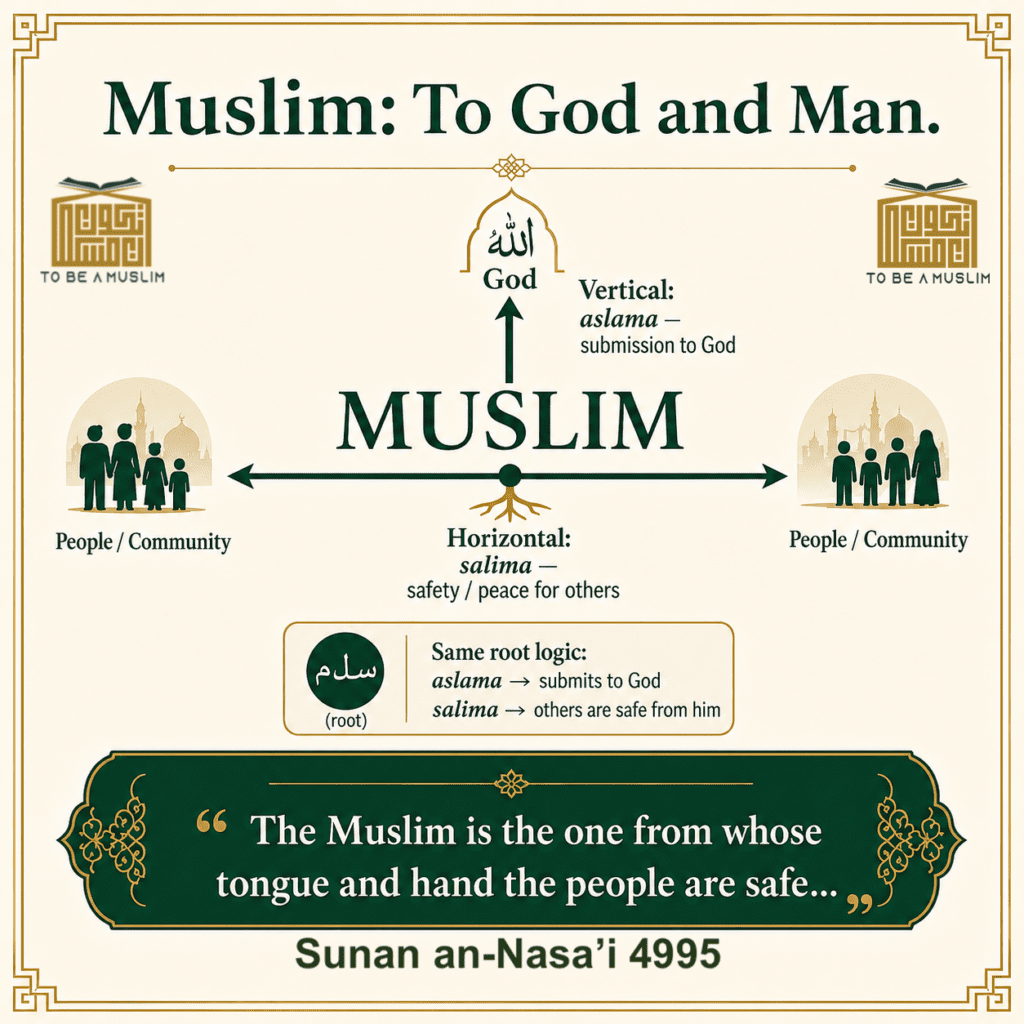
The True Adherent Is Known by the Tongue
There is a striking agreement between the Prophet Muhammad ﷺ and the Epistle of James: both define true religion by the tongue.
The Prophet ﷺ said:
“The Muslim is the one from whose tongue and hand the people are safe, and the believer is the one from whom the people’s lives and wealth are safe.”
This report appears in Sunan an-Nasa’i 4995 from Abu Hurayrah. The wording matters: it says an-nās — the people — not only one’s own tribe, sect, or religious group. The Muslim, in this definition, is the person whose speech and action do not make people unsafe. (Sunnah)
The same doctrine appears in the strongest collections with the more limited wording “the Muslims”: Ṣaḥīḥ al-Bukhārī 10 says the Muslim is the one from whose tongue and hand Muslims are safe, and the muhājir is the one who abandons what Allah forbade; Ṣaḥīḥ Muslim 41 preserves the same core definition. So the doctrine itself is beyond serious isnād attack: Islam defines the Muslim through safety from harm by tongue and hand. (Sunnah)
James says the same thing from the other direction:
“If anyone thinks he is religious and does not bridle his tongue… this person’s religion is worthless.”
That is James 1:26. It is not a decoration of piety. It is not a side virtue. James says unrestrained speech makes a person’s religion empty. (Bible Hub)
The Prophet ﷺ states it positively:
The Muslim is the one whose tongue and hand make people safe.
James states it negatively:
The religious person whose tongue is uncontrolled has worthless religion.
Same test. Same center. Same moral law.
Tongue and Hand: Speech and Deed
The hadith pairs lisān and yad — tongue and hand. That is speech and action. A Muslim is not defined by slogan, costume, tribe, or anger. A Muslim is defined by whether people are safe from his mouth and his conduct.
James uses the same structure. Before he speaks about the tongue, he speaks about the person who is not a forgetful hearer but a doer of the work. James 1:25 calls the blessed person the one who looks into the perfect law and then does it. (Bible Hub)
So James is not defining religion by belief-alone speech. He is defining it by heard truth becoming disciplined action.
That is exactly the hadith structure:
Tongue restrained.
Hand restrained.
People safe.
Trust established.
The Trust Clause: Lives, Wealth, Widows, and Orphans
The second half of Sunan an-Nasa’i 4995 says:
“The believer is the one from whom the people’s lives and wealth are safe.”
That is not abstract spirituality. It is public trust. A believer is someone under whom life and property are protected. (Sunnah)
James 1:27 then defines pure religion as caring for orphans and widows and keeping oneself unstained from the world. The exact categories matter: widows and orphans are the people most likely to be exploited when religion becomes talk without trust. (Biblia)
Islam says the same. The Qur’an commands worship of Allah alone and then immediately commands goodness to parents, relatives, orphans, the poor, neighbors, travelers, and those under one’s authority. (Quran.com) It also says directly: “Do not oppress the orphan.” (Quran.com) And the Prophet ﷺ said the caretaker of an orphan will be with him in Paradise like two fingers together. (Sunnah)
So the pattern is not accidental:
James: pure religion protects the vulnerable.
The Qur’an: true worship includes protecting the vulnerable.
The Prophet ﷺ: the believer is trusted with lives and wealth.
Religion is not proven by claims. It is proven by the safety people experience under your tongue, hand, and authority.
The Perfect Law: Teleios and the Sh-L-M Field
James 1:25 calls this moral order “the perfect law of liberty.” The Greek word behind “perfect” is teleios — complete, whole, mature, brought to its intended end. (Bible Hub)
This matters because teleios stands inside a translation-field that often renders Hebrew ideas of wholeness and completeness. For example, 1 Kings 8:61 speaks of the heart being perfect/whole with the Lord, walking in His statutes and keeping His commandments. The Hebrew interlinear gives the sense of a heart being perfect with the Lord, while the Septuagint tradition renders the same covenant idea with “perfect” language. (Bible Hub)
This is the careful way to state it: James survives in Greek, so we should not claim he literally wrote the Hebrew word shalem. But the concept is absolutely Semitic: wholeness before God, obedience to command, religion proven by action.
That is the same root-field behind shalom, shalem, meshullam, and the Islamic language of Islam/Muslim — surrender, peace, wholeness, and safety under God.
This is why the Isaiah 42 connection matters. Ellicott, commenting on Isaiah 42:19, notes that the Hebrew meshullam means the devoted or surrendered one and explicitly compares it with Moslem/Muslim and Islam, “the man resigned to the will of God.” (Bible Hub)
So when James speaks of the perfect law, we are in the same moral universe: not religion as empty confession, but religion as wholeness before God — speech restrained, deeds righteous, the vulnerable protected, and the self kept clean from the world.
James Is Not Pauline Religion
The Epistle of James opens to “the twelve tribes in the Dispersion.” It is a Jewish-Christian text in voice and atmosphere, traditionally associated with James / Yaʿqūb, the brother of Jesus and leader of the Jerusalem community. (Bible Hub)
That matters because James sounds nothing like a religion of claim without deed.
James says:
Be a doer, not only a hearer.
Control the tongue, or religion is worthless.
Protect widows and orphans.
Remain unstained from the world.
Then in James 2:24, he states the famous line: a person is justified by works and not by faith alone. Paul, by contrast, says in Romans 4:5 that the one who does not work but believes has faith credited as righteousness. (Bible Gateway)
That is the divide.
James defines religion by lived obedience.
The Prophet ﷺ defines the Muslim by lived safety.
Both reject a religion that exists only in claims while the tongue and hand remain destructive.
The Muslim as the One Who Makes People Safe
Put the texts side by side:
The Prophet ﷺ:
The Muslim is the one from whose tongue and hand people are safe.
James:
The religious man who does not bridle his tongue has worthless religion.
The Prophet ﷺ:
The believer is the one trusted with people’s lives and wealth.
James:
Pure religion protects orphans and widows.
The Prophet ﷺ:
The muhājir is the one who abandons what Allah forbade. (Sunnah)
James:
Pure religion keeps itself unstained from the world. (The Historic Faith)
This is not loose similarity. It is the same spiritual definition moving through two sacred vocabularies.
The true servant of God is not the loud one.
Not the abusive one.
Not the one who wins arguments by humiliating people.
Not the one who carries scripture while people fear his tongue.
The true adherent is the one under whom people are safe.
Conclusion: James Defines the Law; Islam Names the Person
James gives the law:
The perfect law.
The bridled tongue.
The doer, not merely the hearer.
The protection of the vulnerable.
The life unstained by the world.
The Prophet ﷺ gives the name:
The Muslim — the one whose tongue and hand make people safe.
This is the Meshullam law in practical form: wholeness with God proven through disciplined speech, righteous action, protection of the vulnerable, and surrender to divine command.
The Muslim is not merely one who claims Islam.
The Muslim is the one from whose tongue and hand people are safe.