Dr. Isa Brimah
There is an evident reason Jesus had to come when and where he did.
The world into which he appeared was not intellectually empty. Greek philosophy had already spent centuries on the problem of transcendence. If God is utterly above the material world, how does the highest reality relate to what lies beneath it? How does unity produce multiplicity? How does mind produce order? How does the invisible become visible?
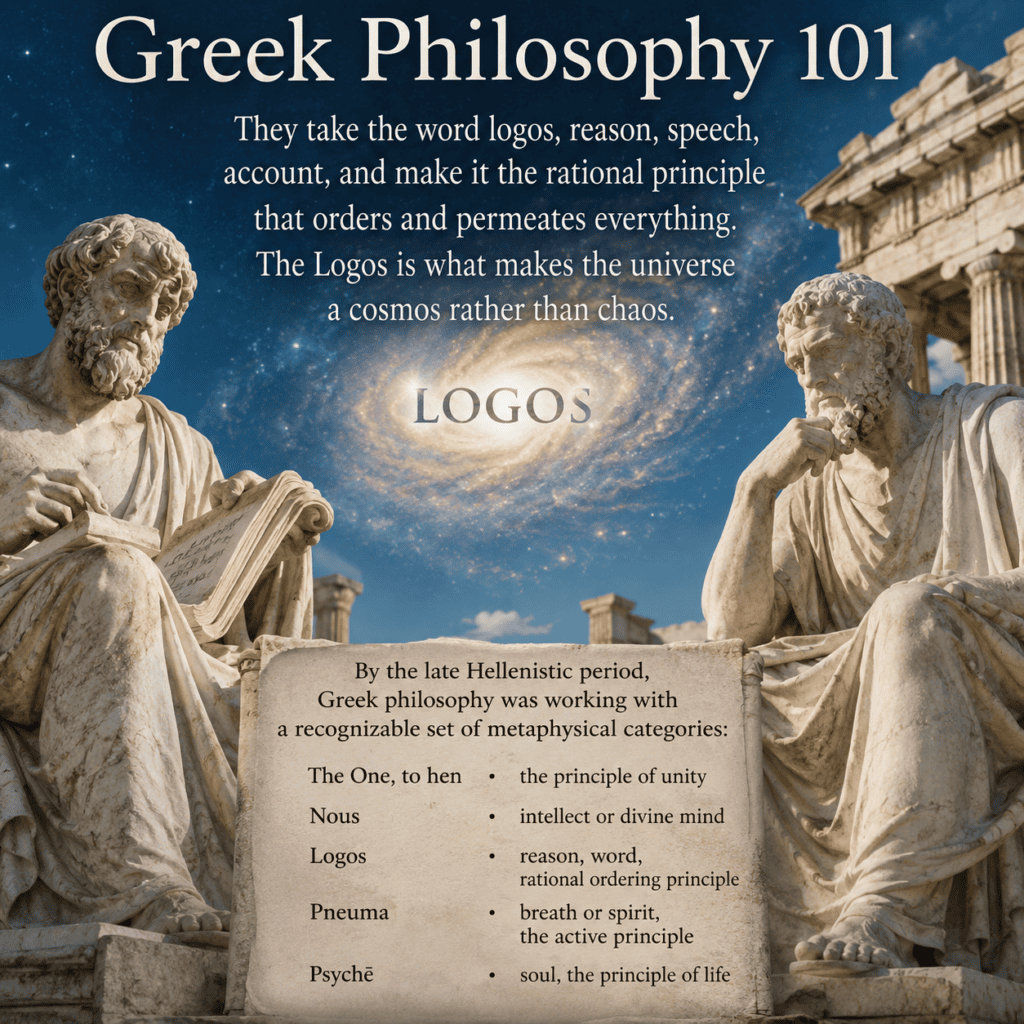
Plato had answered with a divine Craftsman, intelligible Forms, Nous, and a World Soul. The Stoics had answered with Logos, the rational principle ordering and permeating reality, and pneuma, the active breath running through it. By the late Hellenistic period the vocabulary was in place: the One, Nous, Logos, Pneuma, Psychē. Among Hellenized Jews, these categories had already entered the reading of Scripture. Philo of Alexandria, who lived from about 20 BC to AD 50, spoke repeatedly of the Logos as the rational mediator through whom the transcendent God creates, orders, and governs the world. God remained above creation. The Logos explained the connection.
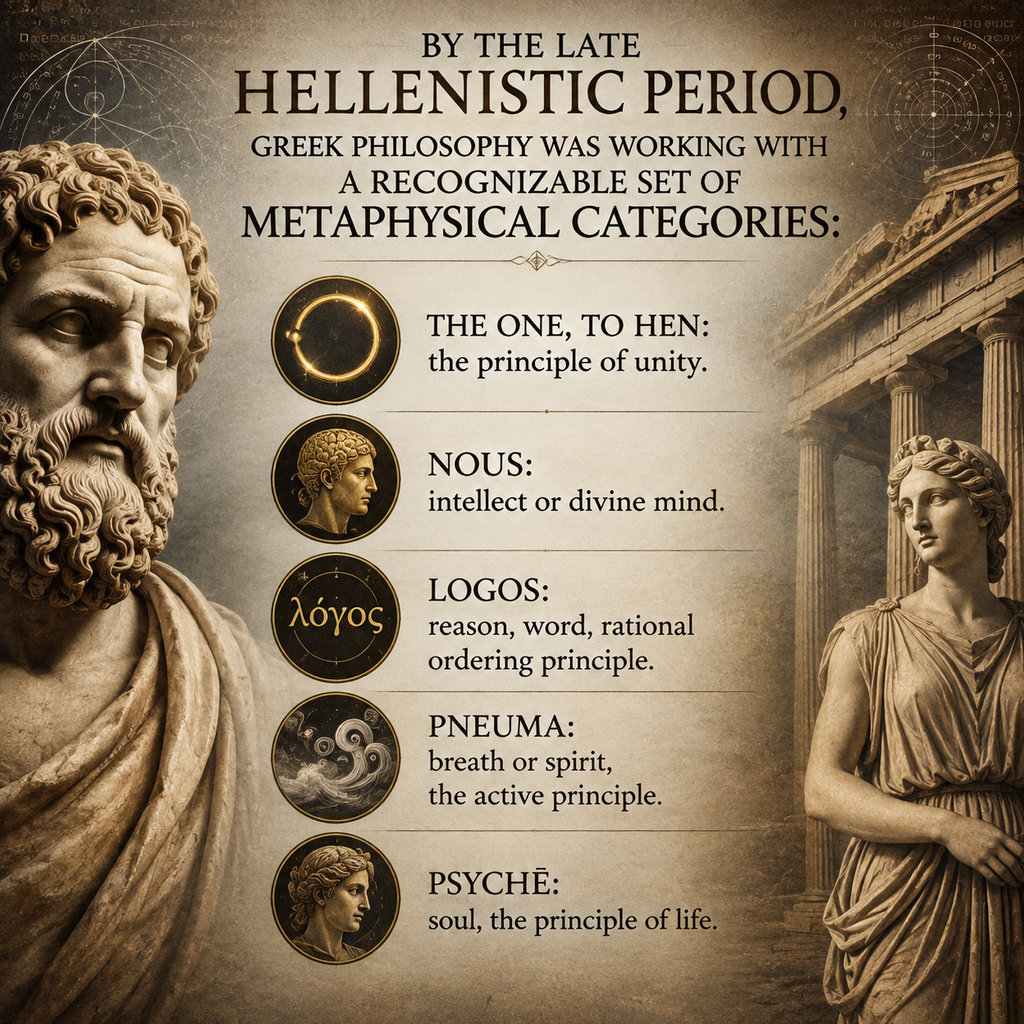
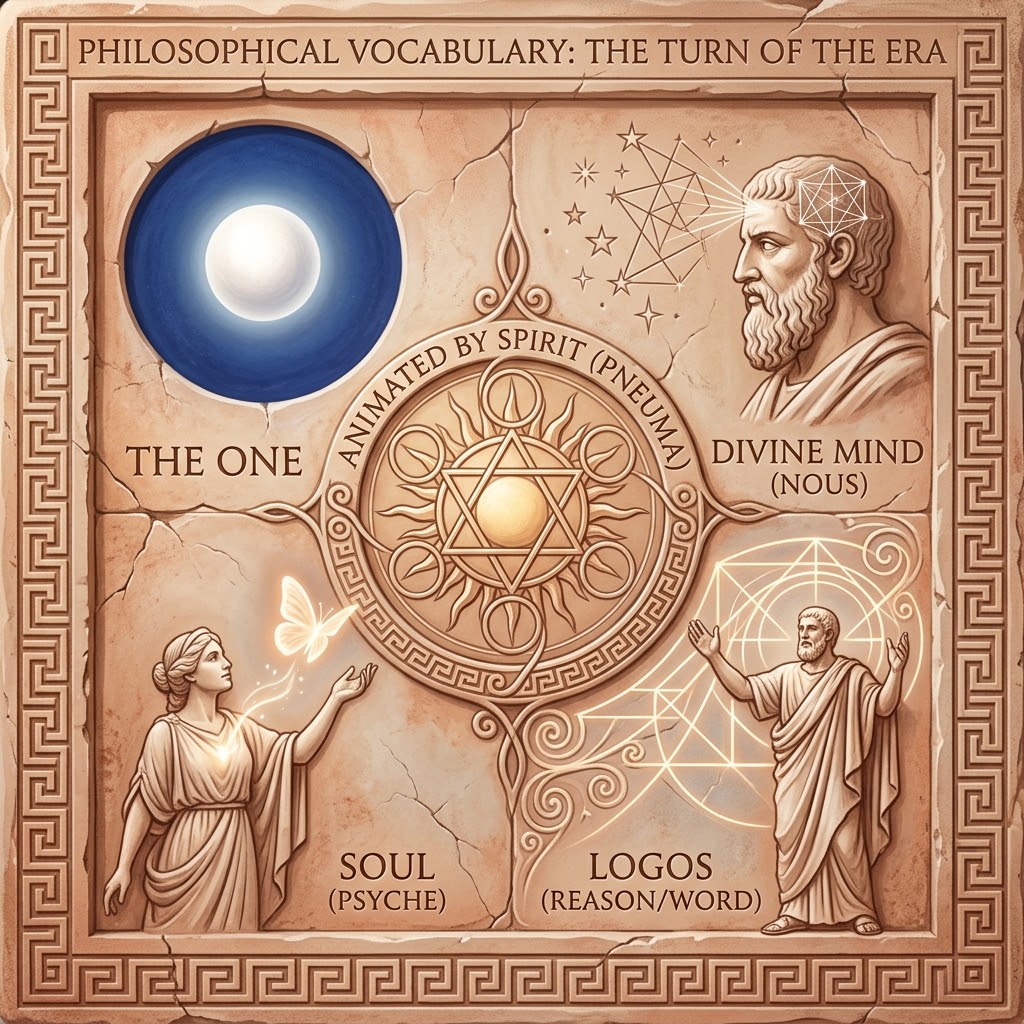
That system is seductive because it seems to solve everything. Begin with the One, absolute unity beyond division. Then Nous, divine Mind, containing the intelligible order of things. Then Logos, reason and expression, the principle through which that order is articulated. Then Soul, transmitting life and order downward into the cosmos. The structure can become so complete that eventually it replaces revelation. God is too transcendent to act directly, so an intermediary appears necessary. The intermediary becomes rationally necessary, then metaphysically necessary, then impossible to remove. The philosopher no longer asks what God has revealed. He asks what God must be like according to the architecture already built.
A stone idol can be smashed. A philosophical system can explain why it cannot be smashed. It does not say, “This is our god.” It says, “This is how reality necessarily works.” That is a far harder adversary to prophetic monotheism than any idol.
And then Jesus appears. Not merely somewhere in that world, but among a Jewish people already deeply exposed to Greek language and thought. Their Scriptures circulated in Greek. Their writers used Greek philosophical categories. Alexandria had already produced a Jewish Logos theology.
Then something extraordinary happens, and it happens inside a single book. The Gospel of John opens by placing Jesus directly inside the Logos category: “In the beginning was the Logos.” The philosophical term now has a face, a biography, and a voice. And then the voice speaks. “The Son can do nothing of himself” (John 5:19). “I can do nothing of myself” (5:30). “I do nothing of myself, but speak just as the Father taught me” (8:28). “I have not spoken of myself; but the Father who sent me gave me a commandment, what I should say and what I should speak” (12:49). “My Father is greater than I” (14:28).
The philosophical Logos had become a mechanism, the way divine rationality operates between the highest God and creation. The Logos in the Gospel says: I was sent. I was taught. The words are not mine. The works are not mine. I can do nothing from myself. The book that gave him the title is the book that recorded the denial.
That is the direct defeat. The category remains, but its autonomy is gone. The Word does not stand beside God as an independent source of divine activity; it points beyond itself to the one who speaks. And that is what a word is. A word does not originate itself. It proceeds from a speaker. It does not decide what it will communicate; it expresses what comes from the one whose word it is. Remarkably, that is exactly how Jesus describes himself: I speak what the Father taught me; the Father sent me; the Father gave me a commandment what I should say. The philosophical category has been occupied from inside and made to confess dependence.
John 17 makes the point unmistakable. Jesus does not identify himself as the God behind the system. He raises his eyes and addresses another: “that they might know You, the only true God, and Jesus Christ whom You sent” (17:3). The Logos has a Sender, and the Sender is named as the only true God. “I have manifested Your name” (17:6). “The words which You gave me I have given them” (17:8). “I have made known to them Your name, and will make it known” (17:26). The movement never reverses. God possesses, God gives, God sends. Jesus receives, Jesus speaks. Human beings hear. That is prophecy.
The orthodox reader has an answer, and it should be stated in his own terms. On the Trinitarian reading, “the Son can do nothing of himself” is not a confession of dependence but a statement of inseparable operation: the Son never acts apart from the Father because the two share one will and one nature, so the verse describes unity, not subordination. It is a serious reading. But it has to survive the same speaker, in the same Gospel, calling someone else “the only true God” and describing himself as the one that God sent. Unity of will does not by itself explain why the Word prays, obeys, is taught, receives commandments, and calls the Father greater. The plain grammatical direction of these sayings is still from Father to Son: sender to sent, teacher to taught, giver to receiver. The theological task is therefore to explain why language that reads naturally as dependence should instead describe equality of divine being.
This is why Jesus becomes historically necessary to the argument. By the third century Neoplatonism would develop the Greek architecture with tremendous sophistication: the One, Intellect, Soul, successive levels of reality descending from absolute unity through intelligible mediation into the material cosmos. This was not crude pagan mythology. Neoplatonism had become the most formidable philosophical theology of the educated Greco-Roman world. Had such a system simply continued to dominate that world in its own name, uncompromising prophetic monotheism would have faced something far more difficult than idols. Whether the later correction came through the descendants of Isaac or the descendants of Ishmael, it would have met a civilization already convinced that rational necessity required intermediary levels between the highest God and the world. A prophet saying, “God is One. Worship Him. He sent me,” could be dismissed by a civilization certain it had already solved the question at a higher intellectual level.
But God had a plan
The Roman world did not ultimately enthrone Neoplatonism as its universal religion. It tried. The emperor Julian spent his short reign, from 361 to 363, attempting to restore and organize the philosophers’ religion against the rising Christian order, and failed. Rome embraced Jesus instead. Constantine had not converted the empire overnight, and Greek philosophy did not disappear; the reverse happened, and its categories flowed deeply into Christian theology. But the figure at the center was now Jesus, and that changed everything.
The intellectual world could place him in its Logos category. It could call him divine. It could build ever more elaborate metaphysics around his relation to God, using ousia, hypostasis, eternal generation, divine simplicity, and every conceptual instrument available to it. But it could never remove the biography. The Logos now had recorded speech, and the speech said: I was sent. I obey. I was taught. I speak what I was commanded. I can do nothing of myself. My Father is greater than I. You are the only true God.
That is the indirect defeat. The philosophy could absorb Jesus, but in absorbing him it also absorbed the testimony that destabilized its own conclusion. Once the empire carried Jesus everywhere, it carried those sentences everywhere. Every church that proclaimed the divine Logos also distributed a Gospel in which the Logos prayed. Every theologian who elevated the Son had to explain why the Son said he could do nothing independently. Every creed that identified him with ultimate deity had to coexist with a text in which he called someone else the only true God. The tension could be interpreted, reconciled, surrounded with metaphysics. It could never be erased.
And so the fault line remained, and it appears very early. Some Jewish followers of Jesus continued to understand him principally as the human Messiah. Paul of Samosata was condemned for a radically different account of Christ. Arius argued that the Son, though preexistent and exalted, was subordinate to the Father and derived from him. Centuries later Servetus attacked Nicene metaphysics; the Socinians returned to the humanity of Jesus; Newton filled private manuscripts with anti-Trinitarian argument; Milton, in De Doctrina Christiana, rejected central elements of orthodox Trinitarian doctrine. These men did not believe the same thing. Arius is not Socinus, and Newton is not an Ebionite. But again and again readers pulled at the same seam: sender and sent, God and his Messiah, source and recipient, the one who gives the command and the one who receives it. The fault line remained because the words remained.
Then comes the Qur’an
The Qur’an does not rearrange Jesus into a new philosophical system. It explains what the title means. Jesus is God’s Word. But a word is not the Speaker. The word comes from the Speaker; the Speaker sends the word; the word communicates what the Speaker wills. So when the Qur’an calls Jesus Kalimat Allāh, the Word of God, it does not make him another god standing beside God. It identifies him as God’s Word sent into creation. That is why the same book can call him extraordinary without surrendering the absolute distinction between God and his messenger. Jesus is the Messiah. Jesus is a Word from God. Jesus is a spirit from Him. Jesus is God’s servant. Jesus is God’s messenger. These are not competing descriptions; they explain one another. The Word belongs to God. The messenger belongs to the one who sent him. The spirit comes from God. The Messiah acts by God’s permission.
The Qur’an therefore keeps the very vocabulary around which the ancient argument had formed and clarifies the direction of dependence. God is the Speaker; Jesus is His Word. God is the Sender; Jesus is His messenger. God is the source of power; Jesus acts by His permission. The distinction is not created by the Qur’an. It is the distinction Jesus himself speaks in John. God sends, Jesus is sent. God teaches, Jesus is taught. God commands, Jesus speaks what he is commanded.
Here the Islamic pattern of prophecy becomes relevant. Messengers appear at the pressure point of their people. Moses confronts a world in which Pharaoh’s authority and the public power of the magicians dominate, and his sign overwhelms their magic. Muhammad enters an Arabic culture in which speech, recitation, eloquence, and poetry hold extraordinary public authority, and his central sign is recited speech. Jesus enters a Hellenized world increasingly occupied with divine mediation, Word, Spirit, reason, and the question of how the transcendent God relates to creation. What does the Qur’an say he was? God’s Word, sent to Mary. And what does that Word say in the Gospel? “I can do nothing of myself.” That is the answer to the Logos problem. Not the abolition of the category; its clarification. God has a Word. But the Word is not God the Speaker. A word depends upon the one whose word it is.
The Qur’an deepens this in its account of Jesus’s creation. He is announced to Mary as “a Word from Him, whose name is the Messiah, Jesus son of Mary” (3:45). He is “His Word which He cast to Mary, and a spirit from Him” (4:171). Mary is told that when God decrees a matter, “He only says to it, ‘Be,’ and it is” (3:47), and the principle is repeated in the Jesus narrative (19:35). Then the Qur’an immediately protects “Word” from being turned into independent deity by setting Jesus beside Adam: “The likeness of Jesus before God is as the likeness of Adam. He created him from dust, then said to him, ‘Be,’ and he was” (3:59).
The symmetry is exact. Adam is presented through divine formation: God creates, fashions, breathes His spirit into him (15:29; 38:72), says “Be,” and Adam results. Jesus is presented through divine speech: God gives the Word, casts it to Mary, breathes His spirit into her (21:91; 66:12), says “Be,” and Jesus results. Both come entirely from divine creative agency. Jesus uniquely bears the title Word of God in this way because his coming is explicitly announced as “a Word from Him” and “His Word which He cast to Mary.”
The philosophical problem had asked how the transcendent God produces intelligible order and acts toward creation. Greek thinkers developed Nous and Logos. Jesus entered history and was identified with the Logos. The empire set him in that philosophical position. But the man in that position left behind the testimony that he had nothing independently of the one who sent him. And the Qur’an then explained the category with extraordinary simplicity: he is God’s Word, but the Word is not the Speaker; he is from God, sent by God, acting by God’s permission; and he remains the servant and messenger of God.
Perhaps Jesus was necessary precisely because this problem could not be attacked from outside. An intellectual civilization can dismiss a prophet who merely condemns its metaphysics. It is much harder when the figure at the center of its own metaphysics keeps pointing beyond himself.
The Logos entered the system.
Then the Logos said:
I was sent. I was taught. I speak what I am commanded. I can do nothing of myself.
The confession was already inside.
Note. The Moses / Jesus / Muhammad pattern of the sign suited to the age is the classical commentators’ elaboration on the report in Ṣaḥīḥ al-Bukhārī 4981, in which the Prophet says that every prophet was given signs by which people believed and that what he was given was revelation. The threefold scheme is not the hadith’s own wording.