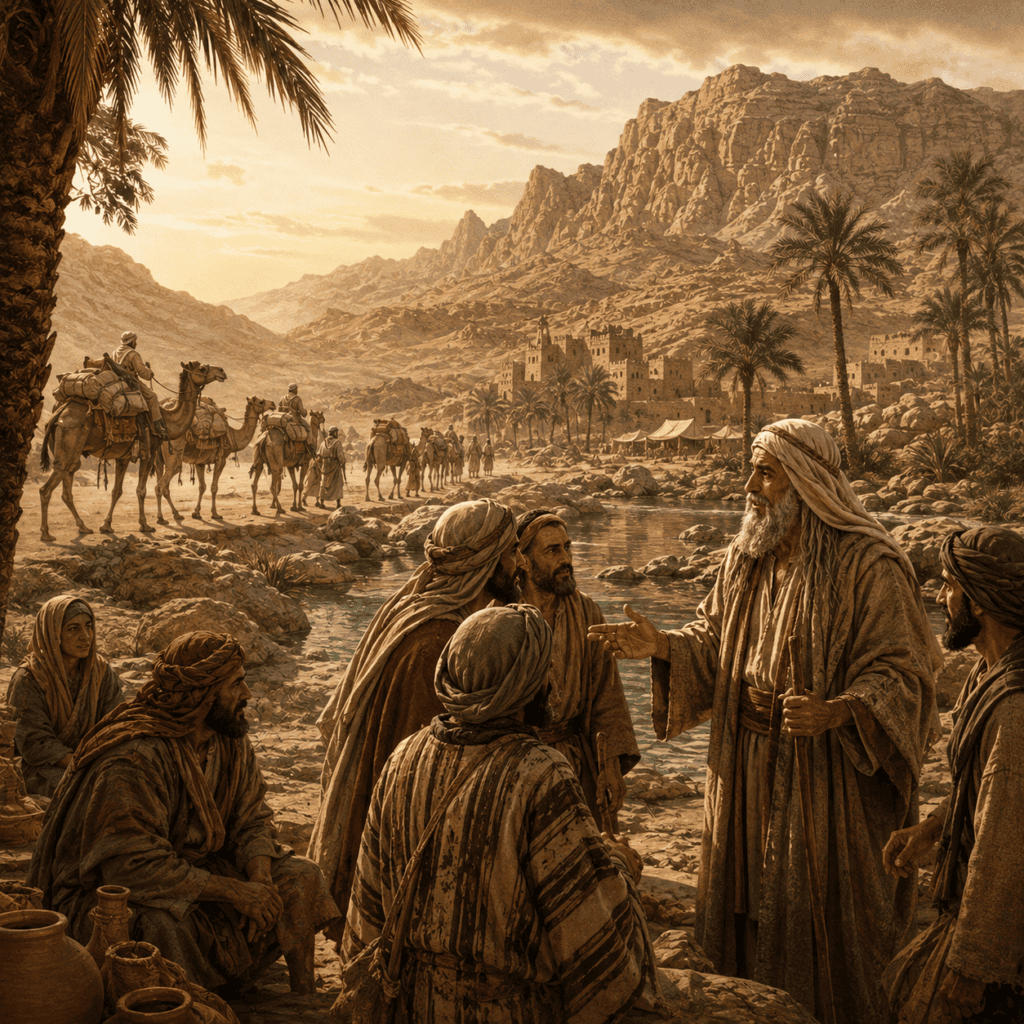
How a prophet with no biblical name turns out to belong unmistakably to the world of ancient Arabia
Abraham had more than two sons.
Everyone remembers Isaac and Ishmael. Genesis remembers six more. After Sarah’s death, Abraham married Keturah, who bore him Zimran, Jokshan, Medan, Midian, Ishbak and Shuah (Gen. 25:1–2). Abraham gave them gifts and sent them eastward, away from Isaac, “unto the east country” (25:6).
Then Genesis largely lets them disappear.
The Qur’an picks up one of those eastern lines in a land still bearing his name—and finds a prophet there.
I. Their Brother Shuʿayb
Three times the Qur’an says:
“And to Madyan, their brother Shuʿayb.”
— Qur’an 7:85; 11:84; 29:36
The formula is deliberate. Hūd is “their brother” to ʿĀd. Ṣāliḥ is “their brother” to Thamūd. Shuʿayb is their brother to Madyan.
He belongs to them.
That matters because Shuʿayb has no biblical name.
Mūsā, Ibrāhīm, Yūsuf and Dāwūd are recognizable biblical names in Arabic form. Shuʿayb is different. His name is thoroughly at home in Arabic morphology: Shuʿayb is a fuʿayl diminutive built from the root š-ʿ-b, the same root as shaʿb, “people.” The Qur’an itself uses its plural in 49:13:
“We made you peoples (shuʿūban) and tribes.”
Earlier Western scholars noticed the problem. Joseph Horovitz and Arthur Jeffery could trace many Qur’anic names into Hebrew, Syriac or Greek, but Shuʿayb resisted that treatment. C. E. Bosworth even remarked that the name was unattested in pre-Islamic inscriptions.
Classical Muslim exegetes solved the problem another way: many identified Shuʿayb with Jethro, Moses’ Midianite father-in-law. Ibn Isḥāq reportedly gave Shuʿayb the alternate Syriac name Yathrūn, strikingly close to Hebrew Yitrō.
But the Qur’an itself never makes that identification.
When it recounts Moses’ flight to Midian in Qur’an 28:22–28, it leaves the old man who receives Moses unnamed. Shuʿayb, by contrast, is explicitly the prophet of Madyan.
That distinction deserves to be respected.
Shuʿayb may belong to an older Midianite prophetic memory rather than simply being the Qur’an’s Arabic renaming of Jethro. Qur’an 11:89 even has him remind his people that the people of Lot “are not far from you,” placing his preaching within the remembered world of the patriarchal age.
II. What the Stones Say
The epigraphy changes the discussion.
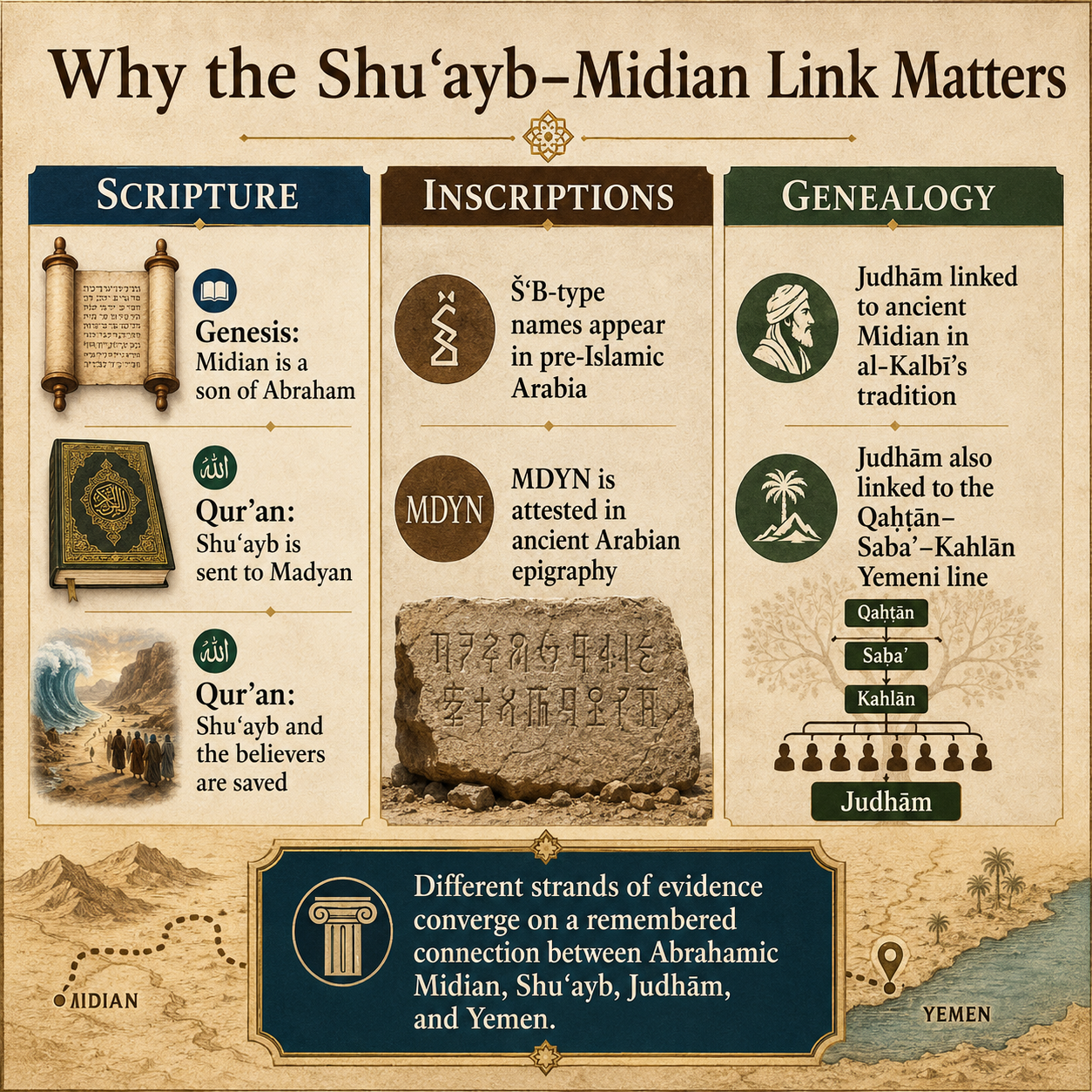
Bosworth was looking for the exact form šʿyb. What the inscriptions preserve abundantly is the name-family from which Shuʿayb comes.
Brannon Wheeler’s survey of Arabian inscriptions collected forms built from Š-ʿ-B across the peninsula:
Safaitic: šʿb
Minaean: šʿb
Nabataean: šʿbw
South Arabian: šʿbm
Safaitic: šʿbn, šʿbyn
The same element occurs in compound personal names such as šʿbʾl and related forms.
Even more importantly, in Sabaic šʿb is a major social term: a “people” or political community.
So the Qur’an’s name for Midian’s prophet belongs to a root that was not merely Arabic—it was embedded throughout ancient Arabian language and naming practice.
The exact vocalized form Shuʿayb has not yet been found on stone. But the consonantal family from which the name is naturally formed is unquestionably ancient.
And Midian itself appears in the epigraphic world.
Forms of mdyn are attested in Ancient North Arabian material, while Greek and Roman geographical sources knew a settlement called Madiama/Madiana along the northwest Arabian coast.
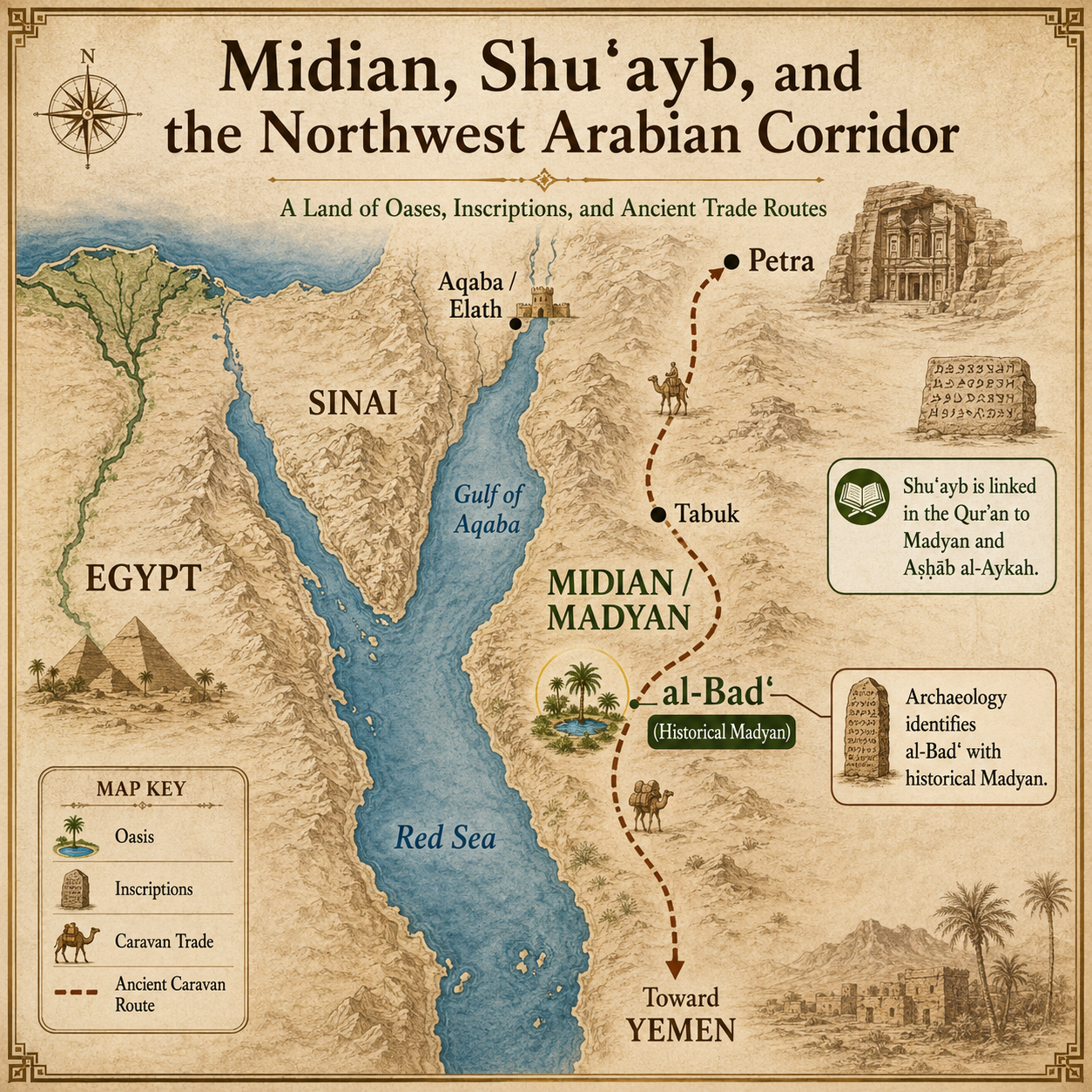
At al-Badʿ, the oasis traditionally identified with ancient Madyan, archaeology has now established a major ancient and Nabataean settlement. Its famous rock-cut necropolis is still called Mughāyir Shuʿayb—“the Caves of Shuʿayb.”
No responsible historian claims those Nabataean tombs belonged to Shuʿayb himself.
The point is better than that:
the place is real, Madyan is real, the Arabian name-family is real, and all occur in the same northwest Arabian cultural landscape.
Recent linguistic work strengthens the setting further. Nabataean Arabia was not simply an Aramaic-speaking world. Arabic was genuinely spoken alongside Aramaic throughout northwest Arabia.
An Arabic-form prophetic name in Midian is therefore not an anachronism. It belongs naturally to the linguistic world of the region.
III. Amos in Midian
Then comes a striking independent convergence.
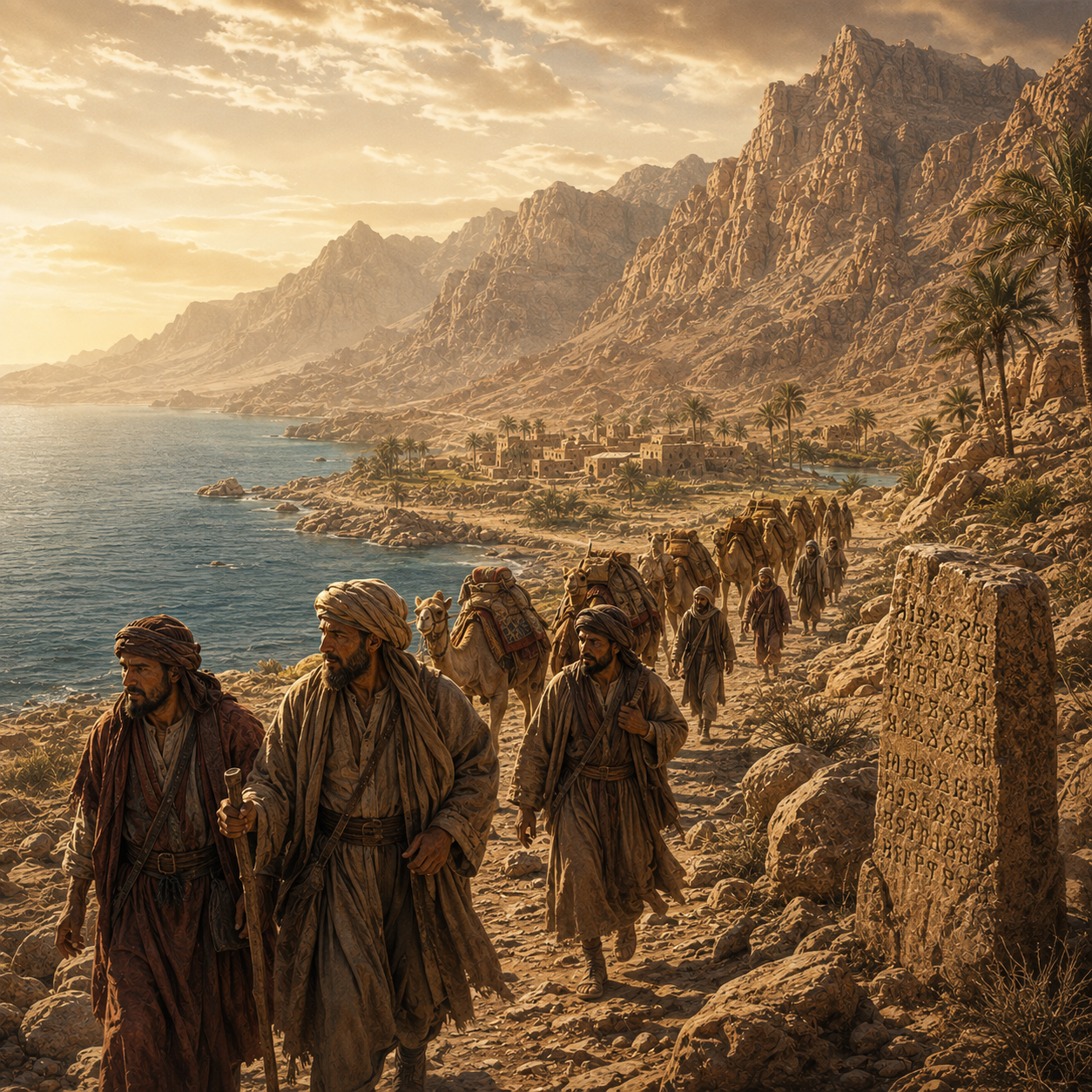
The Bible remembers the Midianites as traders.
Midianite merchants purchase Joseph and carry him toward Egypt (Gen. 37:28, 36). Isaiah pictures “the camels of Midian and Ephah” arriving with the gold and frankincense of Sheba (Isa. 60:6). Judges remembers Midianite wealth in gold ornaments and caravan culture.
The Qur’an remembers Shuʿayb preaching to commercial offenders:
“Give full measure and weight.”
“Do not diminish people their goods.”
“Do not spread corruption in the land.”
— Qur’an 7:85; 11:84–85; 26:181–183
No other Qur’anic prophet is characterized so persistently by the ethics of the marketplace.
The Bible independently describes Midian as a caravan people.
The Qur’an independently remembers Midian’s prophet preaching against fraudulent weights and measures.
And that sermon sounds remarkably like Israel’s own prophetic tradition:
“Just balances, just weights.”
— Leviticus 19:36
“You shall not have… two kinds of weights.”
— Deuteronomy 25:13
Amos condemns merchants who “make the ephah small and the shekel great” and “falsify the balances” (Amos 8:5). Micah condemns the “scant measure” and the “bag of deceitful weights” (Mic. 6:10–11).
Shuʿayb sounds like Amos on the incense road.
Even the landscape fits. Ancient Madyan sat on the commercial corridor linking northwest Arabia, the Red Sea, Transjordan, Petra and the Levant.
Shuʿayb’s concern with scales is exactly the preaching one would expect at a caravan oasis.
IV. The Line That Drank No Wine
The Bible does not portray every Midianite alike.
There is hostile Midian—the Baal-Peor episode, war, and the later raiders defeated by Gideon.
But beside it runs another Midianite line that is treated with extraordinary favor.
It begins with the household that receives Moses.
Moses flees Egypt to Midian. He shepherds the flock of a Midianite priest when God calls him at Horeb (Exod. 3:1). His Midianite wife Zipporah acts decisively to save him during the strange circumcision episode (4:24–26).
After the Exodus, Jethro hears what God has done and declares:
“Now I know that the LORD is greater than all gods.”
He offers sacrifice, and Aaron and the elders of Israel eat with him “before God” (Exod. 18:11–12).
Then this Midianite priest teaches Moses how to structure Israel’s judiciary.
Moses later begs Hobab, the Midianite’s son, to remain with Israel:
“You shall be to us instead of eyes.”
— Numbers 10:31
The family enters Canaan with Judah and settles in the Negev (Judg. 1:16).
From the same Kenite circle comes Jael, wife of Heber the Kenite, celebrated in Deborah’s song as:
“Blessed above women.”
— Judges 5:24
When Saul later campaigns against Amalek, he first warns the Kenites to withdraw:
“For you showed kindness to all the children of Israel when they came up out of Egypt.”
— 1 Samuel 15:6
This is an extraordinary record:
sheltering Moses, worshipping God, offering sacrifice, advising Israel, guiding Israel, showing kindness to Israel.
And then the line continues.
Moses’ Midianite relatives are called Kenites (Judg. 1:16; 4:11). First Chronicles 2:55 connects Kenite families with the house of Rechab.
That brings us to Jeremiah 35.
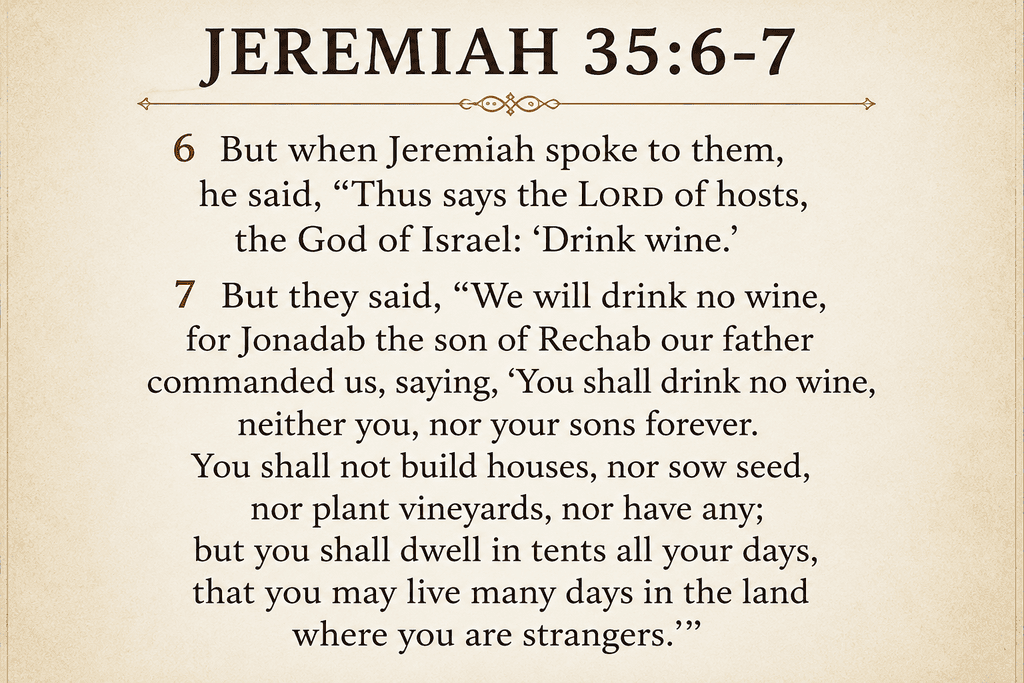
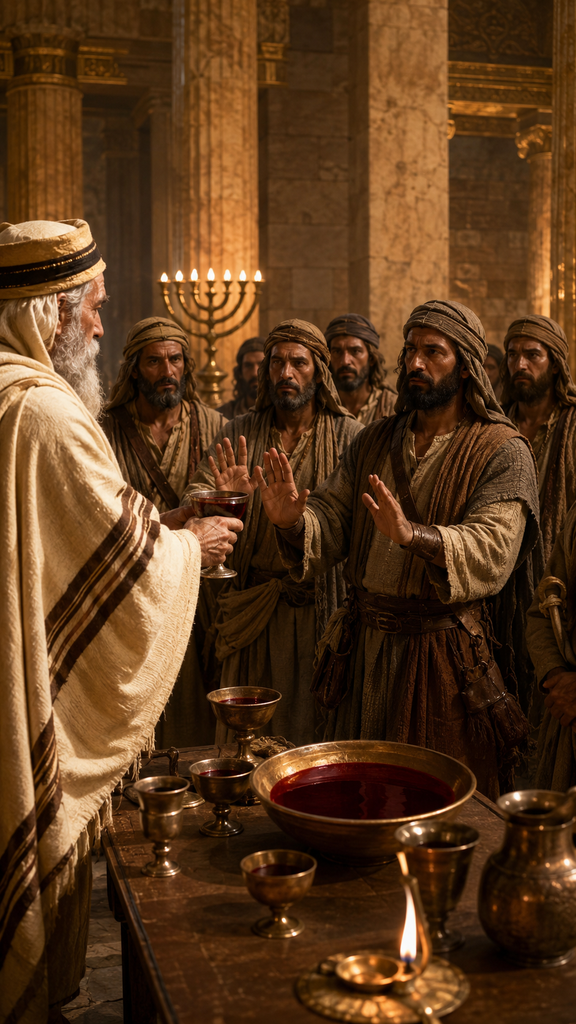
In the final days of Judah, Jeremiah brings the Rechabites into a chamber of the Temple and places wine before them.
They refuse.
Their ancestor Jonadab son of Rechab had commanded:
Drink no wine.
Build no houses.
Plant no vineyards.
Live in tents.
And for generations they obeyed.
God then contrasts their fidelity with Judah’s disobedience and pronounces one of the Bible’s most remarkable promises over this non-Israelite-associated clan:
“Jonadab the son of Rechab shall not want a man to stand before Me for ever.”
— Jeremiah 35:19
That is the hinge.
A family associated through the Kenite tradition with Moses’ Midianite household, living as sojourners among Israel, refusing wine and permanent agricultural settlement, is held up by God as an example of obedience—and promised continuing standing before Him.
V. Still Standing
Centuries later, the Rechabite name appears again in early Christian memory.
Hegesippus, the second-century Christian historian whose account survives through Eusebius (Ecclesiastical History 2.23), describes the death of James the Just, brother of Jesus and leader of the Jerusalem church.
James himself is portrayed as radically ascetic: abstaining from wine, living in prayer, and earning the title “the Just.”
When James is thrown from the Temple and stoned, Hegesippus says that one of the priests “of the sons of Rechab”, the people to whom Jeremiah had borne witness, protested:
“Stop! What are you doing? The Just One is praying for you.”
The historical details of Hegesippus cannot all be independently verified.
But the memory is astonishing.
Jeremiah had promised:
Jonadab will never lack a man to stand before Me.
Centuries later, an early Christian tradition still knew sons of Rechab, still associated them with priestly righteousness, and placed one of them in the Temple defending James the Just.
The Rechabites had not vanished from sacred memory.
VI. The Remnant
The Qur’an itself leaves room for precisely such continuity.
After the destruction of the unbelievers of Madyan, it says:
“We saved Shuʿayb and those who believed with him.”
— Qur’an 11:94
Midian is not annihilated.
The deniers perish.
The believers survive.
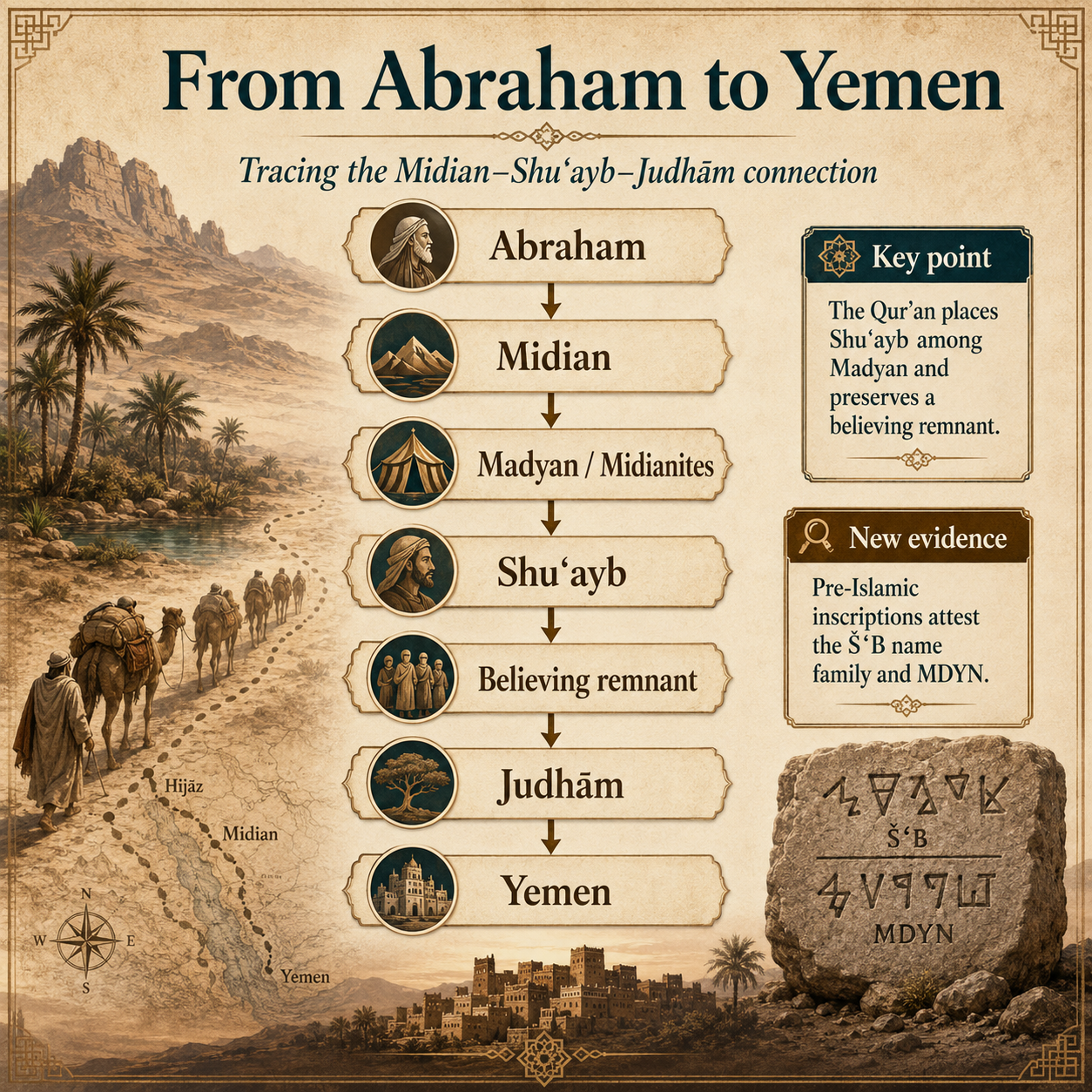
Later Arab genealogical tradition appears to remember a Midianite remnant under another name: Judhām.
The early genealogist Muḥammad ibn al-Sāʾib al-Kalbī is reported to have regarded Judhām as indigenous descendants of the ancient Midianites. A separate saying attributed to Muhammad calls Judhām “the people of Shuʿayb.” Its evidentiary basis is weak and it should be cited as genealogical tradition, not sound hadith.
But the memory is significant because Judhām occupied precisely the broader region of ancient Midian, Aqaba, Sinai, southern Palestine and Transjordan.
Judhām’s deeper pedigree was disputed.
One tradition placed them among the Qaḥṭānī South-Arabian tribes, through:
Qaḥṭān → Sabaʾ → Kahlān → Judhām
Another connected them directly to Midian.
Those pedigrees cannot both be treated as straightforward biological history.
But their convergence is revealing: Judhām was remembered simultaneously in the world of ancient Midian and in the great South-Arabian tribal migrations.
That makes Judhām a traditional bridge between Midian and Yemen.
VII. Down the Road to Yemen
The connection does not depend on Judhām alone.
Genesis itself makes Abraham’s eastern descendants part of the Arabian trade world.
Midian’s brother Jokshan fathers Sheba and Dedan (Gen. 25:3).
Those are not meaningless names.
Dedan belongs to the oasis world of northwest Arabia around modern al-ʿUlā.
Sheba belongs to South Arabia.
And archaeology independently reveals intensive commercial movement between those two worlds. Minaean merchants from the Yemeni Jawf maintained a trading presence at Dedan, leaving inscriptions in northwest Arabia.
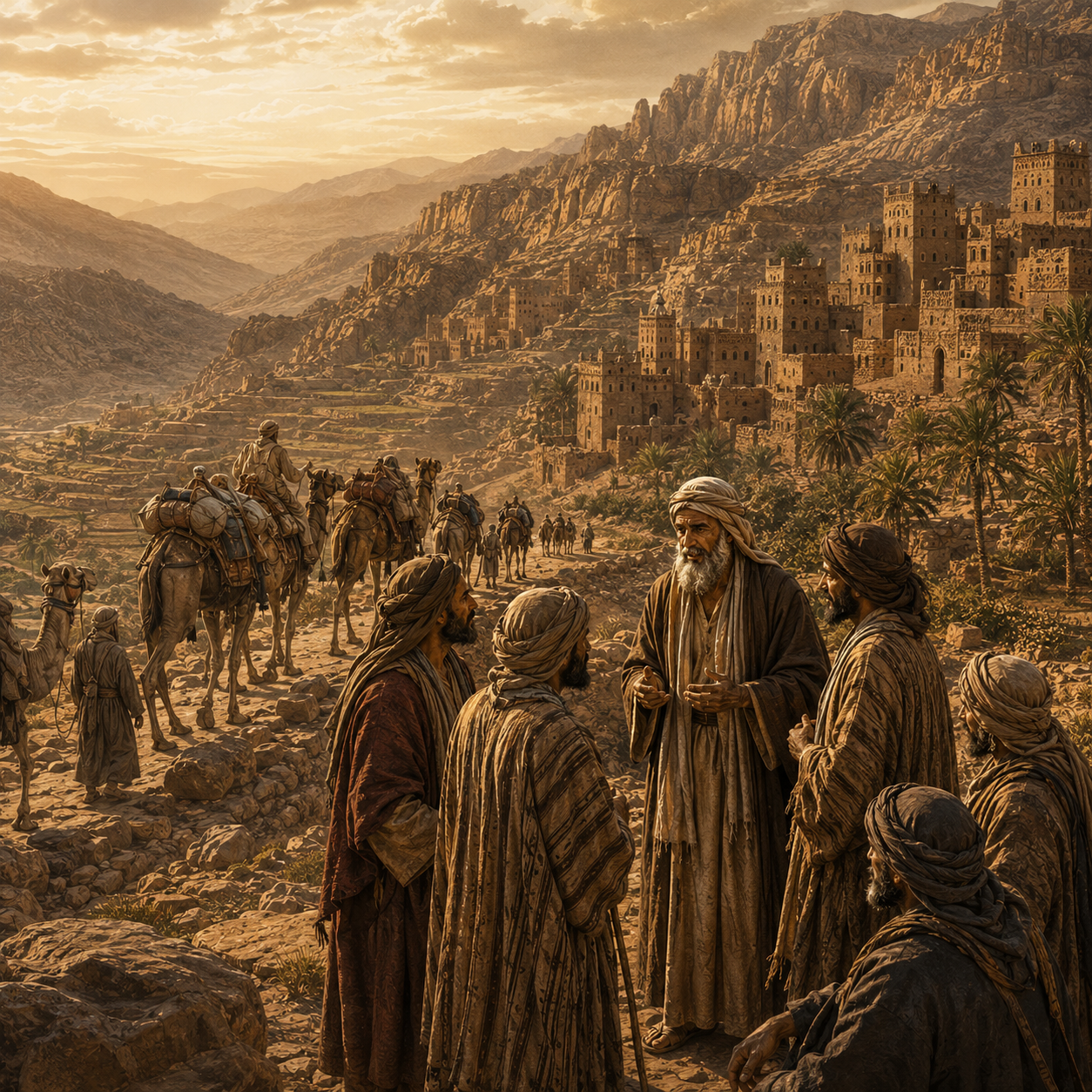
The Bible itself therefore places Abrahamic names at both ends of the incense road:
Midian
Dedan
Sheba
Isaiah 60:6 then puts the commercial system into a single image:
“The camels of Midian and Ephah… all they from Sheba shall come: they shall bring gold and incense.”
That is essentially a map of the Arabian trade road in one verse.
South Arabian aromatics moved north.
North Arabian caravan peoples carried them.
Midian stood between Arabia and the Levant.
And Shuʿayb’s great moral demand was:
Use honest scales.
VIII. Abraham’s Other Son
The evidence does not allow us to draw an unbroken biological family tree from Abraham to any modern population.
It does allow something more interesting.
The Bible remembers:
Abraham → Midian
The Qur’an remembers:
Madyan → their brother Shuʿayb
Ancient Arabian inscriptions preserve:
Š-ʿ-B names and MDYN
Archaeology preserves:
the ancient oasis-world of Madyan in northwest Arabia
The Bible preserves a righteous Midianite/Kenite-associated line that:
shelters Moses → guides Israel → is blessed for kindness → becomes associated with the Rechabites → receives Jeremiah’s promise
The Qur’an explicitly preserves:
Shuʿayb and the believers with him
And Arab genealogical memory later connects:
Midian → Judhām
while another strand connects:
Judhām → Kahlān → Sabaʾ → Qaḥṭān → South Arabia
No single strand proves the whole chain.
Together, however, they preserve something that the usual telling of Abraham’s family misses:
Midian did not simply disappear.
His name remained on the land.
His people remained in the trade routes.
A prophet arose among them.
A believing remnant survived him.
A branch associated with Moses was remembered for fidelity to God.
And Arab genealogy continued to remember Midian in the peoples who moved between the Levant and Yemen.
Genesis sends Abraham’s sons east.
The Qur’an finds one of them there.