
For the 2 rak’ah Fard (obligatory) minimum possible part of prayer in Qur’an, go here.
The prophet of Islam upon his holy spiritual journey to the heavens, was reportedly instructed to recommend five daily prayers for Muslims. These obligatory prayers are to be observed at specific time slots. The performance of these prayers, not only keep us grounded in what is most important for human beings – our reverence of the Creator – but also directly make us lead better lives here on earth.
The Prayers or Salah is for Allah’s Remembrance:
Allah says to Musa (A) in Surah Taha: “Indeed, I am Allah. There is no deity except Me, so worship Me and establish prayer for My remembrance.” (20:14)
The Times of the Five Daily Prayers
Fajr/Subhi: From dawn until just before sunrise. Qur’an 30:17-18 (subhi name), 20:130, 11:114, 17:78 and 24:58 (Salat Fajr name), 50:39
Dhuhr: After the sun’s zenith until late afternoon. Qur’an 30:17-18 (Dhuhr name), 17:78 (salat)
Asr From late afternoon until just before sunset. Qur’an 30:17-18, 50:39, 2:238 (Salat-ul Wusta by name)
Maghrib: From sunset until just before twilight (when the sky turns completely dark). Qur’an 30:17-18, 20:130, 11:114 (Salat)
Isha‘: From twilight until dawn. Qur’an 50:40, 11:114, 50:39, Qur’an 30:17-18 and 24:58 (Salat Isha name)
All these prayers must be prayed at the times mentioned above. However, there are exceptions for when it is permissible to combine prayers. For example, (Dhuhr and Asr) or (Maghrib and Isha‘) may be prayed right after each other. You can combine these two prayers when you are traveling, if you are sick, very sleepy, very tired, or if you cannot control your schedule (classes or work). These are the exceptions and should not become the norm. If you are praying at the Masjid (mosque) in a congregation, and there are bad weather conditions, like rain, snow, ice, etc., then it is permissible to combine these pairs of prayers. You can pray the earlier prayer at the time of the later prayer or vice versa.
5 Daily Prayers Mention in the Qur’an
Qur’an 30 Rum Ayat 17-18 states, “So, glorify Allah in the evening and in the morning; all praise is for Him in the heavens and the earth- as well as in the afternoon and at noon.“
Qur’an 11:114 “And establish the Prayer at the two ends of the day and in the first hours of the night. Indeed, the good deeds drive away the evil deeds. This is a Reminder to those who are mindful of Allah.“
Fajr (Dawn prayer):
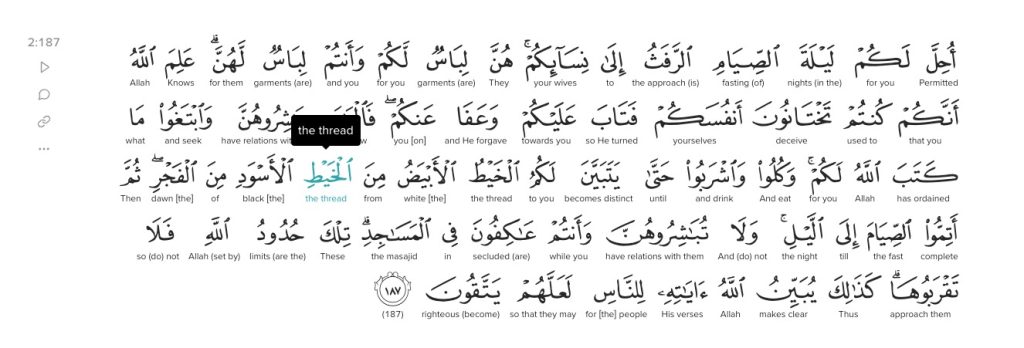
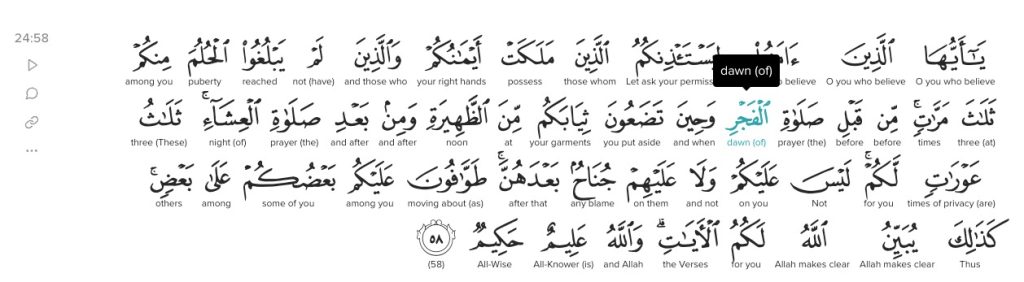
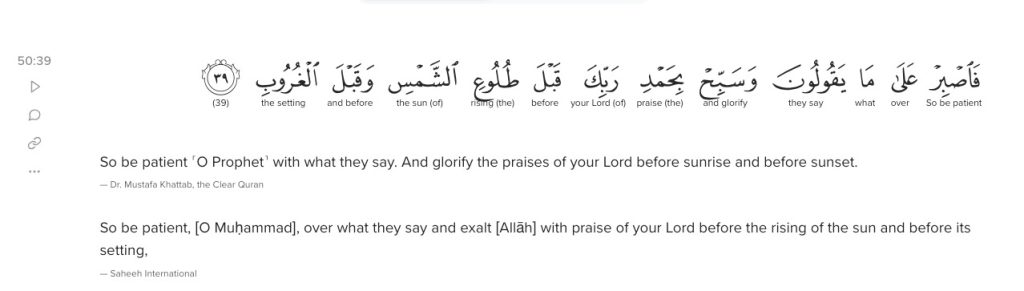
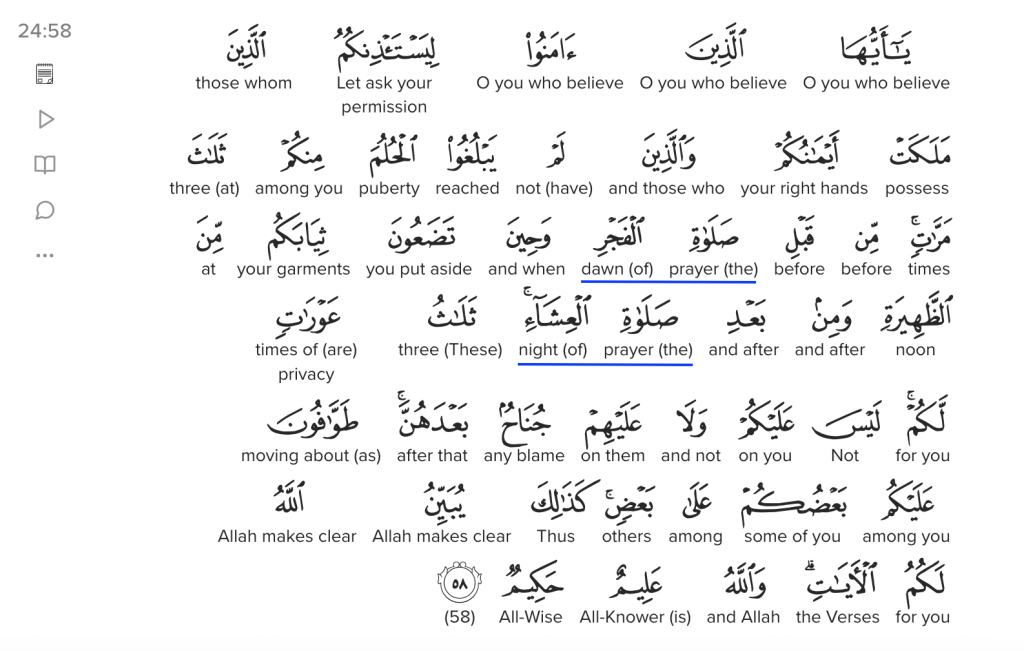
- Go here to see how to pray.
Prayers Can Be Combined
Ibn ‘Abbas reported: The Messenger of Allah (ﷺ) observed the noon and afternoon prayers together, and the sunset and Isha’ prayers together without being in a state of fear or in a state of journey.
Hadith Muslim; The Book yof Prayers; 705a
While on a journey the two prayers are combined and four rakaah prayers can be shortened by half.
Adhan (The Call to Prayer)
| The Adhan is an announcement of the prayer times and it is used to call Muslims to the prayers. This is not done for solitary prayers but only for group prayers in the Mosque. The person who gives the Adhan is called the Mu’adhin (Caller). It is preferred that the Mu’adhin has a beautiful voice. While calling for prayer, he stands facing the Qiblah and raises his hands to his ears, and calls out: |
“Allahu Akbar This means: (Allah is the Greatest) “الله أكبر
Allahu Akbar This means: (Allah is the Greatest) الله أكبر
Allahu Akbar This means: (Allah is the Greatest) الله أكبر
Allahu Akbar This means: (Allah is the Greatest) الله أكبر
Ashhadu alla ilaha illallah أشهد أن لا إ له إلا الله
This means: (I bear witness that there is no god but Allah)
Ashhadu alla ilaha illallah أشهد أن لا إ له إلا الله
This means: (I bear witness that there is no god but Allah)
Ashhadu anna muhammadar rasulullah أشهد أن محمدا رسول الله
This means:(I bear witness that Muhammad is Allah’s messenger)
Ashhadu anna muhammadar rasulullah أشهد أن محمدا رسول الله
This means:(I bear witness that Muhammad is Allah’s messenger)
Hayya alas Salah This means: (Rush to prayer حي على الصلاة
Hayya alas Salah This means: (Rush to prayer حي على الصلاة
Hayya alal Falah This means: (Rush to success) حي على الفلاح
Hayya alal Falah This means: (Rush to success) حي على الفلاح
Allahu Akbar This means: (Allah is the Greatest) الله أكبر
Allahu Akbar This means: (Allah is the Greatest) الله أكبر
La ilaha illallah” (There is no god but Allah) “لا إ له إلا الله
The first Adhan for Fajr Salah done by the Mosque should be shortly before Fajr time to help awaken the people. The following is added after “Hayya alal Falah”:
“Assalatu khayrum minan naum” الصلاة خير من النوم”
This means: (Salah is better than sleep)
“Assalatu khayrum minan naum” “الصلاة خير من النوم
This means: (Salah is better than sleep)
However, there is no need for this addition in the second Adhan, which should be made at the beginning of Fajr time.
It is strongly recommended that whenever possible, Muslim males should offer their Fard (compulsory) prayers in congregation at the Masjid (mosque).
3 Times Prayer In Previous Scripture
Three-times daily prayer is not a Muslim invention; it is the ancient Abrahamic prayer rhythm. In the Hebrew Bible, Daniel prayed three times a day toward Jerusalem (Daniel 6:10), and the Psalm says, “Evening, morning, and noon” the servant of God prays (Psalm 55:17).
https://www.sefaria.org/Mishnah_Berakhot.4.1?lang=bi
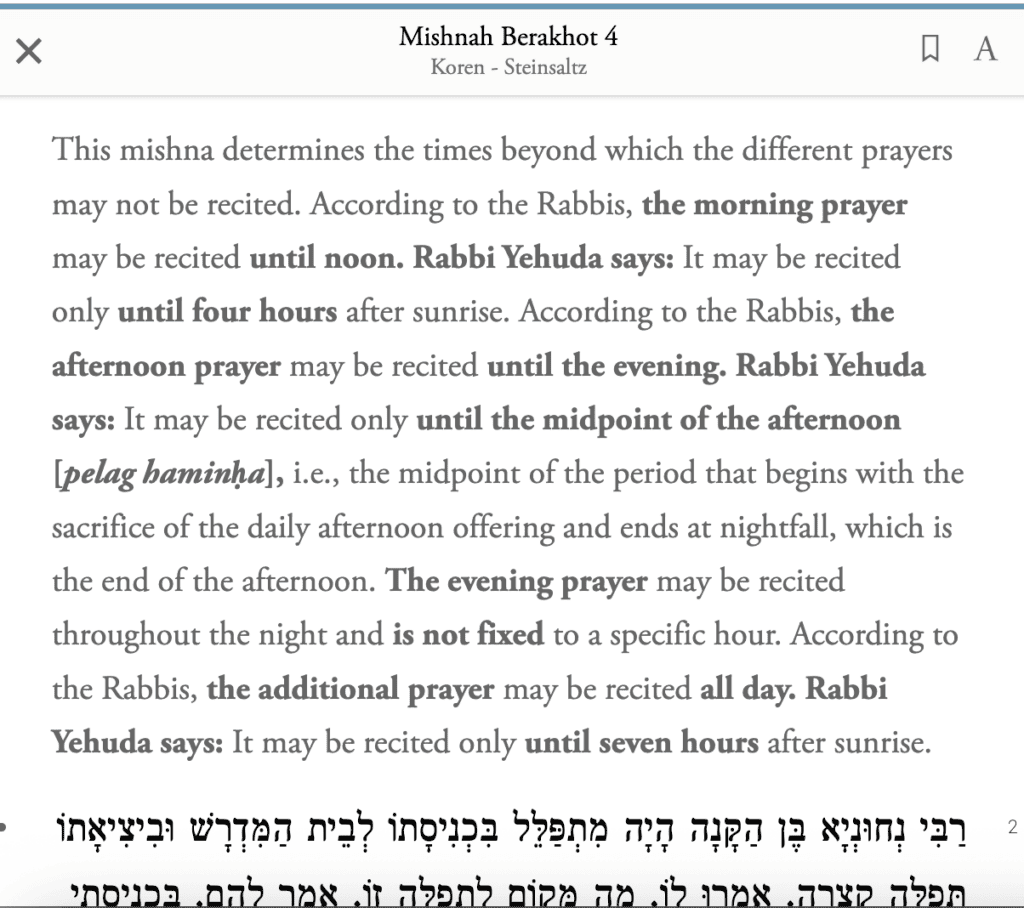
The New Testament preserves that same world of fixed prayer hours: Peter and John went to the Temple at the ninth hour, “the hour of prayer” (Acts 3:1); Peter prayed on the housetop at the sixth hour (Acts 10:9); and Cornelius was praying at the ninth hour when the angel came to him (Acts 10:30).
The earliest Christian manual, the Didache 8:3, then makes it explicit: after teaching the Lord’s Prayer, it says, “Thrice a day pray ye in this fashion.” And the ancient Churches did not lose the pattern: Eastern Orthodox Christianity still preserves canonical prayer hours — First, Third, Sixth, Ninth, Vespers, Compline, Midnight Office, and Orthros/Matins. In the Syriac/Aramaic Christian world, prayer is ṣlōṯā / slota — written ܨܠܽܘܬܳܐ — the same sacred prayer-world that stands close to Arabic ṣalāh in sound and function. So when Muslims pray at fixed times, they are not doing something alien to Jesus’ world; they are standing in the old prayer rhythm of the prophets, the Temple, the earliest Christians, and the ancient Eastern Churches.