Islam is not peace by branding. Islam is peace by consequence. Submission is the root. Peace is the fruit.
Islam is often translated as “peace.” That translation is incomplete.
The word Islām comes from the Arabic root s-l-m, which carries a cluster of related meanings: peace, safety, soundness, wholeness, and submission. But the primary meaning of Islām is submission to Allah — surrendering your will to the will of the One who made you.
The root begins with salima — safety and soundness. The act is aslama — to surrender. The religion is Islām — submission to Allah. And the result is salām/silm — peace, safety, and wholeness.
The peace is what that submission produces.
This distinction matters.
Islam is not peace by branding. Islam is peace by consequence — the peace that flows from a human being submitting himself fully to the One God, and then, through that submission, becoming a source of peace and safety in the world.
The Qur’an names the religion:
إِنَّ الدِّينَ عِندَ اللَّهِ الْإِسْلَامُ
“Indeed, the religion with Allah is Islām.”
Qur’an 3:19
The Qur’an then shows that Islām is not a new tribal label. It is the religion of the prophets: submission to the One God.
Abraham was a muslim.
Qur’an 3:67
Moses’ people were called to be muslimīn.
Qur’an 10:84
The disciples of Jesus declared:
“Bear witness that we are muslimūn.”
Qur’an 3:52
And the Prophet Muhammad ﷺ was commanded to declare that his prayer, sacrifice, life, and death are for Allah, Lord of the worlds, and that he is of the muslimīn.
Qur’an 6:162–163
One God.
One prophetic call.
One religion of believers in submission.
The Prophet ﷺ Defines the Muslim by Islam’s Lived Result
If the Qur’an names the religion, the Prophet ﷺ — in his own preserved words — defines the one who lives it.
الْمُسْلِمُ مَنْ سَلِمَ الْمُسْلِمُونَ مِنْ لِسَانِهِ وَيَدِهِ
Al-muslimu man salima l-muslimūna min lisānihī wa yadih.
“The Muslim is the one from whose tongue and hand the Muslims are safe.”
Sahih al-Bukhari 10; Sahih Muslim 40; also Sahih al-Bukhari 6484
And in a broader narration:
Al-muslimu man salima n-nāsu min lisānihī wa yadih.
“The Muslim is the one from whose tongue and hand the people are safe, and the believer is the one whom the people trust with their lives and wealth.”
Sunan an-Nasa’i 4995
This is profound.
Here, the Prophet ﷺ defines the Muslim by the social result of his Islam. Not merely by what he claims. Not merely by what he performs outwardly. But by what others receive from him.
Are they safe from his tongue?
Are they safe from his hand?
His tongue represents speech: insult, slander, lies, mockery, betrayal, accusation, humiliation.
His hand represents action: violence, oppression, theft, abuse, cheating, harm.
Why tongue then hand specifically, of all organs: they’re the two instruments of harm. The tongue (lisān) is speech — slander, lying, insult, false witness; the hand (yad) is action — striking, stealing, killing. Between word and deed, you’ve covered the entire field of how one human injures another.
Ibn Ḥajar explains in Fatḥ al-Bārī says the hadith is describing the complete/perfect Muslim — meaning Islam is not only a claim of the tongue, but a state whose effect is safety from the tongue and hand.
Seyyed Hossein Nasr explains: Islam seeks peace through submission to the Will of God.
Ibn Rajab al-Ḥanbalī explains in Fatḥ al-Bārī that the hadith describes the complete/perfect Muslim — meaning Islam is not only a claim of the tongue, but a state whose effect is safety from the tongue and hand.
This demonstrates the real meaning of Muslim and the excellence of the prophet. The Prophet ﷺ defines the submitter (muslim) using the very root of peace/safety/wholeness (salām/salima) that muslim itself comes from. The name and the behavior are the same triliteral. To be a muslim (submitter) is to be a source of salāmah (safety) — the word performs its own definition.
When the angels foresaw humanity, they named one danger: “Will You place in it one who will spread corruption (yufsidu) and shed blood?” (Q 2:30) — a creature of fasād, working harm through tongue and hand. Against exactly this, the Prophet ﷺ defined the believer: “The Muslim is he from whose tongue and hand the people are safe (salima).” The two organs the angels feared as instruments of corruption become instruments of safety — and the root says it plainly: muslim and salima share س-ل-م, so to submit is, by the word’s own logic, to become a source of peace. Yet not-harming is only the floor. The one the angels feared as mufsid, the corrupter, Islam reforms into the muslim, the safe-maker, and perfects as the muṣliḥ, the restorer or reformer who sets the earth right — fasād (ف-س-د) undone through submission (س-ل-م), fulfilled as reform (ﺹ-ﻝ-ﺡ).
Islamic law also divides practice into ʿibādāt, worship and obligations toward Allah, and muʿāmalāt, dealings between people.
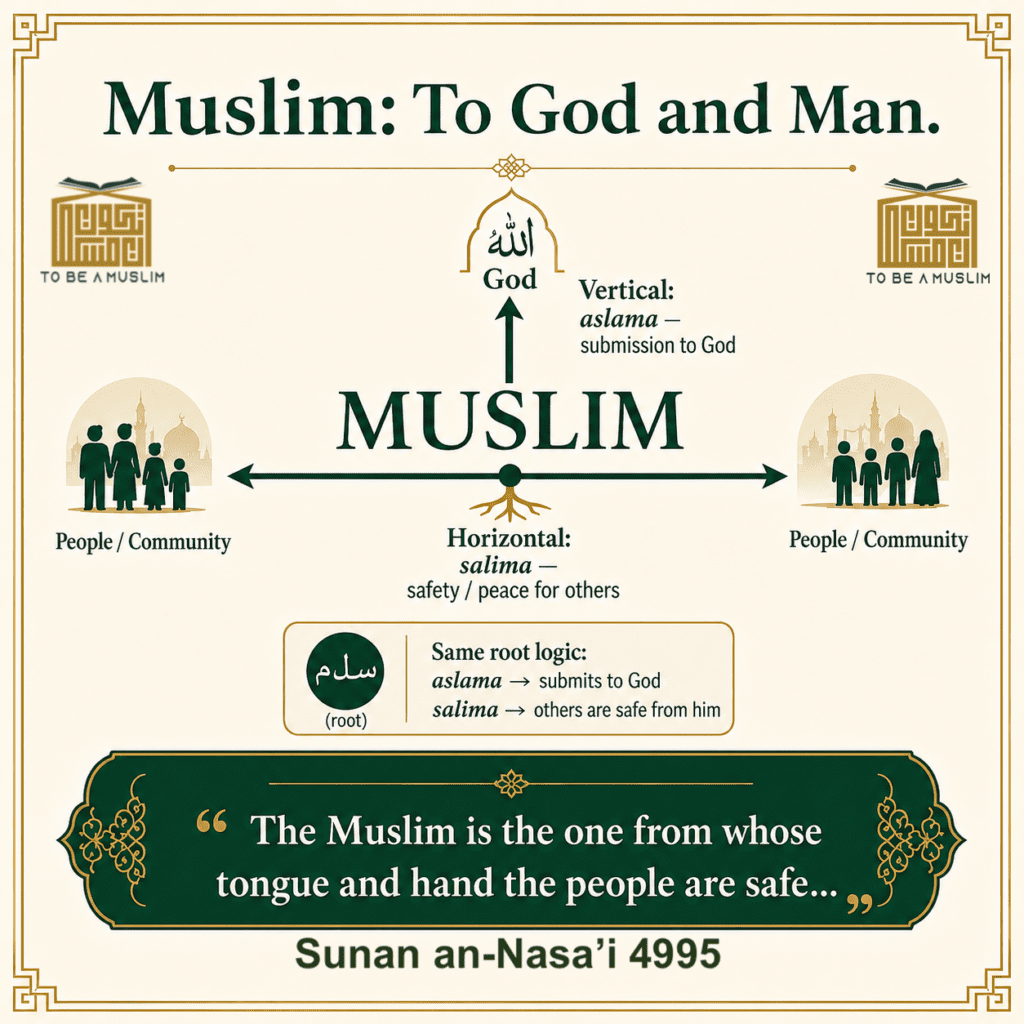
The Two Dimensions of Islam
Islam has two dimensions: the rights of Allah (ḥuqūq Allāh) and the rights of creation (ḥuqūq al-ʿibād). Submission to the One God, and safety to His creatures. This is the structure of the s-l-m root itself: islām (submission to Allah) producing salām (peace with people).
The Prophet ﷺ defined the Muslim by the second dimension: ‘the one from whose tongue and hand the people are safe’ (Bukhari 10). And Jesus gave the same structure when asked the greatest commandment: love God with all your heart, and love your neighbor as yourself — the two on which all hangs (Mark 12:29–31). Submission upward, peace outward. The God-ward and the people-ward. Both prophets named the same architecture.
So the Muslim is not simply someone who says “peace.”
The Muslim is someone whose submission to Allah makes others safer.
The Arabic word used in the hadith is salima — from the same root that gives us Islām and salām.
That is the architecture: Submission inward. Peace outward.
وَاعْبُدُوا اللَّهَ وَلَا تُشْرِكُوا بِهِ شَيْئًا وَبِالْوَالِدَيْنِ إِحْسَانًا…
“Worship Allah and associate nothing with Him, and do good to parents, relatives, orphans, the needy, near and distant neighbors, the companion at your side, the traveler, and those whom your right hands possess…” Qur’an 4:36
Lisān al-ʿArab Definition
The classical Arabic lexicon Lisān al-ʿArab gives the same structure. Ibn Manẓūr’s Lisān al-ʿArab, one of the most authoritative and comprehensive classical Arabic lexicons, defines Islām from aslama — to submit — and gives its core meanings as:
al-istislām — surrender, giving oneself over
al-inqiyād — compliance, being led
al-idhʿān — yielding, submitting
These are the classical Arabic terms for the primary meaning of Islām: the voluntary giving-over of the self to Allah.
Ibn Manẓūr also connects this root to as-silm and as-salām — peace, safety, and soundness — and cites the Qur’anic command:
ادْخُلُوا فِي السِّلْمِ كَافَّةً
“Enter into al-silm completely.”
Qur’an 2:208
Classical commentators read al-silm here as Islām: enter into Islam completely.
So the linguistic structure is not ambiguous. Islām is submission to Allah, and through that submission comes salām — peace, safety, and soundness. The act and the state are bound together in one Arabic root: submission inward, peace outward.
The Muslim
The Muslim submits to Allah in faith, worship, deeds, and character — through the shahādah, prayer, fasting, zakāh, pilgrimage, obedience, restraint, mercy, justice, and infāq: spending in charity on relatives, orphans, the poor, the traveler, and those in bondage.
That submission then appears outwardly as safety from his tongue and hand.
This is why the greeting of Muslims is:
As-salāmu ʿalaykum — peace be upon you.
It is not just a greeting. It is a covenant of safety.
The greeting of Paradise is salām.
Qur’an 10:10
The abode of the saved is Dār as-Salām — the Home of Peace.
Qur’an 6:127
And Allah invites to Dār as-Salām.
Qur’an 10:25
So Islam is not peace because Muslims merely claim peace.
Islam is peace because true submission to Allah produces peace: first in the heart, then in the tongue, then in the hand, then in the world touched by that tongue and hand.
Only submission to the will of God can produce true peace and safety — within the self and among people.
Without that submission, the human being is pulled by ego, appetite, pride, fear, anger, and domination. The result is inner disorder and outer harm.
The World Peace Formula
The Qur’an describes the Muslim as one submitted to the One God.
The Prophet ﷺ defines the Muslim as one from whose tongue and hand others are safe.
Multiply that definition across humanity, and you have world peace.
Not by slogan.
Not by treaty alone.
Not by force.
But by the internal submission of human beings to Allah, producing the external safety of every neighbor, friend, stranger, and society.
Submission is the root.
Peace is the fruit.
That is Islām.
In the Bible: Melchizedek, King of Peace
Melchizedek, in Genesis 14, is called melekh Shālēm — king of Salem. The Hebrew word Shālēm is the cognate of Arabic Salām. Both come from the Semitic root s-l-m / š-l-m, meaning peace, safety, wholeness, completeness. Hebrews 7:2 in the New Testament translates the name directly: King of peace. Melchizedek was a priest of ʾĒl ʿElyōn — God Most High — the One God of strict monotheism, blessing Abraham in His name.
The first named priest-king in the Bible is the king of peace who serves the Most High God. He is the biblical archetype of what the Qur’an names a muslim — one who submits to the One God and from whom peace flows. The Hebrew Shālēm. The Arabic Salām. The Islām that names submission to the One God producing peace. Same root. Same God. Same architecture. The Bible’s first named priest-king and the Qur’an’s name for the religion of submission share the same Semitic word for peace.
Jesus: In the Order of Peace
For it is declared: “You are a priest forever, in the order of Melchizedek.” (Hebrews 7:17)
Biblical Jesus says, “Peace I leave with you; my peace I give you” (John 14:27). In the Semitic world behind the Bible, that peace is shālōm — cognate with Arabic salām. The Qur’an names the religion Islām: submission to the One God producing salām.
The Hebrew Shālōm. The Arabic Salām. The Islām that names the submission producing peace. Jesus left his disciples the peace of the king of Shālēm — Melchizedek is a biblical image of priestly peace under the Most High God: king of Salem, king of peace. For Muslims, this resonates with the Qur’anic architecture of Islām — submission to the One God producing salām.