An ancient term the religious adopted — and why it still matters
In Christianity they say: “Jesus said, ‘I am the way.’”
But before that sentence is turned into a doctrine, it should be set back into the world it was spoken in. Because long before the Gospel of John used those words, the people of God already had an entire language of the way — and in that language, “the way” was never a man to be worshipped. It was a road to be walked, and it led to God alone.
A word older than the Gospel
In Hebrew, the word is derekh — דֶּרֶךְ — way, road, path, a manner of life. It runs through the whole of Scripture as one of the defining images of true religion.
The Torah commands the believer to walk in God’s ways:
“And now, Israel, what does the LORD your God ask of you but to fear the LORD your God, to walk in obedience to Him, to love Him…”
— Deuteronomy 10:12
The Psalms open by setting two roads against each other:
“Blessed is the one who does not walk in step with the wicked… For the LORD watches over the way of the righteous, but the way of the wicked leads to destruction.”
— Psalm 1:1, 6
And the prophets cry out to clear that road for God:
“A voice of one calling: ‘In the wilderness prepare the way for the LORD; make straight in the desert a highway for our God.’”
— Isaiah 40:3
In every one of these, “the way” is moral and prophetic. It is obedience, covenant, and return to God. It is something you walk, not someone you deify.
The community that walked into the desert
This was not a stray metaphor.
Before Christianity had ever become a world religion, a community of devout Jews — the people of the Dead Sea Scrolls — built their identity on this very verse.
They withdrew into the wilderness and explained why in their own rule of life: they separated themselves from the corruption of men “to go to the desert in order to prepare there the way of the LORD,” quoting Isaiah’s command to “prepare the way of the LORD.”
And they defined exactly what that “way” was.
Not a person to be worshipped.
In their own words, it was the study of the Law which He commanded — purification, obedience, covenant, and return to God.
So here is a community, in the very land and century of Jesus, using “the way” as a name for the road of submission to the One God.
That matters.
Because when the New Testament later speaks of “the Way,” it is not inventing language from nowhere. It is standing inside an older Jewish world where true religion was imagined as a road: the road of God, the road of righteousness, the road of life.
The first name of the Jesus movement
Now read the New Testament’s own testimony about Jesus’ earliest followers.
Before they were ever publicly called “Christians,” they were known by one name:
The Way.
It appears again and again in Acts.
Paul sought to arrest those “who belonged to the Way.”
— Acts 9:2
There arose “a great disturbance about the Way.”
— Acts 19:23
Paul later confessed: “I persecuted the followers of this Way.”
— Acts 22:4
Not a creed.
Not a church brand.
Not a slogan about worshipping a man.
The Way.
The same ancient image of a road walked before God.
And when Paul stands on trial and is forced to state his faith plainly, listen to his grammar:
“I admit that I worship the God of our ancestors as a follower of the Way, which they call a sect. I believe everything that is in accordance with the Law and that is written in the Prophets…”
— Acts 24:14
He does not say he replaced the God of the fathers.
He does not say the Way is a new God.
He says: I worship Him — the God of Abraham, Isaac, and Jacob.
That is the key.
The Way was not first a metaphysical claim that the messenger had become the object of worship. It was a prophetic claim that the road to God had been restored.
The two ways in the earliest Christian manuals
This understanding did not disappear after Acts.
The Didache, one of the oldest Christian instruction manuals that survives, opens with the same ancient pattern:
“There are two ways, one of life and one of death, and there is a great difference between the two ways.”
The Epistle of Barnabas teaches it too: the way of light, and the way of darkness.
Every time, across centuries and communities, “the way” carries the same meaning: a road of obedience, a road of life, a road back to God.
It is not first a formula about deifying the messenger.
It is moral. Prophetic. Covenantal. A way to walk.
“I am the way” — read the whole sentence
So what about John 14:6?
Jesus says:
“I am the way and the truth and the life. No one comes to Abba except through me.”
But hear the whole sentence.
No one comes to Abba except through me.
Through me — to Abba.
Even in this verse, Abba is the destination. Jesus does not say, “I am the final object of worship.” He says he is the way by which one comes to Abba.
A road is not where you stop.
A road is what carries you home.
That is the distinction later doctrine often buries.
If Jesus is “the way,” then the next question is simple: the way to whom?
The answer is in the verse itself: to Abba.
So even John 14:6 does not destroy the prophetic grammar. It preserves it. The messenger is the appointed road. God is the destination.
No one comes to God except through the messenger
This is why John 14:6 should not frighten a Muslim.
Properly understood, it expresses one of Islam’s deepest principles: God is reached through the messenger He sends.
God does not leave humanity to invent its own road. He sends guidance. He sends revelation. He sends a messenger. To accept that messenger is to enter the road God opened. To reject that messenger is not to reach God by another route; it is to refuse the door God placed in front of you.
The Qur’an states the principle plainly:
“Whoever obeys the Messenger has obeyed Allah.”
— Qur’an 4:80
And again:
“Say: If you love Allah, then follow me; Allah will love you.”
— Qur’an 3:31
Notice the structure.
Love of God is not abstract. It runs through the one God sent.
That is the same grammar as John 14:6:
to Abba, through the messenger.
The messenger is not the goal. The messenger is the gate.
The Shahada: two halves of one road
This is why the Muslim declaration of faith has two clauses, not one:
Lā ilāha illā Allāh — Muḥammadun rasūlu Allāh.
There is no god but Allah — Muhammad is the Messenger of Allah.
The first clause is pure monotheism: God alone is worshipped.
The second clause is not a second deity. Muhammad ﷺ is never an object of worship; the Qur’an insists he is only a man and a servant:
“Say: I am only a man like you, to whom it has been revealed that your God is one God.”
— Qur’an 18:110
He is the messenger, servant, guide, and witness. The second clause identifies the road God opened for this age.
You cannot claim to love God while rejecting the messenger God sent. That is not monotheism. That is self-made religion.
The two halves of the Shahada are one testimony:
God is the destination.
His messenger is the way.
This is not a rival to John 14:6. It is the same prophetic structure restored — without deifying the messenger.
The prophet of your time
Here is the principle in full:
God is reached through the messenger He sends to your age.
In the time of Moses, the way to God ran through Moses. To reject Moses was to reject the One who sent him.
In the time of Jesus, the way to God ran through Jesus. To reject Jesus was to reject the One who sent him.
And when the final messenger came, the way to God came to run through Muhammad ﷺ.
The Qur’an says:
“Muhammad is not the father of any of your men, but he is the Messenger of Allah and the seal of the prophets.”
— Qur’an 33:40
So to come to God in this age is to recognize the messenger of this age.
This is not Islam exalting a man over God.
It is Islam preserving the law of the prophets: the door God opens is the door you must enter.
The Qur’an places the straight path on the tongue of Jesus: 3x!
Now return to Jesus himself.
The Qur’an places the straight path back on his tongue, and it does so with perfect clarity.
When Jesus comes with clear proofs, he says:
“I have come to you with wisdom, and to clarify to you some of what you differ about. So fear Allah and obey me. Indeed, Allah is my Lord and your Lord, so worship Him. This is a straight path.”
— Qur’an 43:63–64
Look carefully.
Jesus says: Allah is my Lord and your Lord.
My Lord and yours.
That means Jesus stands on the same side of worship as the people he teaches. He is not the object of the road. He is the caller to the road.
He says: obey me.
But worship Allah.
That is the prophetic balance. The messenger must be followed. God alone must be worshipped.
And then Jesus names that road by its ancient name: a straight path.
Four times the Qur’an places the same confession on Jesus’s lips — God is my Lord and your Lord (rabbī wa-rabbukum) — and three of those four bind it directly to the Way: “so worship Him; this is a straight path” (hādhā ṣirāṭ mustaqīm).
He speaks it in the cradle (19:36), to his disciples (3:51), and to the Children of Israel (43:64).
And a fourth time, in heaven on the Day of Judgment, he affirms my Lord and your Lord without the clause (5:117).
What Jesus calls “the straight path” is not a path to himself but through him to the One he worships — the same road the earliest believers walked when their movement was known simply as “the Way” (hē hodos, Acts 9:2; 24:14), before it bore any other name.
The straight path, the Way, al-ṣirāṭ al-mustaqīm: one continuous road, and on it Jesus stands not at its end as the destination, but on it as a traveler pointing forward — my Lord and your Lord — calling his hearers to walk where he walks.
It is the same straight path every Muslim still asks for in every prayer, every day:
“Guide us to the straight path.”
— Qur’an 1:6
Ihdinā al-ṣirāṭ al-mustaqīm.
Subul as-Salām (The Ways of Peace)
The Qur’anic passage that says the Messenger clarifies what had been concealed also names where that clarification leads.
After declaring that a light and a clear Book have come from God, the next verse gives the function of that light:
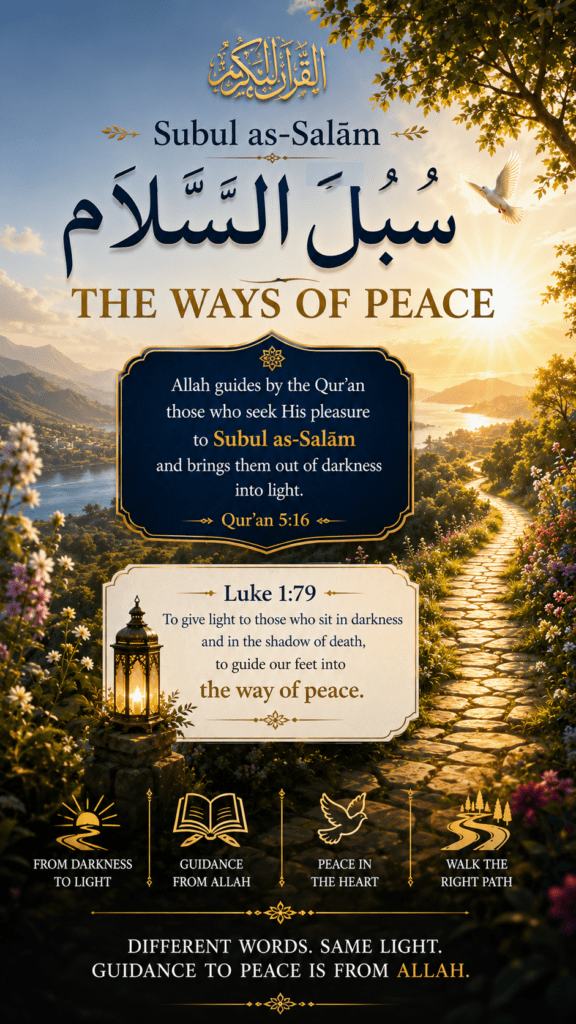
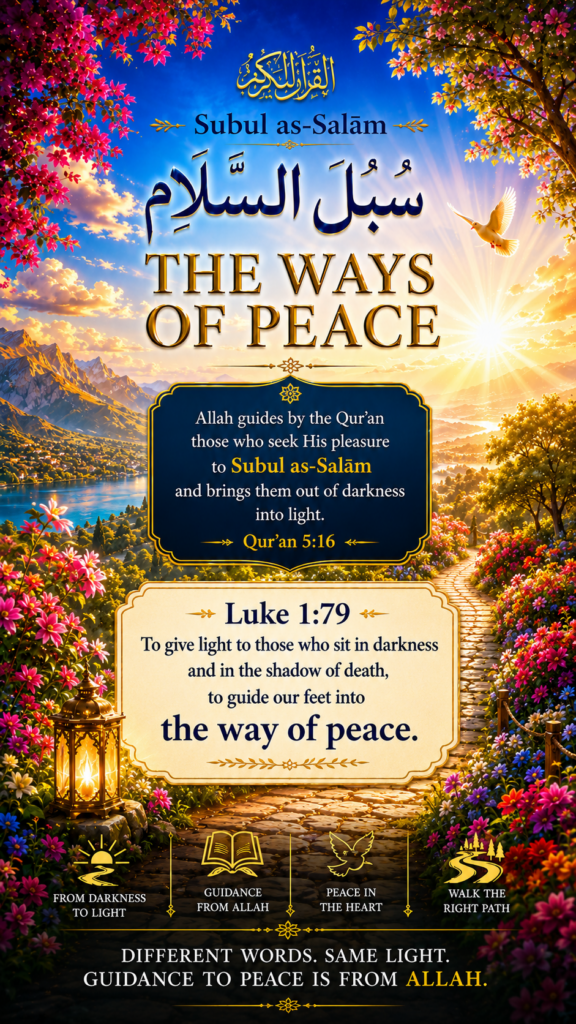
يَهْدِي بِهِ اللَّهُ مَنِ اتَّبَعَ رِضْوَانَهُ سُبُلَ السَّلَامِ
“By it Allah guides those who follow His pleasure to the ways of peace.”
— Qur’an 5:16
Not merely “a way” in the abstract, but subul as-salām — ways of peace, safety, soundness, and wholeness. The root s-l-m is the same root behind islām and salām, and it is cognate with Hebrew shalom: peace not as mere quiet, but as completeness, restoration, and soundness.
So “the Way” is not first an argument floating in the air. It is the condition produced when divine light lands on the human being. The verse continues:
وَيُخْرِجُهُم مِّنَ الظُّلُمَاتِ إِلَى النُّورِ بِإِذْنِهِ وَيَهْدِيهِمْ إِلَىٰ صِرَاطٍ مُّسْتَقِيمٍ
“And He brings them out of darknesses into light by His permission, and guides them to a straight path.”
That is the Qur’anic architecture of the Way: obscurity is clarified, darkness is exited, peace becomes the path, and the traveler is set upon ṣirāṭ mustaqīm.
The Way is where the light lands.
One prophetic grammar
So trace the whole line from beginning to end.
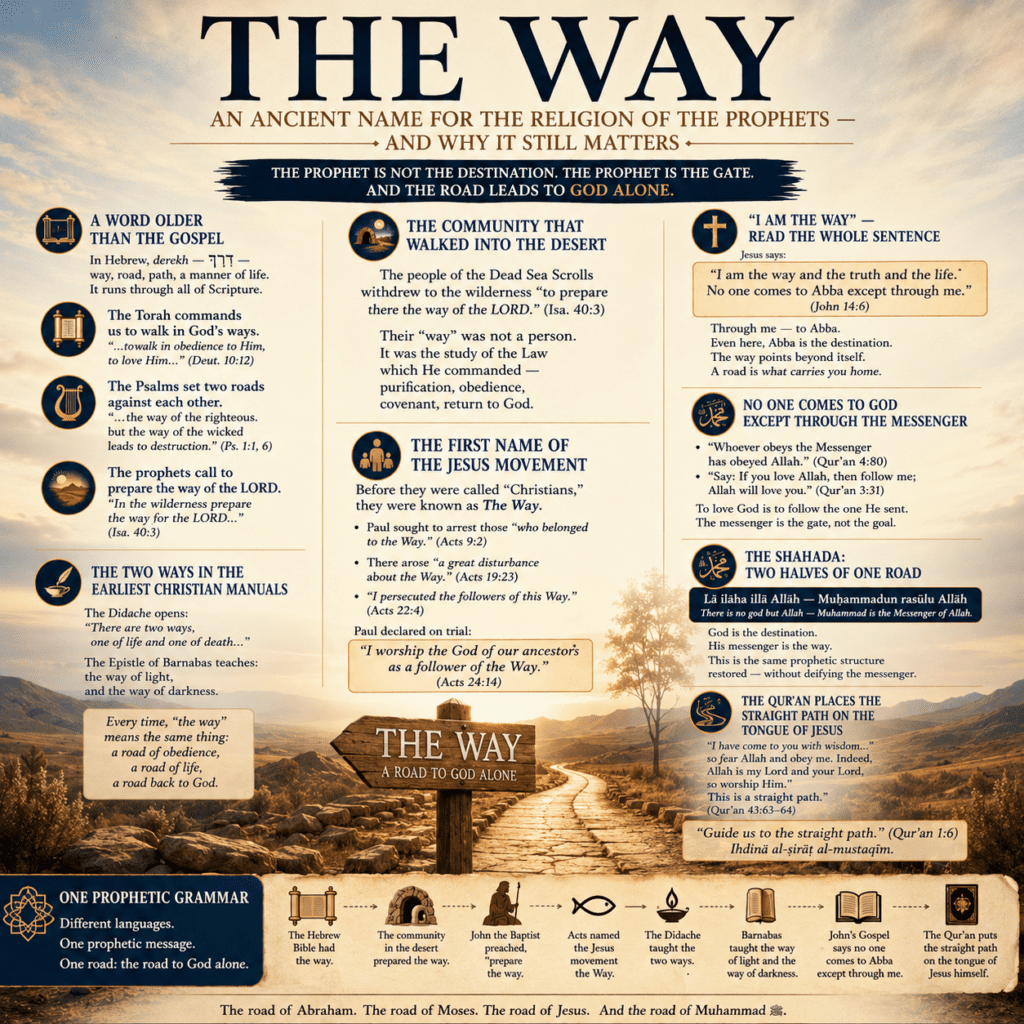
The Hebrew Bible had the way.
The community in the desert prepared the way.
John the Baptist preached, “prepare the way.”
Acts named the Jesus movement the Way.
The Didache taught the two ways.
Barnabas taught the way of light and the way of darkness.
John’s Gospel says no one comes to Abba except through the messenger.
And the Qur’an puts the straight path back into the mouth of Jesus himself, then places it on the lips of every believer who prays.
Different languages.
One prophetic grammar.
The road of Abraham. The road of Moses. The road of Jesus. And the road of Muhammad ﷺ.
The prophet is not the end of the road. The prophet shows you the road.
The prophet is not the destination. The prophet is the gate God appointed.
And the road leads to God alone.
ToBeAMuslim.com