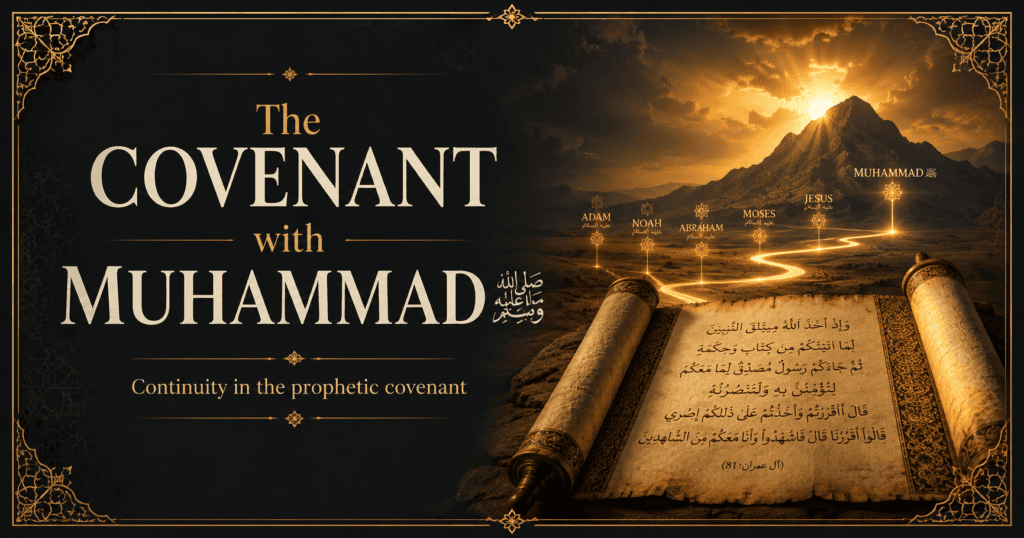
A common claim in Jewish-Christian-Muslim debate is that “covenant” belongs to the Bible, while Islam appears later as something outside that covenant history. That claim is false. The Qur’an does not present Muhammad ﷺ as a stranger to the covenant tradition. It places him inside the same covenantal line God established with the prophets before him, then extends that binding to his community.
The Qur’an’s argument is direct: God did not abolish covenant. He did not lock it permanently to bloodline, priesthood, temple, or institution. Covenant belongs to God, and God binds it to those who uphold it.
Muhammad ﷺ Is Named Inside the Prophetic Covenant
Allah says:
“And when We took from the prophets their covenant, and from you, and from Noah and Abraham and Moses and Jesus son of Mary; and We took from them a solemn covenant.”
Qur’an 33:7
The structure is explicit. Muhammad ﷺ is addressed directly: “and from you.” Then the verse names Noah, Abraham, Moses, and Jesus. He is not outside the prophetic covenant. He is named within it.
The phrase used is mīthāqan ghalīẓan — a solemn, weighty covenant. This is not casual religious language. The Qur’an uses the same solemn covenantal register for the covenant taken from Israel in connection with the mountain:
“And We raised over them the Mount because of their covenant, and We said to them, ‘Enter the gate prostrating,’ and We said to them, ‘Do not transgress in the Sabbath,’ and We took from them a solemn covenant.”
Qur’an 4:154
So when Qur’an 33:7 says God took a mīthāqan ghalīẓan from Muhammad ﷺ and the great prophets, it places him inside the highest covenantal category. Muhammad is not an outsider to Noah, Abraham, Moses, and Jesus. He stands in the same prophetic covenantal line.
This is not resemblance. It is continuity.
The Prophets Were Bound to the Confirming Messenger
The Qur’an explains the content of the prophetic covenant:
“And when Allah took the covenant of the prophets: Whatever I give you of Scripture and wisdom, then there comes to you a messenger confirming what is with you, you shall surely believe in him and support him. He said, ‘Have you acknowledged and taken upon that My binding?’ They said, ‘We acknowledge.’ He said, ‘Then bear witness, and I am with you among the witnesses.’”
Qur’an 3:81
This verse destroys the idea that each prophet was sealed off from the next. The prophets were not isolated founders of separate religions. They were links in one chain.
Each prophet was bound to the truth God gave him, and also bound to recognize the messenger who came confirming what was with him.
The key word is muṣaddiq — confirming. The later messenger does not arrive as a foreign intruder. He comes as a confirmer of the divine truth already sent before him.
This is exactly how the Qur’an presents Muhammad ﷺ. He comes confirming what remains of divine truth before him, exposing what was hidden, judging what was corrupted, and restoring the covenantal line to its final form.
The Covenant Reaches the Muslim Community
The covenant does not stop with the Prophet. It is extended to the believers.
Allah says:
“And remember the favor of Allah upon you and His covenant with which He bound you when you said: We hear and we obey. And fear Allah. Indeed, Allah knows what is within the breasts.”
Qur’an 5:7
This is unmistakable covenant language. The believers are not merely invited to private spirituality. They are bound.
The covenant response is:
سَمِعْنَا وَأَطَعْنَا
samiʿnā wa-aṭaʿnā
“We hear, and we obey.”
Every reader of the Hebrew Bible should hear the echo.
At Sinai, Israel answered:
“All that the LORD has spoken we will do, and we will hear.”
Exodus 24:7
In Hebrew, the famous oath is:
נַעֲשֶׂה וְנִשְׁמָע
naʿaseh ve-nishmaʿ
“We will do, and we will hear/obey.”
The order is not identical, but the covenant sound is unmistakable. Hebrew nishmaʿ and Arabic samiʿnā come from the same Semitic root of hearing: שמע / سمع. In both languages, hearing is not passive listening. In covenant context, to “hear” means to receive the command with obedience.
The Qur’an then adds the explicit obedience term: aṭaʿnā — “we obeyed.”
So the Qur’anic formula samiʿnā wa-aṭaʿnā is not random phrasing. It sounds like the Sinai world. It answers the Hebrew covenant oath in Arabic: God speaks, the covenant people hear, and obedience is required.
The contrast becomes sharper because the Qur’an also records the opposite response from covenant-breakers:
“They said: We hear and we disobey.”
Qur’an 2:93
That is the whole dispute in one sentence. The issue is not whether God made covenant. The issue is whether the people obeyed it.
One covenantal pattern.
Two responses.
We hear and obey.
Or: we hear and disobey.
The Qur’an places the Muslim community on the side of covenant obedience.
The Ethical Core of the Covenant: Justice
Immediately after reminding the believers of the covenant, the Qur’an states the ethical obligation that comes with it:
“O you who believe, be steadfast for Allah, witnesses in justice, and let not hatred of a people cause you to be unjust. Be just; that is nearer to righteousness. And fear Allah. Indeed, Allah is aware of what you do.”
Qur’an 5:8
This is covenant law in direct form.
The covenant community must stand for Allah.
It must be a witness community.
It must uphold justice.
It must not let hatred corrupt judgment.
It must not use religion as tribal cover.
It must not excuse oppression because the victim is an enemy.
This is not vague moral language. This is the legal and spiritual demand of covenant.
A covenant people are not chosen so they can boast. They are chosen so they can obey, witness, judge truthfully, and stand against corruption.
Witnesshood Is the Office of the Covenant Community
The Qur’an gives the Muslim community the same covenantal office the Bible gave Israel: witnesshood.
Allah says:
“And thus We made you a middle nation so that you may be witnesses over mankind, and the Messenger may be a witness over you.”
Qur’an 2:143
This matches the biblical covenant office:
“You are My witnesses, declares the LORD, and My servant whom I have chosen.”
Isaiah 43:10
Israel was appointed as a witness among the nations. The Qur’an does not deny that such an office existed. It declares that witnesshood now belongs to the final covenant community under Muhammad ﷺ.
The Muslim ummah is not just another religious group. It is a witness community. Its duty is to testify to God’s truth, preserve revelation, command justice, forbid corruption, and stand before mankind as proof.
That office is not symbolic. It carries liability.
If the community lies, conceals truth, corrupts revelation, excuses oppression, or sells religion for worldly gain, it betrays the covenant it claims to carry.
The Covenant Has a Wage: Forgiveness and Paradise
The Qur’an repeatedly joins covenant, witnesshood, and reward.
In Surah al-Mā’idah, the sequence is clear.
First, the covenant:
“His covenant with which He bound you when you said: We hear and we obey.”
Qur’an 5:7
Then, the witness-duty:
“Be steadfast for Allah, witnesses in justice.”
Qur’an 5:8
Then, the promised reward:
“Allah has promised those who believe and do righteous deeds: for them is forgiveness and a great reward.”
Qur’an 5:9
The same pattern appears when Allah recalls the covenant with the Children of Israel:
“Allah had already taken the covenant of the Children of Israel…”
Qur’an 5:12
And the covenant promise is stated:
“I will surely remove from you your misdeeds and admit you to gardens beneath which rivers flow.”
Qur’an 5:12
That is the covenant wage: forgiveness and the Garden.
Surah al-Ḥadīd gives the same structure:
“Believe in Allah and His Messenger and spend from that over which He has made you successors.”
Qur’an 57:7
Then:
“And why do you not believe in Allah while the Messenger invites you to believe in your Lord, and He has already taken your covenant, if you are believers?”
Qur’an 57:8
The covenant is already upon them. The Messenger is not merely giving advice. He is calling people to honor a binding God has already placed over them.
Later in the same surah:
“Those who believe in Allah and His messengers — they are the truthful and the witnesses with their Lord. For them is their reward and their light.”
Qur’an 57:19
Again: belief, covenant, witnesshood, reward, light.
And the promised destination is explicit:
“Race toward forgiveness from your Lord and a garden whose width is like the width of heaven and earth, prepared for those who believe in Allah and His messengers.”
Qur’an 57:21
The pattern is fixed:
Covenant taken.
Community appointed as witnesses.
Justice demanded.
Forgiveness and Paradise promised.
That is Qur’anic covenant theology.
The Bible Itself Rejects Bloodline Entitlement
Modern apologetics often treats biblical covenant as if it were an unconditional ethnic possession. The Bible itself does not support that claim.
When Abraham asked about his descendants, Allah answered:
“My covenant does not reach the wrongdoers.”
Qur’an 2:124
That is the law of covenant. Bloodline does not protect wrongdoing. Descent does not override obedience. A corrupt heir does not inherit God’s approval simply because his ancestor was righteous.
The Hebrew Bible teaches the same principle.
Eli’s house had a priestly promise, but when his house became corrupt, God said:
“I promised that your house and the house of your father should go in and out before Me forever, but now the LORD declares: Far be it from Me, for those who honor Me I will honor, and those who despise Me shall be lightly esteemed.”
1 Samuel 2:30
That is not a minor verse. It is a covenant principle.
A sacred office can be lost through corruption. A promised house can be judged. God does not become the prisoner of an unfaithful lineage.
The same principle appears again:
“The earth lies defiled under its inhabitants; for they have transgressed the laws, violated the statutes, broken the everlasting covenant.”
Isaiah 24:5
Even an “everlasting covenant” can be broken by its human bearers. “Everlasting” does not mean corrupt people can violate God’s command and still claim immunity.
The Davidic promise also carries conditions:
“If your sons keep My covenant and My testimonies that I shall teach them, their sons also forever shall sit on your throne.”
Psalm 132:12
The word is if. Covenant has conditions. Covenant demands faithfulness.
The Qur’an Applies the Same Covenant Law
The Qur’an does not invent a different standard. It applies the same divine law consistently.
When previous covenant-bearers broke their covenant, Allah says:
“So for their breaking of their covenant, We cursed them and made their hearts hard. They distort words from their places and forgot a portion of what they were reminded of.”
Qur’an 5:13
This is the Qur’an’s charge: covenant-breaking leads to curse, hardness of heart, distortion, and forgetfulness.
That is the same principle seen in the Bible with Eli’s house. God gives a trust. The people corrupt it. God judges them. The office does not belong permanently to the corrupt. It belongs to those who honor God.
So when the Qur’an presents Muhammad ﷺ as the final confirming Messenger, it is not presenting a rupture. It is presenting continuation through judgment.
The covenant was not cancelled.
The covenant was not abandoned.
The covenant was not owned by the unfaithful.
The trust passed to those God bound to uphold it.
Muhammad ﷺ Is Not Outside the Covenant
This is the central point.
Muhammad ﷺ is not outside Noah’s covenantal world.
He is not outside Abraham’s covenantal world.
He is not outside Moses’ covenantal world.
He is not outside Jesus’ covenantal world.
The Qur’an places him in the same covenantal line:
“And when We took from the prophets their covenant, and from you, and from Noah and Abraham and Moses and Jesus son of Mary…”
Qur’an 33:7
The Qur’an then gives his community the covenant oath:
“We hear and we obey.”
Qur’an 5:7
It gives them the covenant office:
“That you may be witnesses over mankind.”
Qur’an 2:143
It gives them the covenant law:
“Be just; that is nearer to righteousness.”
Qur’an 5:8
It gives them the covenant wage:
“Forgiveness and a great reward.”
Qur’an 5:9
This is not a new religion detached from the prophets. This is the restoration and completion of the same divine covenantal line.
Conclusion
The covenant with Muhammad ﷺ is not a late Arabian invention. It is the Qur’an’s declaration that the same God who bound Noah, Abraham, Moses, and Jesus also bound Muhammad.
The same God took the covenant.
The same God sent Scripture and wisdom.
The same God required obedience.
The same God appointed witnesses.
The same God demanded justice.
The same God promised forgiveness and Paradise.
The same God judged covenant-breakers.
The biblical record already shows that covenant is not a license for corruption. Eli’s house lost standing. Israel is accused of breaking the everlasting covenant. The Davidic throne is stated with conditions. Abraham’s descendants are told that God’s covenant does not reach wrongdoers.
The Qur’an says the same thing with final clarity.
The covenant did not end.
The covenant did not fail.
The covenant was not owned by bloodline, temple, priesthood, or tribe.
It belonged to God.
And God bound it to Muhammad ﷺ and to the community commanded to say:
سَمِعْنَا وَأَطَعْنَا
samiʿnā wa-aṭaʿnā
We hear and we obey.
The chain never broke.
The covenant keepers changed.