The Qur’an, Bukhārī, and three classical source witnesses
The identification of the revealing angel as Gabriel rests on four independent evidentiary layers — a contemporary document, ṣaḥīḥ eyewitness-chain testimony, multiple independent early narrative routes, and the total absence of any counter-tradition. Judged by the method historians actually use for antiquity, the self-introduction is not a weak point in the narrative. It is one of the best-attested dialogue lines in ancient history.
The direct phrase appears as:
يَا مُحَمَّدُ، أَنْتَ رَسُولُ اللَّهِ، وَأَنَا جِبْرِيلُ
“O Muhammad, you are the Messenger of Allah, and I am Gabriel.”
This article reviews the evidence in layers.
1. The Qur’anic Foundation: Gabriel Is Named as the Revealer
The Qur’an itself names Gabriel as the one who brought revelation to the Prophet’s heart:
قُلْ مَن كَانَ عَدُوًّا لِّجِبْرِيلَ فَإِنَّهُ نَزَّلَهُ عَلَىٰ قَلْبِكَ بِإِذْنِ اللَّهِ
“Say, whoever is an enemy to Gabriel — it is he who brought it down upon your heart by Allah’s permission…”
Qur’an 2:97
This establishes the central identification: the revealer of the Qur’an is Jibrīl/Gabriel. The identity is therefore Qur’anic before it is biographical or historical.
The Qur’an also describes a powerful angelic vision on the horizon. Sūrat al-Takwīr says the Prophet’s companion was not mad and that he saw the noble messenger “on the clear horizon.” Sūrat al-Najm similarly describes the one mighty in power appearing on the highest horizon and drawing near. These passages give the Qur’anic frame for the horizon-vision scene later narrated in sīrah literature.
2. The Ṣaḥīḥ Frame: Bukhārī and the Nāmūs
The main first-revelation report in Ṣaḥīḥ al-Bukhārī describes the angel coming to the Prophet ﷺ in the cave of Ḥirāʾ and commanding him to read. The report preserves the three embraces, the revelation of Qur’an 96:1–5, the Prophet’s shaken return to Khadījah, and the visit to Waraqah b. Nawfal.
When Waraqah hears the account, his Arabic wording is precise:
هَذَا النَّامُوسُ الَّذِي نَزَّلَ اللَّهُ عَلَى مُوسَى
“This is the Nāmūs whom Allah sent down to Moses.”
Waraqah does not literally say the word Jibrīl in Bukhārī’s Arabic wording. He says al-Nāmūs. Many English translations explain this as Gabriel, and that explanation is correct in meaning, but it is not the literal wording Waraqah used. Bukhārī’s report identifies the being by office: the revelation-bearing messenger sent to Moses.
“This is the Namūs (the angel entrusted with Divine Secrets) that Allah sent down to Musa (Moses)“. [1, 2]
Gabriel: The Angel of Revelation Across the Three Scriptures
There is also a ṣaḥīḥ report from Jābir b. ʿAbdillāh about the pause of revelation. The Prophet ﷺ says he heard a voice from the sky, looked up, and saw the same angel who had come to him at Ḥirāʾ sitting between heaven and earth. This confirms continuity: the later angelic appearance is explicitly tied back to the angel of Ḥirāʾ.
So before we even discuss the direct wording, the frame is already strong:
Gabriel is named in the Qur’an.
The first encounter with the angel at Ḥirāʾ is in Bukhārī.
Waraqah identifies the visitor as the Nāmūs sent to Moses.
The same angel later appears again in a ṣaḥīḥ report.
The direct phrase “I am Gabriel” is found in the next layer: classical sīrah and historical sources.
3. Source One: Ibn Kathīr — al-Bidāyah wa-l-Nihāyah
Ibn Kathīr preserves the direct self-identification wording in al-Bidāyah wa-l-Nihāyah, in the section on the age and time of the Prophet’s mission. The report says that the Prophet ﷺ heard a voice from the sky saying:
يا محمد أنت رسول الله وأنا جبريل
“O Muhammad, you are the Messenger of Allah, and I am Gabriel.”
It then describes the Prophet ﷺ raising his head and seeing Gabriel in the form of a man standing on the horizon, with the same words repeated.
The route behind Ibn Kathīr
Ibn Kathīr gives this through the Ibn Isḥāq material. The chain includes Ibn Isḥāq from Wahb b. Kaysān, who heard ʿAbdullāh b. al-Zubayr asking ʿUbayd b. ʿUmayr about the beginning of the Prophet’s revelation. ʿUbayd b. ʿUmayr then narrates the account of the Prophet’s seclusion at Ḥirāʾ and the arrival of Gabriel.
How strong is this source?
This is early sīrah material, not a standalone ṣaḥīḥ hadith. The key issue is that ʿUbayd b. ʿUmayr is a senior tābiʿī, not a Companion eyewitness. Because he narrates the event without naming the Companion source, the report is treated as mursal. Dorar lists the ʿUbayd b. ʿUmayr first-revelation report and gives the ruling mursal.
But “mursal” does not mean useless. It means the report does not meet the highest connected-chain standard. Historically, this remains important because it is early, Meccan-connected sīrah material, transmitted through known early names, and it fits inside the Qur’anic and ṣaḥīḥ frame already described.
So Ibn Kathīr’s value is this: he preserves the direct wording as part of the well-known early sīrah account of the beginning of revelation.
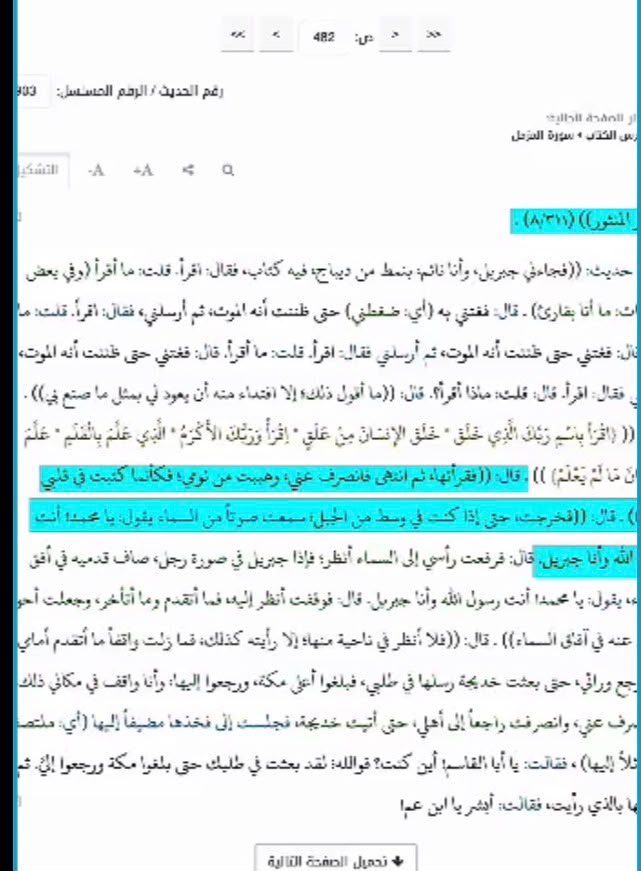
Ref: https://www.islamweb.net/ar/library/content/59/180/
4. Source Two: al-Ṭabarī — Direct Wording Through the ʿĀʾishah Route
Al-Ṭabarī also preserves a version with explicit self-identification. In this version, the angel says:
يا محمد، أنا جبريل وأنت رسول الله
“O Muhammad, I am Gabriel, and you are the Messenger of Allah.”
This appears in al-Ṭabarī’s material on the beginning of revelation. The report runs through:
Aḥmad b. ʿUthmān al-Baṣrī → Wahb b. Jarīr → his father → al-Nuʿmān b. Rāshid → al-Zuhrī → ʿUrwah → ʿĀʾishah.
That is important because it is not simply the same Ibn Isḥāq / ʿUbayd b. ʿUmayr route. It is a different route, through al-Zuhrī, ʿUrwah, and ʿĀʾishah.
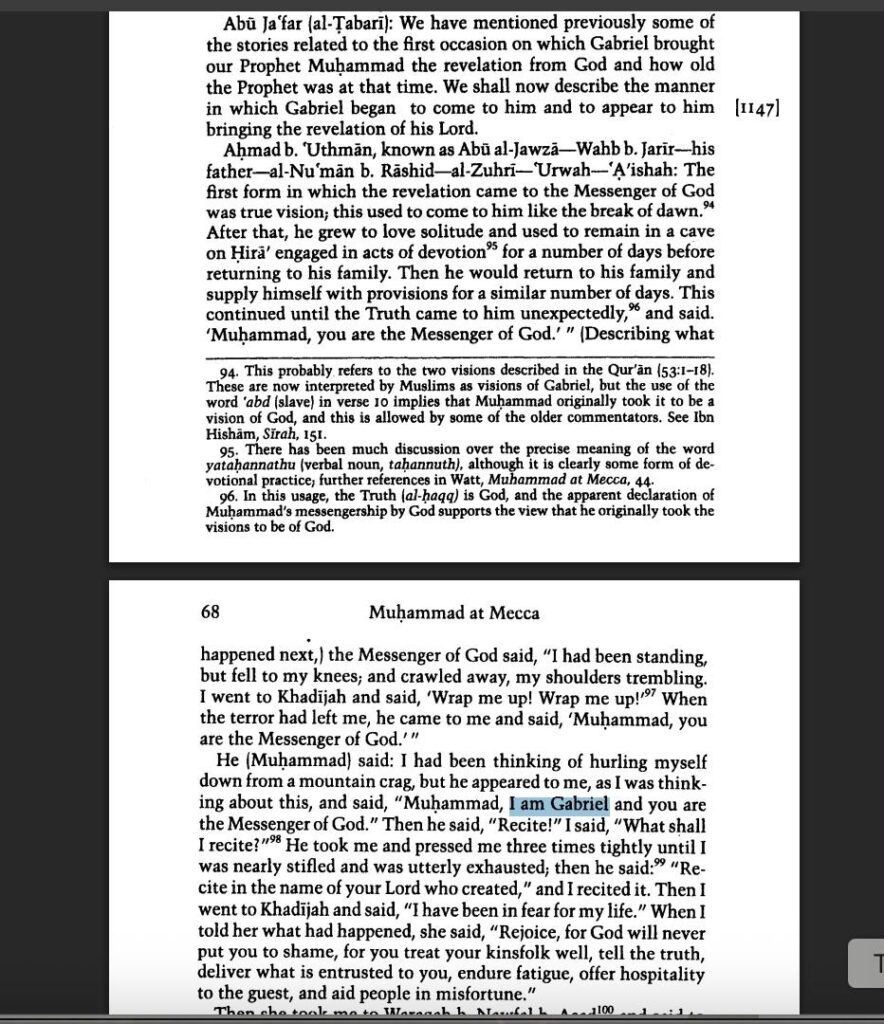
Ref: https://www.kalamullah.com/Books/The%20History%20Of%20Tabari/Tabari_Volume_06.pdf
How strong is this source?
This route has a weakness: al-Nuʿmān b. Rāshid. The hadith critics criticized him, especially in his narrations from al-Zuhrī. Al-Nasāʾī called him weak and very mistake-prone, and other critics also mention weakness, confusion, or many errors in his narrations.
So this report should not be called ṣaḥīḥ. Its value is different: it gives supporting attestation from another route. The direct wording is not preserved in only one sīrah strand; al-Ṭabarī preserves a similar phrase through a separate transmission pathway.
That makes the evidence stronger historically, even though it does not make the individual isnād legally ṣaḥīḥ.
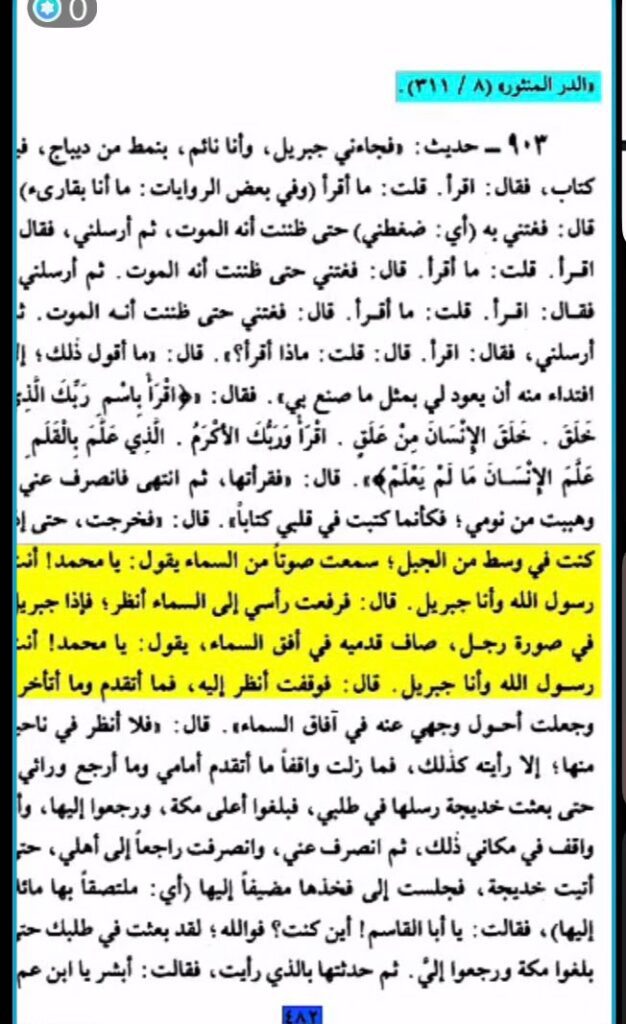
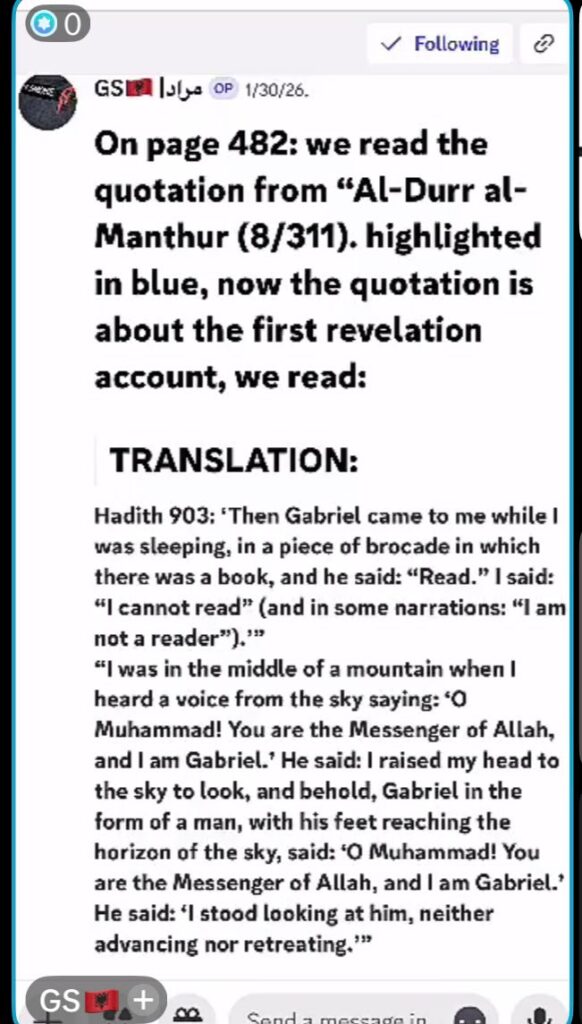
5. Source Three: al-Bayhaqī — Dalāʾil al-Nubuwwah
Al-Bayhaqī also preserves the direct wording in Dalāʾil al-Nubuwwah, in the chapter on the beginning of the mission and revelation. The report says the Prophet ﷺ heard a caller from the sky saying:
يا محمد أنت رسول الله وأنا جبريل
“O Muhammad, you are the Messenger of Allah, and I am Gabriel.”
It then describes him looking up and seeing Gabriel in the form of a man standing on the horizon, with the phrase repeated.
The route in al-Bayhaqī
Al-Bayhaqī transmits this through:
Abū ʿAbdillāh al-Ḥāfiẓ → Abū al-ʿAbbās Muḥammad b. Yaʿqūb → Aḥmad b. ʿAbd al-Jabbār → Yūnus b. Bukayr → Ibn Isḥāq → ʿAbd al-Malik b. ʿAbdillāh b. Abī Sufyān → some people of knowledge.
Then the narrative continues into the first revelation scene and the direct self-identification wording.
How strong is this source?
Al-Bayhaqī’s version is valuable because it shows the report was preserved in the dalāʾil literature — literature concerned with the signs and proofs of prophethood. However, its chain also contains sīrah-style features, including Ibn Isḥāq material and unnamed “people of knowledge” in part of the report. So again, this should not be described as a standalone ṣaḥīḥ chain.
Its value is cumulative: al-Bayhaqī preserves the same core wording and the same scene — the voice from the sky, Gabriel’s name, the horizon vision, and the Prophet’s fear — in a classical hadith-sīrah work devoted to the signs of prophethood.
6. Reading the Three Sources Together
The three sources should be read carefully.
They are not three independent ṣaḥīḥ chains. That would be an overstatement.
But they are also not nothing. They represent multiple classical source locations preserving the direct wording “I am Gabriel” in the same beginning-of-revelation scene.
The strongest way to describe them is:
Ibn Kathīr and al-Bayhaqī preserve the early Ibn Isḥāq / sīrah stream of the report, while al-Ṭabarī preserves a separate route through al-Zuhrī, ʿUrwah, and ʿĀʾishah, though with weakness because of al-Nuʿmān b. Rāshid. Together, these sources show that the wording “I am Gabriel” is early and widely preserved in classical sīrah and historical literature, even though it is not established as a standalone ṣaḥīḥ hadith.
That is the balanced strength.
7. The Evidence Is as Strong as Any in History
In historical study, a report becomes stronger when it is supported by several kinds of evidence at once: documentary evidence, early transmitted reports, multiple attestation, coherence with stronger sources, and the absence of rival explanations. This is the same kind of reasoning used in biblical studies and ancient history generally. Historians do not usually possess video, signed transcripts, or modern courtroom records. They weigh layers: a text, a remembered tradition, independent witnesses, later preservation, and whether the claim fits or conflicts with what is already established.
By that standard, the Gabriel identification is very strong. It has more than one kind of support. The Qur’an functions as the primary documentary layer, naming Gabriel as the one who brought revelation to the Prophet’s heart and preserving the horizon-vision language. Bukhārī provides the ṣaḥīḥ narrative frame: the encounter at Ḥirāʾ, Waraqah’s recognition of the being as al-Nāmūs sent to Moses, and the later reappearance of the same angel who first came at Ḥirāʾ. The sīrah and historical sources then preserve the direct wording: “O Muhammad, you are the Messenger of Allah, and I am Gabriel.”
This is comparable to how biblical and ancient historical claims are often evaluated. In New Testament studies, sayings and events are weighed by criteria such as multiple attestation, coherence, and embarrassment. In Greek and Roman history, many accepted details depend on later historians preserving earlier materials. In archaeology, inscriptions often confirm persons, offices, places, and settings, even when they do not preserve full conversations. Historical confidence usually comes from convergence, not from one isolated source.
That is why the direct phrase “I am Gabriel” should be treated as historically meaningful sīrah evidence. It is not a standalone ṣaḥīḥ hadith in the legal-grade sense, but it is not a weak isolated detail either. It is supported by Qur’anic identity, Qur’anic scene-setting, ṣaḥīḥ narrative structure, multiple classical preservations, and no competing early identification.
“O Muhammad, you are the Messenger of Allah, and I am Gabriel.”
The direct wording is supported by a broad structure:
Qur’anic identity.
Qur’anic horizon-vision frame.
Ṣaḥīḥ first-revelation scene.
Ṣaḥīḥ continuity of the same angel.
Multiple classical sīrah/historical preservations of the direct wording.
This is why the phrase should be treated as historically meaningful sīrah evidence, not as a weak isolated detail.
Conclusion
We must note that the muḥaddith labels “mursal” and “ḍaʿīf” are internal precision instruments — legal-grade standards developed to decide whether a report can establish law. No historiography on earth applies standards that strict to anything. A report that falls short of legal-grade ṣaḥīḥ can still tower over the evidence accepted without comment for nearly every fact of Greek and Roman history.
The Qur’an names Gabriel as the revealer. Bukhārī preserves the first-revelation encounter and Waraqah’s identification of the visitor as the Nāmūs sent to Moses. Bukhārī also confirms the later appearance of the same angel who came at Ḥirāʾ. The direct phrase “I am Gabriel” is then preserved in classical sīrah and historical sources, including Ibn Kathīr, al-Ṭabarī, and al-Bayhaqī.