Complete with Servant, Kedar, Sela, Tahlil, and Muslim––The Surrendered One
Isaiah 42 is one of the most striking chapters in the Hebrew Bible when read alongside the Islamic memory of Prophet Muhammad ﷺ. There is no need to force the text or turn every line into a debate point. The chapter carries its own atmosphere: a servant of God, a messenger, a law-bearing mission to the nations, gentleness of character, the opening of blind eyes, a new praise rising from the desert, the villages of Kedar named outright, the inhabitants of Sela called to shout from the mountaintops, the victory of God — and, standing in the middle of it all, a Hebrew title built on the same Semitic root as the word Muslim.
Read slowly, Isaiah 42 sounds less like a private devotional poem and more like the announcement of a public divine mission. And the world it points toward is the world of Arabia.
The Servant and Messenger
The chapter opens:
“Behold My servant, whom I uphold; My chosen, in whom My soul delights. I have put My Spirit upon him; he will bring forth justice to the nations.” — Isaiah 42:1
The figure is called God’s servant. He is upheld by God, chosen by God, strengthened by God, and sent by God. This is not the language of a man claiming divinity. It is the language of divine appointment — a servant commissioned with a mission to the nations.
This is why Muslims immediately recognize the category: ʿabduhū wa rasūluh — His servant and His messenger. It is the most basic description of Muhammad ﷺ in Islam, recited in every tashahhud of every prayer.
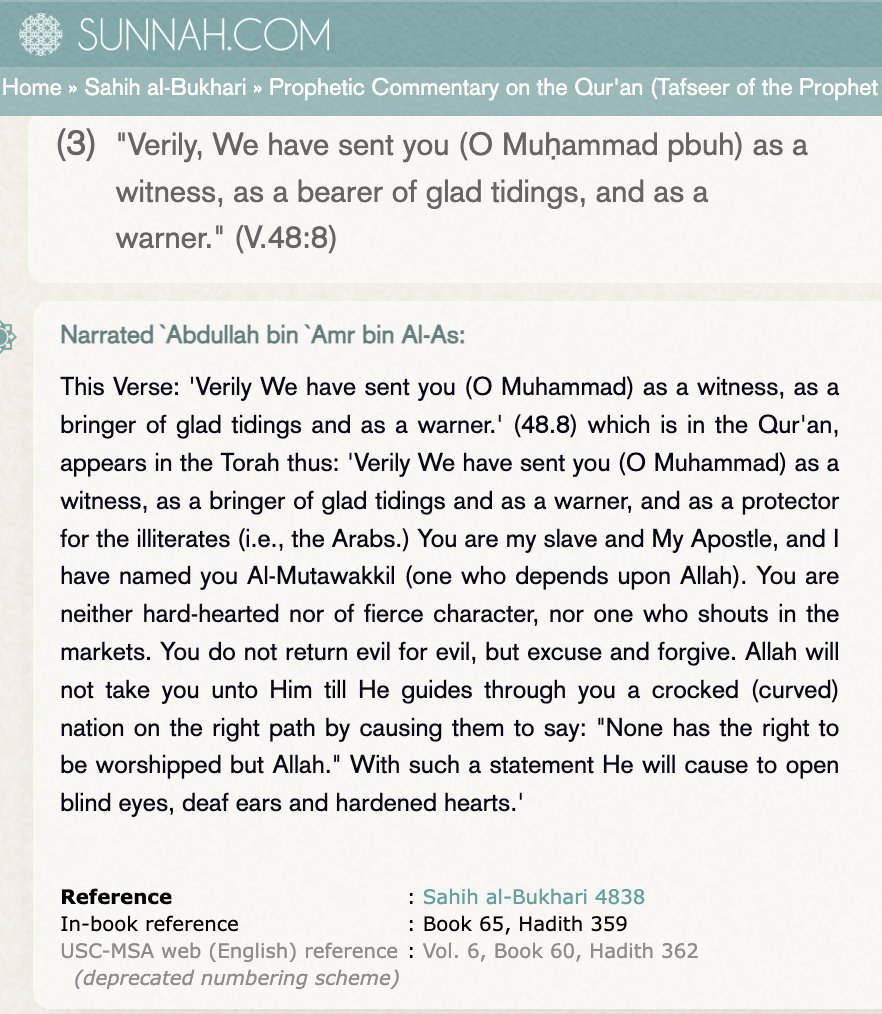
And it is precisely the profile preserved in early Muslim memory. When ʿAbdullāh ibn ʿAmr ibn al-ʿĀṣ — a companion known for reading the earlier scriptures — was asked how the Prophet ﷺ was described in them, he answered with God’s own address to His Prophet:
“You are My servant and My messenger. I have named you al-Mutawakkil” — sammaytuka al-Mutawakkil — the one who entrusts himself wholly to God — a witness, a bringer of glad tidings, and a warner; a protector of the unlettered; not harsh, not rude, not loud in the markets; not one who repays evil with evil, but one who pardons and forgives — and he would not be taken until, through him, a crooked people were made straight by declaring that none has the right to be worshipped but Allah, by which blind eyes, deaf ears, and covered hearts would be opened.
This report is in Ṣaḥīḥ al-Bukhārī (2125, 4838).
Now watch the first epithet.
Isaiah 42:1 in the Hebrew reads: hēn ʿavdī etmokh-bō — “Behold My servant, I uphold him.” The root t-m-k: to grasp, to support, to sustain, to hold up.
The hadith gives the Prophet’s ﷺ scriptural name as al-Mutawakkil: the one who leans his entire weight upon God.
These are the two faces of one embrace. Isaiah states the relationship from God’s side — I uphold him. The hadith states it from the servant’s side — he entrusts himself wholly to Me. A man can only be al-Mutawakkil if God is the one upholding him; “whom I uphold” and “the one who leans on Me” are the same fact spoken from opposite ends. And note what this proves about the hadith: it is not a translation of Isaiah. A forger copying Isaiah 42:1 would have produced the passive — the upheld one. Instead the tradition preserves the theological reciprocal of the Hebrew epithet — which is what an independent, authentic memory looks like, not a borrowing.
The Quran holds the two sides together in a single system: “And rely (tawakkal) upon the Ever-Living who does not die” (25:58); “Is not Allah sufficient for His servant?” (39:36) — sufficiency-language, upholding-language, attached to ʿabd, the same servant-title Isaiah opens with.
Al-Mustafa: The Chosen One
Isaiah also calls the servant “My chosen one” — bechiri. In Islam, this is the Prophet’s ﷺ own beloved name: al-Mustafa, the Chosen One.
Now set the rest of the portrait beside Isaiah:
“He will not cry aloud or lift up his voice, or make it heard in the street.” — Isaiah 42:2
The scripture says he does not lift his voice in the street. The hadith says he is not loud in the markets. This is not a vague overlap of general goodness. It is the same portrait, feature for feature: a servant and messenger of God, public in mission, gentle in speech, forgiving in temperament — and the instrument by which the blind are made to see.
“I will give you as a covenant for the people, a light for the nations, to open the eyes that are blind, to bring out the prisoners from the dungeon, from the prison those who sit in darkness.” — Isaiah 42:6–7
Through one declaration, an entire people’s eyes were opened:
لَا إِلٰهَ إِلَّا ٱللَّٰه Lā ilāha illā Allāh — There is no god worthy of worship except Allah.
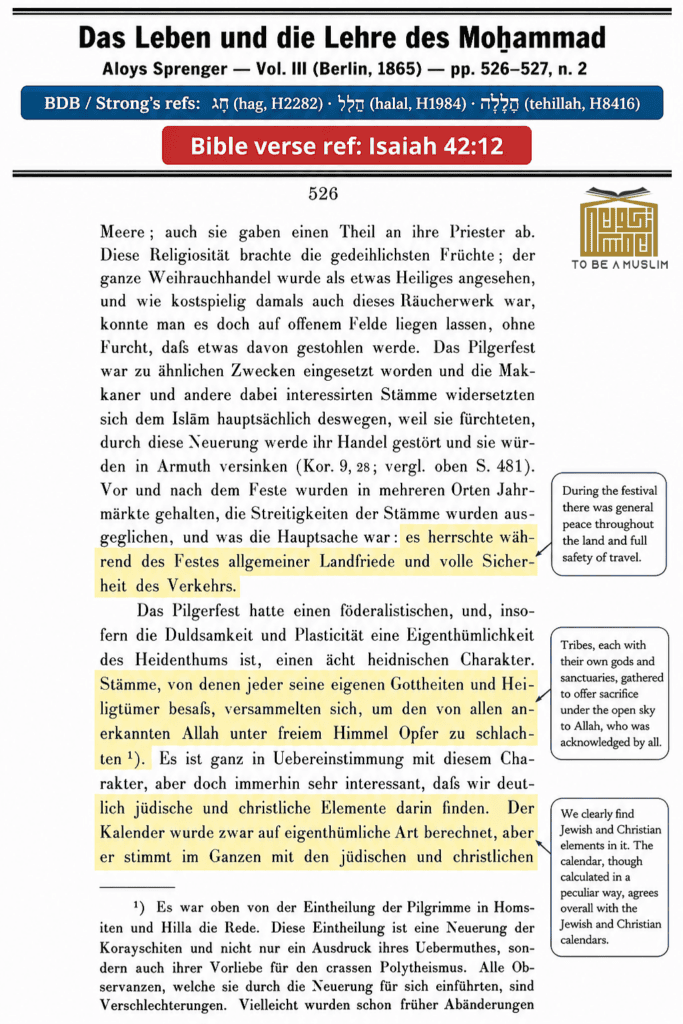
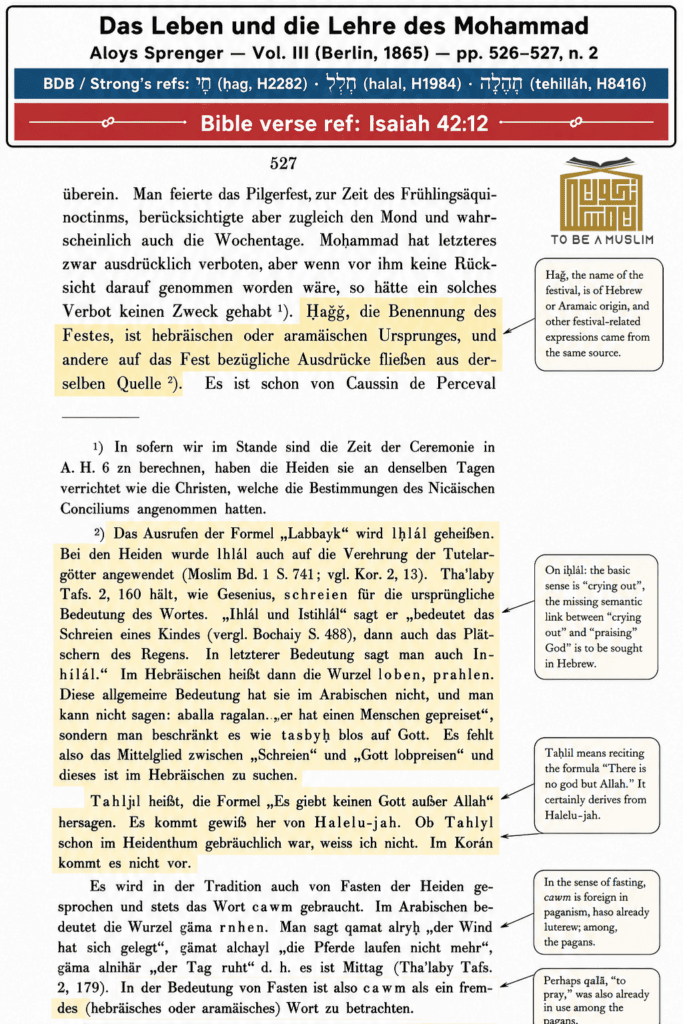
Even the Orientalist Aloys Sprenger — no friend of Islam — renders the Prophet’s earliest message in exactly this form in The Life of Mohammad: “There is no God but God.” That is the tahlīl. That is the sound of Arabia turning from idols to the worship of the One God.
The Law to the Nations
“He will faithfully bring forth justice. He will not grow faint or be discouraged till he has established justice in the earth; and the coastlands wait for his law.” — Isaiah 42:3–4
The word rendered “law” — torah in the Hebrew, meaning divine instruction — belongs here to the servant’s mission. The nations are waiting for it. This servant is not a local preacher of private piety. He carries a system: justice established in the earth.
Measure that against history. Muhammad ﷺ did not leave behind a sentiment; he left behind an order. Revelation, prayer, charity, fasting, family law, commercial ethics, criminal justice, treaties, rules of war, governance — a complete public order built around the worship of the One God, and carried within a generation to the coastlands and beyond. Isaiah’s servant establishes law among the nations. History records exactly one gentle, unlettered servant-messenger from the Ishmaelite world of whom that is literally true.
The New Song from the Desert
“Sing to the LORD a new song, His praise from the end of the earth.” — Isaiah 42:10
The Hebrew word for “His praise” is təhillātō — tehillah, praise, exaltation. The chapter demands something unprecedented: a new praise, from new regions, from peoples not yet singing. Arabic carries the same root, h-l-l, in tahlil: the declaration la ilaha illa Llah, as Sprenger documented i his 165 book, “Muhammad” as referenced in the BDB Hebrew lexicon entry for the term. The praise Isaiah commanded in Hebrew, Kedar’s descendants still shout in Arabic — same root, same mountaintops.
Then the geography stops being general:
“Let the wilderness and its cities lift up their voice, the villages that Kedar inhabits; let the inhabitants of Sela sing for joy; let them shout from the top of the mountains.” — Isaiah 42:11
Kedar: Arabia, Named
Kedar is a son of Ishmael. The Bible says so itself:
“These are the names of the sons of Ishmael… Nebaioth, the firstborn of Ishmael; and Kedar…” — Genesis 25:13
And the Bible locates Kedar’s descendants exactly where you would expect Ishmael’s line to be. Isaiah’s own oracle “concerning Arabia” names Kedar directly:
“The oracle concerning Arabia… the glory of Kedar will come to an end.” — Isaiah 21:13, 16
So this is not a Muslim identification imposed on the text. The Bible itself defines Kedar as Ishmaelite and places Kedar in Arabia. When Isaiah 42 summons the villages of Kedar to raise the new praise, the text is summoning the Arab, Ishmaelite world — by name.
And Isaiah returns to this theme. In the vision of the latter-day glory:
“All the flocks of Kedar shall be gathered to you… they shall come up with acceptance on My altar.” — Isaiah 60:7
Kedar does not merely exist in Isaiah’s future. Kedar worships in Isaiah’s future — accepted at God’s own altar. A sustained Isaianic expectation: Arabia entering the praise of God.
Muhammad ﷺ arose from precisely this world, and through him precisely this happened. The villages of Kedar lifted their voice. The wilderness cities — the desert settlements of the Hijaz — filled with praise. What was tribal idolatry became a civilization of tahlīl.
Sela: The Rock and the Mountain Cry
“Let the inhabitants of Sela sing for joy; let them shout from the top of the mountains.” — Isaiah 42:11
Sela means rock. Commentators — Cambridge among them — have long connected it with the rocky country south and southeast of Palestine, the region of Arabia Petraea. And Muslims cannot fail to notice that Mount Selaʿ stands inside Madinah itself — the mountain beside which the Prophet’s ﷺ community lived, prayed, and dug the Trench.
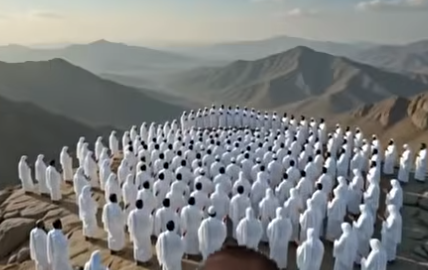
One need not press the identification to see the field the verse paints: wilderness, desert villages, Kedar, rock, mountains. Desert praise. Mountain praise. Arabian praise. Five times a day, for fourteen centuries, the call has gone up from the rooftops and minarets of that exact landscape: Allāhu Akbar. Lā ilāha illā Allāh. The inhabitants of the rock, shouting from the high places, exactly as the verse demanded.
The Man of War
Then the chapter shifts:
“The LORD goes out like a mighty man, like a man of war He stirs up His zeal; He cries out, He shouts aloud, He shows Himself mighty against His foes.” — Isaiah 42:13
Note carefully who the warrior is: the LORD, not the servant. The servant does not cry aloud in the street; God cries aloud against His foes. The servant is gentle; the victory is God’s.
This is not a tension in the chapter. It is the chapter’s architecture — and it is the exact architecture of the Prophet’s ﷺ mission. Patience in Makkah. Persecution endured without retaliation. Migration. Then, when God gave the command, victory that the Quran refuses to credit to human hands:
“You did not kill them, but Allah killed them. And you did not throw when you threw, but Allah threw.” — Surah Al-Anfal 8:17
The gentle servant, and the God who wars for him. Isaiah 42 holds both. So does the sīrah.
Meshullam: The Surrendered One
And then the chapter delivers its most remarkable word.
“Who is blind but My servant, or deaf as My messenger whom I send? Who is blind as the meshullam [מְשֻׁלָּם], blind as the servant of the LORD?” — Isaiah 42:19
Translators have wrestled with meshullam — and their wrestling is the evidence. Look at the renderings:
“he who is at peace with Me” — NASB, Darby “my covenant partner” — the NET/NIV tradition “he that is perfect” — KJV, Geneva “the dedicated one” — JPS Tanakh “the devoted one” — multiple modern versions
Peace with God. Covenant with God. Perfection. Dedication. Devotion. Every translation committee, working independently, lands inside one semantic field — and it is entirely a field of honor. Not one version renders meshullam as anything shameful.
The reference works say why. Brown-Driver-Briggs places meshullam under the root שׁ-ל-ם (sh-l-m): wholeness, soundness, peace, completeness. Ellicott’s Commentary gives the meaning as the devoted or surrendered one — and Ellicott, a Christian bishop writing a standard Victorian commentary, draws the comparison himself: to “Moslem” and “Islam” — the one resigned and surrendered to God. The Cambridge Bible for Schools and Colleges treats the term in the same field: the one standing in perfect surrender and peace toward God.
Now translate that meaning into Arabic. One who is whole with God, at peace with God, surrendered to God — from the root S-L-M. That is not like the definition of a Muslim. That is the definition of a Muslim. The Hebrew sh-l-m and the Arabic s-l-m are the same Proto-Semitic root in sister tongues — exactly as shalom is salaam. Meshullam is the Hebrew cognate of Muslim. A Christian bishop said as much in print, with no Muslims in the room.
Surrender to God is not an Arabian innovation. It is the oldest covenant category there is. Islam did not import it into biblical religion. Islam is what it is called.
Blind Like the Muslim: The Servant Who Sees Only God
Now read the verse again, and let the translations mean what they say.
“Who is blind as he who is at peace with Me? Who is blind as My covenant partner? Blind as the perfect one, blind as the servant of the LORD?”
If blindness here were simply condemnation, these sentences would collapse. You cannot say “who is as defective as My perfect one, as estranged as the one at peace with Me.” The translators’ own honorifics force the question: what kind of blindness belongs to the one at peace with God?
Only one kind. Elective blindness. Blindness to everything except God.
Read this way, Isaiah 42:19 is not an insult — it is a superlative, cast in the same rhetorical mold as “Who is like You among the gods?” (Exodus 15:11). Who is blind like My servant? — meaning: who else has attained it? Who has so completely shut his eyes to the world — to means, to wealth, to fear, to insult, to everything that is not his Sender — that he can be called blind to all but God?
The Hebrew Bible itself describes this blindness as the posture of the righteous. David, under attack, in Psalm 38: “I am like the deaf, I do not hear; like the mute who opens not his mouth… For in You, O LORD, I hope; You will answer.” Deaf to abuse — because his trust is in God. And Isaiah’s servant again in chapter 50: struck, spat upon, and unmoved — “for the Lord GOD helps me… I have set my face like flint.” Eyes of flint: seeing nothing but the commission.
And watch the chapter’s own grammar. Verse 18 commands the audience: “Hear, you deaf; look, you blind, that you may see!” Verse 20 indicts them: “You have seen many things, but you do not observe them.” Their blindness is refusal — eyes open, heart shut. But between those two verses stands the servant, whose blindness is the opposite: eyes shut to the world, heart open to God. Two blindnesses, opposite directions. The disobedient blind are told to look at the devoted blind one and learn to see.
Now bring back the servant’s name from the hadith.
Al-Mutawakkil. The one who leans his whole weight on God. The one named in Bukhari as God’s servant and messenger, whom Isaiah 42:1 says God upholds — and the one whose blindness Isaiah 42:19 exalts, because the man upheld entirely by God looks at nothing else.
This was Muhammad ﷺ, described to the letter. At Taif, bleeding, offered the destruction of his attackers, and blind to the offer — praying instead for their descendants. Deaf for a decade to “poet, madman, sorcerer” — the hadith says it plainly: he does not repay evil with evil, but pardons and overlooks — and the Arabic for overlooking, ṣafḥ, literally means turning the face away: choosing not to see the offense. The Quran commanded exactly this blessed blindness and named its mechanism: “Be patient over what they say, and avoid them with gracious avoidance” (73:10); “Rely upon Allah — and sufficient is Allah as Disposer of affairs” (33:48, wa-tawakkal ʿalā Allāh). Deaf to what they say. Blind to all but God. Leaning wholly on the Wakīl.
So the chapter’s epithets now lock together as one portrait, spoken from three directions:
ʿAvdī — My servant — ʿabdī wa rasūlī. Etmokh-bō — whom I uphold — al-Mutawakkil, who leans on Me. ʿIwwēr… meshullam — blind, the surrendered one — blind like the Muslim: the one so surrendered to God that the world calls him blind, and God calls him perfect, at peace, Mine.
Isaiah 42:1 and Isaiah 42:19 are not two servants, and not a commission followed by a rebuke. They are the same servant seen from God’s side, from the servant’s side, and from the world’s side. The world looks at total tawakkul and calls it blindness. Isaiah lets the world say the word — and then asks it a question the world still cannot answer: who else is blind like him?
The Picture Isaiah 42 Leaves Behind
Put the whole chapter back together and read it as one statement.
God’s servant and chosen messenger — whom I uphold: al-Mutawakkil, the one who leans his whole weight on God. Gentle — no shouting in the streets, no breaking the bruised reed. Yet global — justice and divine law established in the earth, the coastlands waiting. A light to the nations, opening blind eyes, freeing the prisoners of darkness. A new praise — a new tehillah — rising from the ends of the earth: from the wilderness and its cities, from the villages of Kedar, son of Ishmael, from the rock, shouted from the mountaintops. God Himself going forth as a man of war to give the mission victory. And embedded in the chapter’s own vocabulary, the identity that binds it all: meshullam — the surrendered one — blind like the Muslim, blind to everything but God.
The servant is not worshipped as God. He serves God. He calls to God. He sees nothing but God. He brings people out of darkness by God’s permission. He establishes the praise of God where idols once stood.
Isaiah 42 names the world (Kedar), the landscape (the desert, the rock, the mountains), the mission (law and light to the nations), the character (the gentle servant-messenger, upheld by God and leaning wholly upon Him), the praise (a new song from the ends of the earth), and the identity (the surrendered one, blind to all but God).
And from the villages of Kedar, the new praise rose — and has never stopped:
لَا إِلٰهَ إِلَّا ٱللَّٰه
Lā ilāha illā Allāh. There is no god worthy of worship except Allah.