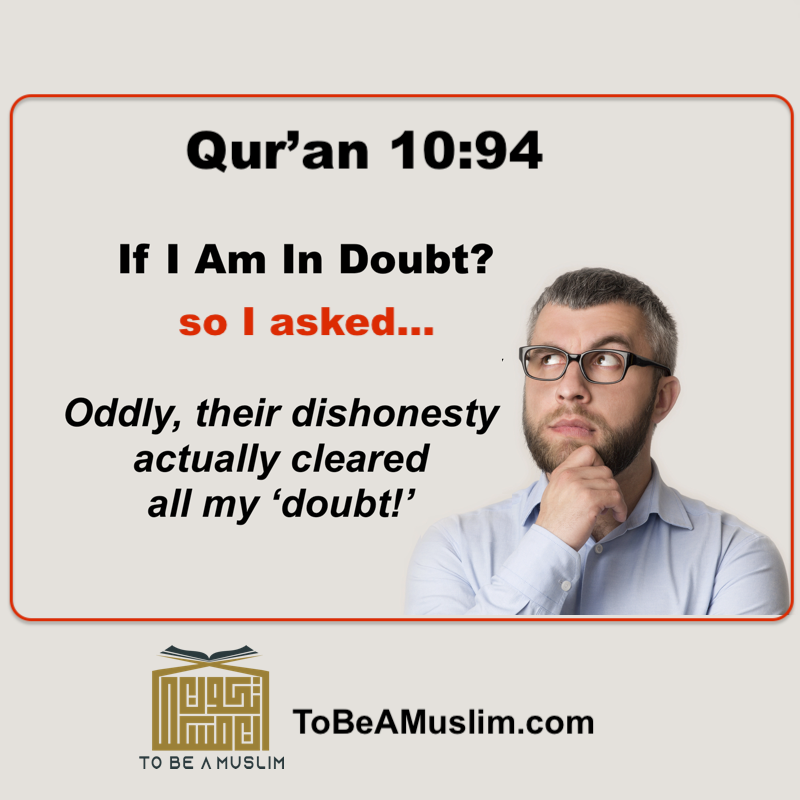
Does the Qur’an Forbid Doubt? A Closer Look at Surah Yunus 10:94
One of the most cited verses in Christian apologetic critiques of Islam is Qur’an 10:94:
“So if you are in doubt about what We have revealed to you, then ask those who have been reading the Scripture before you. The truth has certainly come to you from your Lord, so never be among the doubters.“
The standard polemical reading runs like this: the Prophet ﷺ was told to consult Jews and Christians to verify his revelation; therefore the Qur’an depends on the Bible for its authority; therefore the Qur’an is suspect. A closer reading of the Arabic and the classical exegesis dissolves this reading entirely — and recovers a principle about how truth resolves doubt that the verse encodes far more deeply than translators allow.
The verse does not say “don’t doubt”
English translators have flattened two completely different Arabic words into the single English word doubt. The first half of the verse uses شَكّ (shakk) — from the root ش-ك-ك — meaning internal uncertainty, the natural state of a sincere mind weighing a claim. The second half uses مُمْتَرِين (mumtarīn) — from the root م-ر-ي, an entirely different root meaning to dispute, to contend, to wrangle against.
These are not synonyms. They are different mental states. Shakk is passive uncertainty. Imtirāʾ (the verbal noun of mumtarīn) is active hostility to established truth. The Arabic dictionaries are unanimous: Lane’s Lexicon defines imtirāʾ as “the act of being in dispute about a thing, contending with another, especially with the implication of contentious wrangling against truth.”
The verse, read correctly, says: if you are in doubt (shakk), ask. The truth has come. Do not become a disputer (mumtarī) against it. It permits doubt. It commands inquiry. It forbids only the active wrangling that refuses to engage with what becomes clear.
What the classical exegesis says
Ibn Kathir in his commentary on Q 10:94 notes that the Prophet ﷺ himself was never in doubt — the verse is rhetorical, addressed through him to the broader community. He identifies “those who have been reading the Scripture before you” as early figures like ʿAbdullāh ibn Salām, the former chief rabbi of Banu Qaynuqa who recognized the Prophet ﷺ on first sight and confirmed the Qur’an’s truth upon inquiry. The verse does not direct seekers to certified theologians or flawless authorities. It directs them to anyone with relevant exposure to prior revelation.
Ibn Kathir on Q 6:114 explicitly extends the mumtarīn prohibition to “the Book sent down in truth, explained in detail” — the entire Qur’an, not a subset of stories. The same applies in his commentary on Q 11:17. The defensive interpretation sometimes offered — that this all refers only to “the historical narratives” — is read into the verse, not out of it. The Arabic mā anzalnā ilayka (“what We have revealed to you”) uses the universal relative mā, encompassing the entire revelation.
The diagnostic question
When Christian apologists deploy 10:94 against the Qur’an, the position they implicitly hold is that any flaw in a source disqualifies it from removing rational doubt. The question that exposes this assumption is simple:
Do flaws in a source necessarily mean it cannot remove rational doubt?
If the answer is yes, the position collapses into global skepticism. The Gospels have textual variants and disputed passages. History books contain errors. Every scientific paper has methodological limitations. Eyewitness testimony is imperfect. Human memory is flawed. By the universal principle, none of these can remove any rational doubt about anything. The position refutes itself, the Bible, history, science, and the speaker’s own existence.
The moment they qualify the position — “certain kinds of flaws,” “certain degrees of corruption” — they have conceded the answer is no. Flaws do not necessarily prevent doubt-removal. And once that is conceded, the argument against Q 10:94 has already disarmed itself.
The principle the verse encodes
Doubt is not solved by the quality of the answerer. It is solved by the act of asking.
Truth, once it has come, emerges through any sincere encounter:
- A wise answer resolves doubt by its wisdom
- A foolish answer resolves doubt by the contrast its foolishness draws
- A hostile answer reveals what truth is being avoided
- A confused answer sharpens what is not confused
- Even a dishonest answer, once examined, points toward what is honest
The verse commands fa-sʾal — ask — without specifying the wise, the perfect, or the certain. The method itself does the work, not the perfection of the interlocutor. A sincere seeker finds the answer in any encounter, because truth’s reality is what radiates through every contact with it. This is why the Qur’an is so confident in its instruction: it does not depend on the inquirer encountering a flawless responder. It depends only on the inquirer being willing to engage.
What the verse actually does
- It permits honest doubt (shakk) across the entire revelation, not a subset
- It commands inquiry (fa-sʾal) without restriction on the source
- It forbids only active disputation (imtirāʾ) against truth that has become clear
Honest doubt is permitted. Honest inquiry is commanded. The truth itself does the resolving. The Qur’an’s structure of knowing is open to inquiry in any direction — because truth is what radiates through every sincere contact with it. The polemical reading of 10:94 not only misses this; it inverts it. Far from being an embarrassment for Islam, the verse encodes a more confident epistemology than the apologists who deploy it possess themselves.
The two Arabic words in this verse — shakk and mumtarīn — make a precise distinction that English translation flattens. Recovering the distinction recovers the verse. The Qur’an does not forbid doubt. It honors honest doubt, commands honest inquiry, and trusts the truth itself to do the resolving.