This argument is not against the Sunnah. It is not against the salaf. It is not against clarifying one’s creed when clarification is genuinely needed.
The argument is against turning any name — “Salafi,” “Sunni,” “Ahl al-Ḥadīth,” or anything else — into a sectarian badge, a loyalty test, a superiority slogan, or a tribe.
Allah named us Muslims. The Prophet ﷺ warned against factional calls. The scholars distinguished between following the truth and turning names into party-identities.
The balanced position is simple:
Follow the Sunnah. Follow the salaf. But do not turn a descriptive name into a sectarian identity by which Muslims are loved, hated, ranked, dismissed, or declared outside the truth.
1. Allah gave the Ummah its primary name
Allah says:
هُوَ سَمَّاكُمُ ٱلْمُسْلِمِينَ مِن قَبْلُ وَفِي هَـٰذَا
“He named you Muslims before and in this.”
— Qur’an 22:78
The foundational name of this Ummah is not an invented label. It is not tribal. It is not later. It is not a party-brand. It is divine. Allah Himself named the believers Muslims.
That is why the Qur’an gives this as the clean self-identification of the caller to Allah:
إِنَّنِي مِنَ ٱلْمُسْلِمِينَ
“Indeed, I am of the Muslims.”
— Qur’an 41:33
The best speech is to call to Allah, do righteousness, and say: I am of the Muslims. Not: I am of my faction. Not: I am of my slogan. Not: I am of my camp.
2. The Qur’an condemns sectarian splitting
Allah says:
“Indeed, those who divided their religion and became sects — you have nothing to do with them in anything.”
— Qur’an 6:159
The warning is severe. The Prophet ﷺ is told that those who turn religion into sectarian fragmentation are not upon his way in that matter.
Allah also says:
“Do not be among those who split their religion and became sects, each party rejoicing in what it has.”
— Qur’an 30:31–32
The phrase is devastating:
كُلُّ حِزْبٍ بِمَا لَدَيْهِمْ فَرِحُونَ
“Each party rejoicing in what it has.”
This is the psychology of sectarian religion: my group, my saved circle, my superior label, my people, my camp.
And Allah says:
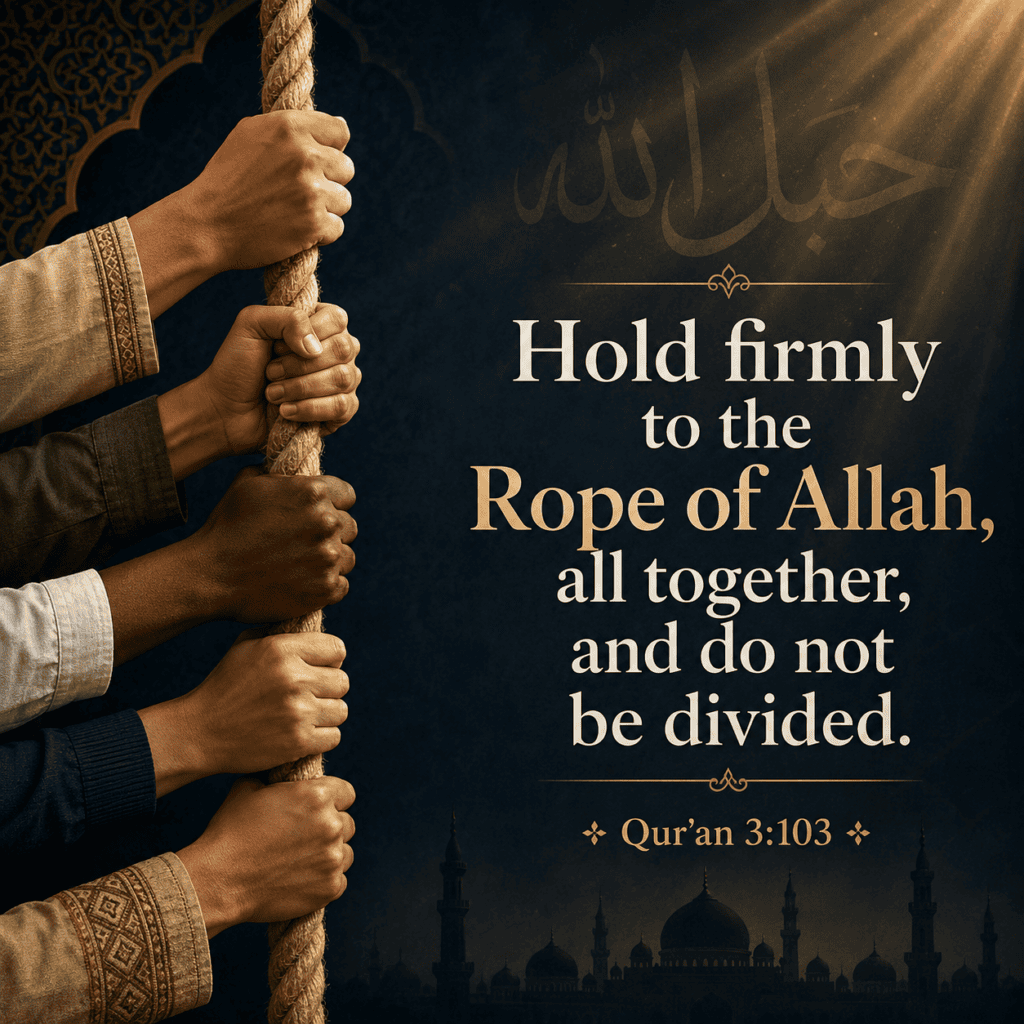
“Hold firmly together to the rope of Allah, and do not be divided.”
— Qur’an 3:103
So the Qur’anic cure for confusion is not to invent sharper party-identities. The cure is to hold to Allah’s rope together and avoid division.
3. The Prophet ﷺ returned the Ummah to the names Allah gave
In the ḥadīth of al-Ḥārith al-Ashʿarī, the Prophet ﷺ said:
“Whoever calls with the call of Jāhiliyyah is from the coals of Hell.”
A man asked: even if he prays and fasts?
The Prophet ﷺ said:
“Even if he prays and fasts. So call with the call that Allah named you with: Muslims, believers, servants of Allah.”
This narration is recorded in Jāmiʿ al-Tirmidhī 2863 and graded ṣaḥīḥ in the commonly circulated Darussalam/Sunnah.com presentation.
The point is not that Muslims may never use any descriptive term. The Companions themselves had names like Muhājirūn and Anṣār. The point is that when names become factional calls, the Prophet ﷺ directs the Ummah back to the names Allah gave: Muslims, believers, servants of Allah.
4. Even noble names become rotten when weaponized
The clearest example is the incident of the Muhājirūn and Anṣār.
A man from the Muhājirūn and a man from the Anṣār had a conflict. One cried out, “O Muhājirūn!” and the other cried out, “O Anṣār!” The Prophet ﷺ heard this and said:
“What is this call of Jāhiliyyah?”
Then he said:
دَعُوهَا فَإِنَّهَا مُنْتِنَةٌ
“Leave it, for it is rotten.”
This is recorded in Ṣaḥīḥ al-Bukhārī 4905.
This is decisive because “Muhājirūn” and “Anṣār” are not false names. They are Qur’anic, noble, and historically real. But when they were used as factional rallying cries, the Prophet ﷺ called that usage rotten.
So the principle is clear:
A name may be true in origin but false in function.
A name may be noble in meaning but rotten when weaponized.
That applies directly to “Salafi,” “Sunni,” “Ahl al-Ḥadīth,” or any other label when it becomes a party-banner.
5. Imam Mālik: Ahl al-Sunnah are not known by sectarian labels
Imam Mālik was asked about Ahl al-Sunnah. He reportedly answered:
أهل السنة الذين ليس لهم لقب يعرفون به، لا جهمي، ولا قدري، ولا رافضي
“Ahl al-Sunnah are those who have no label by which they are known: not Jahmī, not Qadarī, not Rāfiḍī.”
This statement is cited from Imam Mālik in discussions of Ahl al-Sunnah and sectarian labels.
The point is powerful. “Ahl al-Sunnah” was not meant to be a tribal slogan. It meant the people who remained upon the Prophetic way without becoming a deviant sect known by its factional label.
So if “Sunni” itself becomes a badge of boasting, contempt, or exclusion, then the label has been inverted. It is no longer serving the Sunnah. It is serving factional ego.
The argument is not: “Never say Sunni.” That is too crude.
The stronger argument is:
“Sunni” may be used as clarification. But it must not become a tribe.
6. Ibn Taymiyyah: do not build loyalty and hostility around invented standards
Ibn Taymiyyah gave the governing principle with great clarity:
وليس لأحد أن ينصب للأمة شخصًا يدعو إلى طريقته ويوالي ويعادي عليها غير النبي ﷺ، ولا ينصب لهم كلامًا يوالي عليه ويعادي غير كلام الله ورسوله وما اجتمعت عليه الأمة…
Meaning:
“It is not for anyone to set up for the Ummah a person, other than the Prophet ﷺ, calling to his way and basing loyalty and hostility upon it; nor to set up speech, other than the speech of Allah and His Messenger and what the Ummah has agreed upon, as a basis of loyalty and hostility.”
He then says this is from the way of the people of innovation, who divide the Ummah around a person, statement, or affiliation.
This is the heart of the issue.
The problem is not the word “salaf.” The problem is when an affiliation becomes the basis of walāʾ and barāʾ — loyalty and hostility, acceptance and rejection, praise and blame.
Ibn Taymiyyah also allowed manifesting the way of the salaf, because the way of the salaf is true. So his position is balanced:
Manifesting the way of the salaf is acceptable.
Turning an ascription into a factional loyalty-system is condemned.
That distinction destroys both extremes.
7. Ibn ʿUthaymīn: partisan Salafiyyah is against Salafiyyah
Shaykh Ibn ʿUthaymīn gave one of the clearest modern statements on this issue.
He explained that Salafiyyah, in its correct meaning, is following the methodology of the Prophet ﷺ and his Companions. But then he warned against turning Salafiyyah into a special partisan identity:
وأما اتخاذ السلفية كمنهج خاص ينفرد به الإنسان، ويضلل من خالفه من المسلمين ولو كانوا على حق، واتخاذ السلفية كمنهج حزبي فلا شك أن هذا خلاف السلفية
Meaning:
“As for taking Salafiyyah as a special methodology by which a person distinguishes himself and declares misguided whoever differs with him from the Muslims, even if they are upon truth, and taking Salafiyyah as a partisan methodology — there is no doubt that this is contrary to Salafiyyah.”
This is from Liqāʾ al-Bāb al-Maftūḥ, no. 57.
This quote is extremely important because Ibn ʿUthaymīn is not attacking the salaf. He is not attacking the Sunnah. He is defending real Salafiyyah from fake Salafi partisanship.
His point is clear:
True Salafiyyah follows the Prophet ﷺ and the Companions.
False Salafiyyah turns the name into a party, then declares other Muslims astray through that party-identity.
That is not Salafiyyah. That is hizbiyyah wearing Salafi clothing.
8. Even pro-label scholars limit the label
Some scholars allowed saying “Salafi” when it is needed for clarification. But even this permissive position does not support using the label as self-praise, branding, or tribal identity.
Shaykh Ṣāliḥ al-Fawzān was asked whether saying “I am Salafi” is self-praise. He answered that if a person says it to praise himself, it is not allowed. But if he says it for clarification because he is among opposing groups and wants to clarify that he is upon the way of the salaf, then that is acceptable.
So even the permissive answer admits the key distinction:
Clarification when needed is one thing.
Self-praise and branding are another.
Shaykh al-Albānī also argued that merely saying “Muslim” may not clarify enough in a time when many sects claim Islam. But his argument was contextual: the additional description is for clarification in a confused environment, not a replacement of the divine name “Muslim,” and not a license for factional arrogance.
Therefore, even the pro-label side does not prove that Muslims should turn “Salafi” into a tribe. At most, it proves that a descriptive clarification may be used when needed.
9. The correct distinction
The issue is not whether the salaf should be followed. They should.
The issue is not whether the Sunnah should be followed. It must.
The issue is not whether a Muslim may clarify his creed when people are confused. He may.
The issue is this:
Has the label become a tribe?
Has it become a superiority badge?
Has it become a weapon?
Has it become the standard by which Muslims are loved, hated, ranked, mocked, or dismissed?
If yes, then the label has crossed from clarification into hizbiyyah.
That is exactly what the Qur’an condemns. That is what the Prophet ﷺ corrected. That is what Ibn Taymiyyah warned against. That is what Ibn ʿUthaymīn rejected when he condemned partisan Salafiyyah as contrary to Salafiyyah itself.
Final word
Allah named us Muslims.
The Prophet ﷺ told us to call with the names Allah gave: Muslims, believers, servants of Allah.
He condemned even noble names like Muhājirūn and Anṣār when they became factional cries.
The scholars allowed clarification when needed, but condemned turning names into loyalty-systems, superiority badges, and party-identities.
So say it plainly:
Follow the salaf.
Follow the Sunnah.
But do not turn “Salafi” or “Sunni” into your tribe.
Allah named you Muslim — and the Prophet ﷺ was not sent to found slogan-gangs.