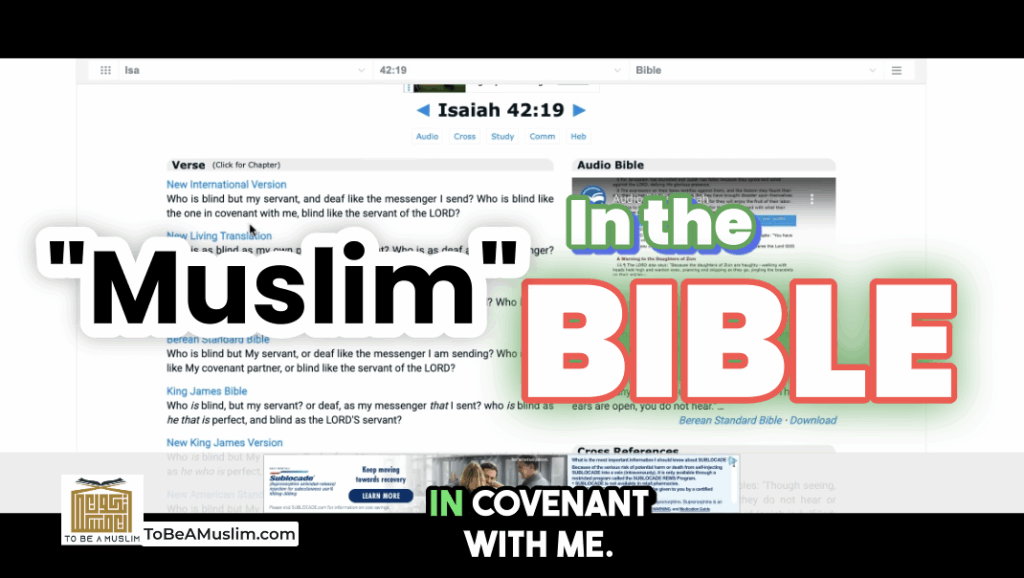
In Isaiah 42:19, the Hebrew text uses a word that is linguistically tied to the same Semitic root that produces the Arabic words Islam and Muslim.
Isaiah 42:19 in Hebrew
The verse reads:
“Who is blind but My servant, or deaf as My messenger whom I send? Who is so blind as he that is meshullam, or so blind as the servant of the LORD?”
The highlighted word is מְשֻׁלָּם (meshullam). See in Hebrew
Meaning of Meshullam
- Root: From the Hebrew verb שָׁלַם (shalam)
- Form: Pual participle — meaning “one who is surrendered, devoted, completed”
- Lexical definitions:
- Brown-Driver-Briggs: “devoted, surrendered one”
- Strong’s Concordance (#4918): derived from shalam, “to be complete, safe, surrender”
Shared Semitic Root
The root Š-L-M is common across Semitic languages:
| Language | Word | Meaning |
|---|---|---|
| Hebrew | שָׁלוֹם (shalom) | peace |
| Aramaic | שְׁלָם (shelam) | peace, prosperity |
| Arabic | سَلَام (salaam) | peace |
| Arabic | إِسْلَام (Islam) | submission, surrender |
| Arabic | مُسْلِم (Muslim) | one who submits |
Thus, Hebrew meshullam and Arabic Muslim are directly related: both mean “the one who is surrendered/submitted.”
Biblical Commentators
- Ellicott’s Commentary: “The Hebrew meshullam is connected with the modern Moslem and Islam — the man resigned to the will of God.”
- BDB Lexicon: confirms meshullam as a participle meaning “surrendered one.” See Strong 7999
Context in Isaiah
In Isaiah 42, God addresses His “servant” — a title applied collectively to Israel. When the verse describes them as meshullam, it portrays them as “the surrendered ones.”
This is the only place in the Hebrew Bible where the Š-L-M root is used in this way, describing the people of God collectively by their posture of surrender.
Theological Significance
- In Hebrew Scripture: Israel is called meshullam — those surrendered to God.
- In Arabic: Muslim means exactly that — one who submits to God.
- Both traditions reflect the same ancient Semitic idea: a true believer is defined not by race or ritual, but by submission to divine will.
Finally
The word “Muslim” itself does not appear in English Bibles, but in the Hebrew of Isaiah 42:19 the related term meshullam is right there: a designation for God’s people as “the surrendered ones.”
This shows that the concept of being Muslim — one who submits to God — is not foreign to the Bible, but is rooted in the same Semitic language family and theological framework.
Sources:
- Ellicott’s Commentary for English Readers
- Brown-Driver-Briggs Hebrew Lexicon
- Strong’s Exhaustive Concordance
- Masoretic Hebrew Text
- Comparative Semitic Linguistics