At a Glance
- The Qur’anic datum is primary: Q 37:130 preserves Ilyāsīn and the canonical reading Āl Yāsīn, “the House of Yāsīn.” The later patronymic Ilyās ibn Yāsīn belongs to historical transmission, not to the wording of the Qur’an itself.
- The passage explicitly identifies Elijah’s God as Allah: immediately after rejecting Baʿl, Q 37:126 names the One whom Ilyās calls his people back to as Allāha rabbakum wa-rabba ābāʾikumu al-awwalīn—“Allah, your Lord and the Lord of your earliest forefathers.” The Qur’an thus presents Allah not as a new Arabian deity, but as the God already worshipped by the ancestors of Elijah’s Israelite audience.
- Later reports preserve three Aaronide genealogies: one with Yāsīn, one with no intervening name, and one with Yashīn—written with shīn and without the alif of Yāsīn.
- Hebrew independently attests Y-Š-N in two registers: Yāšēn as an apparent personal or ancestral designation in 2 Samuel 23:32, and Yeshanah as a Northern Kingdom town beside Bethel in 2 Chronicles 13:19.
- The geography coheres without proving derivation: Phinehas, Bethel, Ephraim, Yeshanah, and Elijah’s Baal confrontation all belong to the same broad northern Israelite setting, but no surviving source directly connects Yeshanah with Elijah.
- Elijah’s genealogy was open in ancient tradition: Jewish and Christian sources variously made him a Gadite, a Benjamite, Phinehas himself, or an Aaronide with a named father.
- The decisive datum is Yashīn: if early manuscripts consistently preserve يشين with deliberate vocalization, it becomes more difficult to explain as a simple development from the familiar Qur’anic spelling ياسين.
- The conclusion is convergence, not identification: the Yāsīn/Yashīn genealogy may preserve a reworked Y-Š-N tradition associated with Elijah’s northern Israelite setting, but the historical connection is not yet demonstrable.
Abstract
Sūrat al-Ṣāffāt introduces the prophet Ilyās in conflict with the worship of Baʿl and closes his account with the extended or differently segmented form Ilyāsīn / Āl Yāsīn — “Peace be upon Ilyāsīn,” canonically read in another transmission as “Peace be upon the House of Yāsīn.” The Quranic attestation is the primary and controlling datum in the Arabic evidence, canonically transmitted in two recognized readings rather than produced by ordinary scribal drift. Later historical transmission preserves three different Aaronide genealogies: Ilyās ibn Yāsīn ibn Finḥāṣ, attributed to Ibn Isḥāq; a chain attributed to Wahb with no intervening name; and Ilyās ibn Yashīn — with shīn — attributed to Ibn al-Munādī. The Hebrew Bible independently attests Y-Š-N both as an apparent personal or ancestral designation (Yāšēn, 2 Sam 23:32) and as Yeshanah, a Northern Kingdom town beside Bethel (2 Chr 13:19). This is a convergence argument, not an identification. The unresolved question is whether the biblical and Arabic name evidence is historically connected rather than independently similar. No presently identified extra-Quranic witness supplies that connection directly.
1. Categories
Two categories of Arabic evidence must never be blurred. The Quranic attestation — Ilyāsīn (Ḥafṣ) / Āl Yāsīn (Nāfiʿ through Warsh and Qālūn; Ibn ʿĀmir) — is primary and controlling; within the Islamic framework it is revelatory and is never described as having “entered” any tradition. The genealogical interpretation — Ilyās ibn Yāsīn — belongs to later historical transmission attributed to named transmitters, open to source criticism, manuscript comparison, and comparative onomastics. Yashīn is a textual variant within the transmitted genealogy, potentially the most important single datum in the historical file, pending manuscript control.
2. The Quranic Attestation
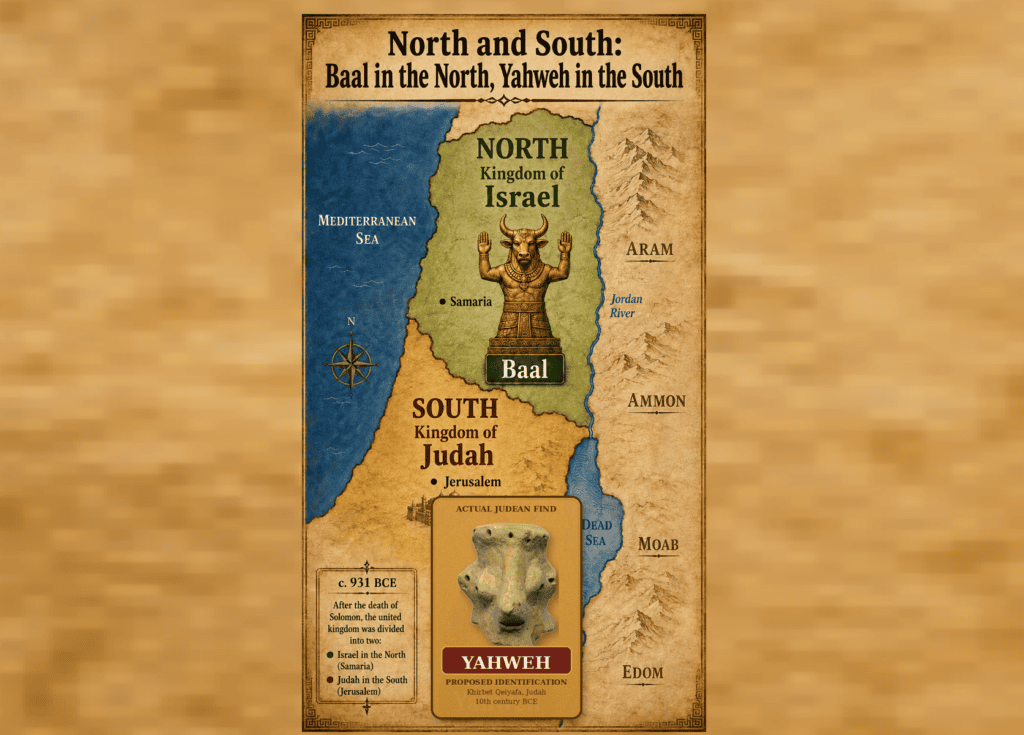
Q 37:123–130 sets Ilyās against Baʿl. The explicit naming of Baʿl unmistakably evokes the signature confrontation of the biblical Elijah cycle in the Northern Kingdom — his defining setting, though not the Bible’s only Baal opposition (Gideon, Jehu, Hosea). The Samaria ostraca independently corroborate that setting, preserving Baal-theophoric and Yahwistic personal names side by side among Israelites of that kingdom.
The account introduces the prophet as Ilyās; the closing salutation employs Ilyāsīn, canonically read in another transmission as Āl Yāsīn. The Āl Yāsīn reading grammatically presupposes Yāsīn as a proper-name form following āl, “house/family,” but does not by itself identify the bearer — exegetes variously understood the house of Ilyās, his followers, or the family of Muḥammad. The patronymic interpretation is first recoverable in the surviving later historical transmission. The reported Ibn Masʿūd form Idrāsīn supplies additional evidence of early interpretive or recitational variation surrounding the extended closing form; it admits at least two interpretations — a structural element retained under substitution of the prophet’s name, or rhyme-based adaptation to the surah’s -īn cadence — neither presently established.
3. The Later Historical Transmission
Ibn al-Jawzī’s al-Muntaẓam preserves three genealogical forms together:
- Ibn Isḥāq (d. 767): Ilyās ibn Yāsīn ibn Finḥāṣ ibn al-ʿAyzār ibn Hārūn — one early attributed stream with later textual witnesses (al-Ṭabarī, Ibn al-Jawzī), not multiple independent attestations.
- Wahb (d. c. 730): Ilyās ibn al-ʿĀzar ibn al-ʿAyzār ibn Hārūn — no intervening name; the doubled Eleazar-like forms themselves require explanation.
- Ibn al-Munādī (d. 947): Ilyās ibn Yashīn ibn al-ʿĀzar ibn Hārūn — with Ibn al-Jawzī’s note, naqaltuhu min khaṭṭihi wa-ḍabṭihi, “I copied it from his handwriting and his vocalization.” This authenticates the reading attributed to Ibn al-Munādī’s copy, not the genealogy itself; it does present Yashīn as a deliberately read form.
The written forms differ materially: يشين changes sīn to shīn and lacks the alif of ياسين. It cannot be produced by a single redotting operation alone, though omission plus redotting, orthographic fluctuation, corruption, correction, or a genuinely distinct inherited form all remain possible. Arabic Yashīn and Hebrew Yāšēn share an exact consonantal correspondence — Y-Š-N — and a broadly comparable bisyllabic shape; the vocalizations are not identical.
Every chain is Aaronide; two separately attributed forms place a Y-S/Š-N-shaped ancestor directly behind Ilyās. The middle position fluctuates — absent / Yāsīn / Yashīn — consistent with an unstable or open genealogical position, without by itself explaining how the forms arose. Ibn al-Munādī’s chain also omits Finḥāṣ, a structural divergence that may indicate a distinct source, abbreviation, or textual loss and therefore requires explanation. Until his independence from the Ibn Isḥāq stream is established, Yāsīn and Yashīn are two separately attributed forms, not two proven independent attestations.
4. Biblical Y-Š-N Precedence
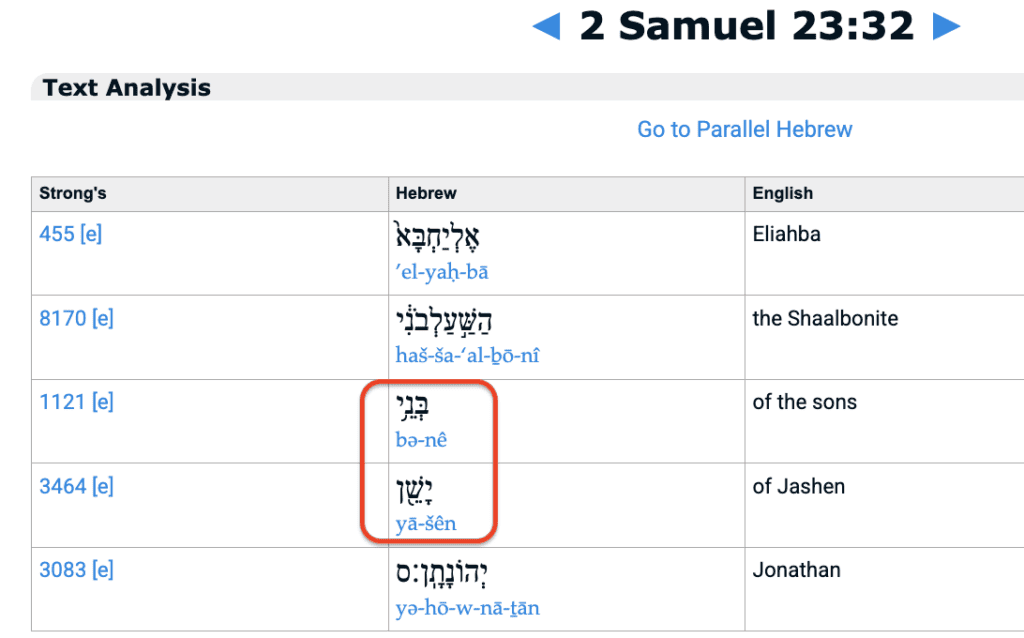
Personal register. 2 Samuel 23:32 contains benê Yāšēn, “the sons of Yāšēn,” among David’s warriors. The passage is textually unstable (1 Chr 11:34 diverges), so the claim is limited but real: the received Hebrew tradition attests Yāšēn as an apparent personal or ancestral designation — defeating the objection that Y-Š-N could only be a place-name.
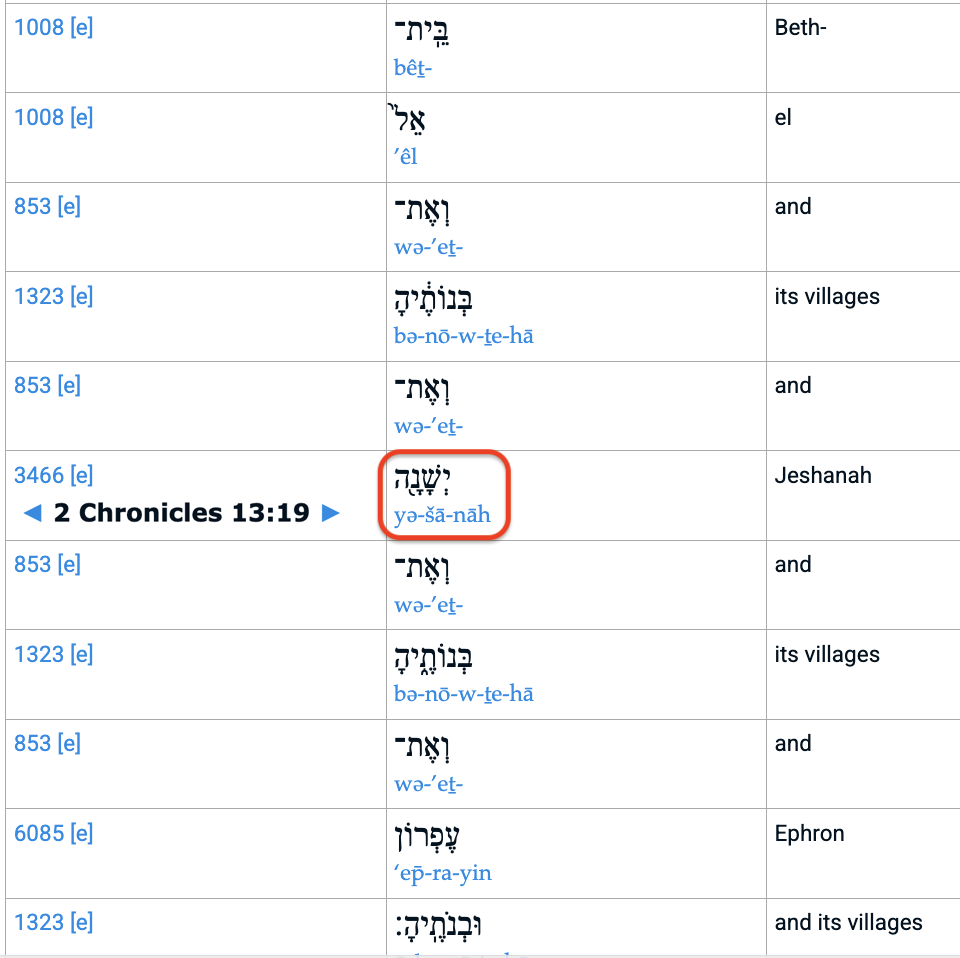
Geographical register. 2 Chronicles 13:19 names Yeshanah as a town of the Kingdom of Israel captured together with Bethel — a northern toponym directly beside Bethel in one conquest notice. Older critics proposed restoring the name in 1 Samuel 7:12 (an emendation). Some interpreters read shaʿar ha-yeshanah (Neh 3:6; 12:39) as “the Gate of Yeshanah,” the feminine form being awkward as a mere adjective; “Old Gate” remains possible. Josephus’s Isana and the modern candidates Burj el-Isaneh and ʿAin Siniya may preserve later toponymic echoes; identification is disputed and uninterrupted continuity undemonstrated.
Caveat. Yeshanah derives naturally from the ordinary root y-š-n, “old,” and Yāšēn can be read against the same lexical background. Short triconsonantal matches can arise accidentally; the correspondence is evidence to investigate, not proof of transmission, and requires the base-rate study below.
5. Regional Coherence and the Open Genealogy
The genealogical interpretation is regionally coherent with a Bethel–Ephraim–Northern Kingdom corridor: Judges 20:27–28 places Phinehas ministering before the Ark at Bethel; Joshua 24:33 gives him an estate in the Ephraim hills where Eleazar was buried (the ʿAwarta identification is later tradition); Yeshanah stands beside Bethel; the priestly name Phinehas is independently attested in another northern sanctuary setting at Shiloh; and Elijah’s mission unfolds across the same kingdom. These notices belong to different periods and establish regional compatibility, not direct transmission. No surviving source connects Yeshanah specifically with Elijah, his priestly ancestry, or his Tishbite identity — the geographic discrimination problem remains open.
Kings introduces Elijah without a patronymic. Later traditions filled that opening in materially different ways: a Gadite (Genesis Rabbah); a Benjamite son of Jeroham (1 Chr 8:27) — the one filling with an actual biblical father-name, nowhere near Y-Š-N; Phinehas himself — an identity claim, not a genealogy, with early-Roman-period roots in Pseudo-Philo (commonly dated first or early second century), later attributed to Reish Lakish, categorical in Pirqe de-Rabbi Eliezer and targumic tradition; and, in the pre-Islamic Christian Lives of the Prophets, an Aaronide with a named father, Sobacha/Shobach, who receives a birth vision. That Christian notice demonstrates that an Aaronide genealogy with a father-name circulated in the pre-Islamic Christian textual tradition, subject to confirmation of the relevant recension’s date; it does not supply Yāsīn or Yashīn.
These forms cannot all be straightforwardly correct as literal names of Elijah’s immediate biological father, although more than one could preserve displaced or differently categorized elements of older tradition — clan, house, location, title, or corrupted personal name. The Arabic chains consistently choose the priestly branch and express it as descent: Phinehas becomes ancestor rather than Elijah himself. That transformation from identity to genealogy is itself a feature requiring explanation.
6. Mechanism, Dating, and the Aaronide Framework
Elijah’s identifier ha-Tishbi was reprocessed across traditions: Pirqe de-Rabbi Eliezer reinterprets it through repentance language; Islamic transmission preserves it as the nisbah al-Tashbī. Elijah’s geographical identifier was therefore susceptible to translation, reinterpretation, and preservation in new categories — an analogue for, not evidence of, a hypothetical Yeshanah → Yāsīn/Yashīn movement. No surviving witness performs that conversion.
Ibn Isḥāq’s death in 767 supplies an eighth-century terminus ante quem for the attributed Yāsīn report, not for the origin of the underlying tradition, which could be contemporary, inherited, received from Jewish or Christian informants, built from Quranic interpretation, or composite. Pirqe de-Rabbi Eliezer, commonly situated in the eighth–ninth-century Islamic-era Jewish environment, reflects continued reformulation of the Elijah–Phinehas complex — an important synchronism that proves no direction of borrowing. Jewish chronological tradition had already linked the northern prophetic succession Elijah → Elisha → Jonah, with Jonah sent to anoint Jehu (Seder Olam Rabbah 18). The early exegetical view attributed to al-Ḍaḥḥāk and Qatāda that Ilyās was Idrīs belongs to a wider cluster of deathless-figure fusions (Enoch/Idrīs, Phinehas/Elijah, Elijah/Khiḍr) that traditions repeatedly merged and genealogists repeatedly separated.
Biblical Aaronide pedigrees, particularly Ezra 7:1–5 and 1 Chronicles 6:3–15, preserve the sequence Phinehas–Eleazar–Aaron. This sequence closely accounts for the priestly skeleton of Ibn Isḥāq’s genealogy, in which Yāsīn is the sole additional member placed between Ilyās and Phinehas. The conclusion must be limited to that chain: Wahb’s doubled al-ʿĀzar/al-ʿAyzār sequence and Ibn al-Munādī’s al-ʿĀzar form remain textually or onomastically unresolved. Yāsīn/Yashīn is therefore the most conspicuous shared nonbiblical datum, but not the only unexplained element across all three genealogies.
7. Rival Hypotheses
H1 — Preservation. A lost Jewish or Christian Elijah tradition already contained a Y-Š-N name or house-designation. Prediction: an early extra-Quranic Y-Š-N form will appear in Elijah, Phinehas, Tishbite, Aaronide, or Northern Kingdom material.
H2 — Geographic genealogization. Yeshanah or a related northern name was converted into an ancestor in late-antique or early Islamic transmission. Prediction: evidence will connect Yeshanah or a related Y-Š-N place or family with Elijah’s Tishbite, priestly, Bethel, or Northern Kingdom traditions.
H3 — Later genealogical interpretation of the Quranic form. The Quranic Āl Yāsīn reading is primary; later transmitters may have interpreted Yāsīn genealogically as the name of Ilyās’s father or ancestor. This concerns the origin of the later genealogy, not the origin or authority of the Quranic reading. Prediction: the patronymic appears only in post-Quranic transmission, with no demonstrable earlier Elijah genealogy containing the name.
H4 — Scribal development. Yashīn arose secondarily from Yāsīn through orthographic or transmissional change. Prediction: manuscripts fluctuate among ياسين, يشين, يسين, with Yashīn late, sporadic, or confined to a limited family.
H5 — Independent resemblance. The biblical and Arabic forms are unrelated ordinary Semitic formations. Prediction: no transmission bridge emerges, while comparable triconsonantal coincidences prove common.
Present ranking. H3 and H4 currently require fewer unverified bridges than H1 and H2. The Yashīn form, however — carrying a non-Quranic sibilant and lacking the alif — creates pressure against simple derivation from the familiar Quranic spelling. If early manuscript witnesses consistently preserve يشين with explicit vocalization, H4 becomes less straightforward and H1/H2 gain relative explanatory weight. The result would not by itself establish either constructive hypothesis, but it would make derivation from the familiar Quranic spelling less economical. The decisive issue is not whether Yashīn looks difficult in the abstract; it is whether the difficult form is genuinely early, consistently transmitted, and deliberately vocalized.
8. The Decisive Tests
- Manuscript control of Yashīn: the oldest witnesses of al-Muntaẓam — do all read يشين; is any fully vocalized; is the authentication phrase consistently transmitted; could the absent alif be ordinary orthography; does the form occur elsewhere in Ibn al-Munādī’s writings.
- Comparative onomastic base rate: Y-S/Š-N across biblical and epigraphic Hebrew, Aramaic, Syriac, Nabataean, Safaitic, early Arabic papyri, and pre-Islamic Arabian inscriptions; sīn/shīn fluctuation and alif omission rates in transmitted foreign names. The Arabian results will determine whether the form was independently available, specifically associated with biblical transmission, or absent outside the Quranic and later Elijah materials.
- Ancient-version control: Yāšēn and Yeshanah across MT, Septuagint, Peshitta, Vulgate, Targum, and Qumran — whether recognizable forms were available to the traditions most likely to have reached Arabic transmitters.
- Lives of the Prophets recension study: the father-name across Greek, Syriac, Armenian, Ethiopic, and Arabic recensions — its earliest recoverable form, its changes, and any Y-S/Š-N-like drift.
Supporting controls: Ibn al-Munādī’s sources and independence; a negative-control comparison with roughly ten other prophet genealogies in the same transmitters; a source-chronology table separating attribution dates, compiler dates, and manuscript dates; and a geographic discrimination study of Yeshanah itself.
9. Method
The argument begins with transmitted disagreements — the Ilyāsīn/Āl Yāsīn reading division, the three genealogical forms preserved together, and the competing ancient accounts of Elijah’s origin — rather than harmonizing them away. The Quranic datum is not subjected to the same category of criticism as the later reports; historical criticism applies to the genealogical claims. The proposed historical relationship among these data remains an inference to be tested. Peripheral material remains peripheral; no weak parallel is permitted to carry the central case.
Conclusion
The principal unresolved question is no longer whether Y-Š-N existed in biblical Israel or whether Yāsīn/Yashīn is attested in the Arabic evidence — the Quranic Yāsīn form is primary and controlling, while the Yāsīn/Yashīn patronymic forms are preserved in later historical transmission. The unresolved question is whether the biblical and Arabic name evidence is historically connected rather than independently similar. No presently identified extra-Quranic witness directly supplies that connection.
The evidence establishes a primary Quranic Yāsīn form; later Aaronide genealogies containing Yāsīn and Yashīn; biblical Y-Š-N precedent in personal and geographical registers; and regional coherence within the Bethel–Ephraim–Northern Kingdom setting. It does not establish that Yāsīn or Yashīn derives from Yeshanah, that the genealogical interpretation predates Islam, or that a Y-Š-N name historically belonged to Elijah’s family.
The Yāsīn/Yashīn genealogy may preserve a reworked Y-Š-N name tradition associated with Elijah’s northern Israelite setting. The evidence makes that possibility historically worthy of investigation, but not yet demonstrable.
We invite further deep research.
And Allah knows best.