

The Qur’anic Inheritance System: Why the “Mathematical Flaw” Is Actually the Point
The Critics’ Misunderstood Target
Critics point to Islamic inheritance’s “fatal flaw”: fixed shares sometimes exceed 100% of the estate, requiring proportional reduction (awl). They call this a divine mathematical error.
They’ve identified the wrong problem.
The Qur’an wasn’t designing a spreadsheet. It was designing a protection system that prioritizes vulnerable heirs first — and lets the math adjust afterwards.
How the Dual-Pressure Design Works
Step 1: Lock Non-Negotiable Minimums
- Widows: 1/8 (with children) or 1/4 (without)
- Daughters: 1/2 (single) or 2/3 (multiple)
- Parents: 1/6 each (with children) or enhanced shares
- These fractions are deliberately generous — even if they push the total over 100%.
Step 2: Handle Mathematical Consequences
When shares exceed 100% (overflow):
- Proportional scaling (awl) spreads the shortfall evenly
- No heir is erased — all retain a fair proportion of their entitlement
- Protection hierarchy is preserved — vulnerable heirs don’t get crushed by the arrival of new claimants
When shares fall short (underflow):
- Leftover (residual) goes to the closest male relative or other designated category
- Maintains family retention unless redirected via the one-third bequest allowance
Step 3: Preserve Protection
No one is zeroed out. The vulnerable keep their proportional priority no matter how many heirs appear.
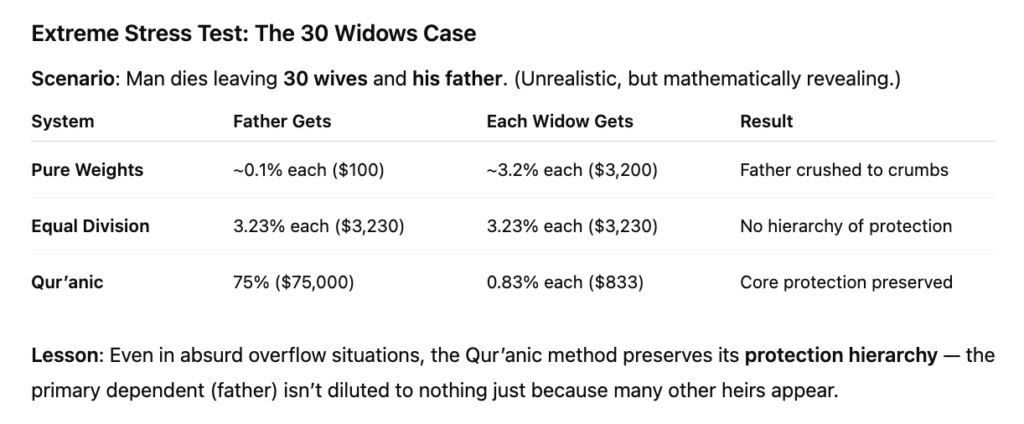
Guardrails: Qur’anic & Prophetic Instructions
The system is more than math — it’s morally tamper-proof.
1. Qur’anic “Do No Harm” Clause (Qur’an 4:12)
“…after payment of any bequest he may have made or debt — without causing harm.” (غَيْرَ مُضَارٍّ)
This bans fake debts, oversized bequests, or will-games that rob or deprive rightful heirs. It forces fair allocation.
2. Prophetic Distribution Directive (Ṣaḥīḥ al-Bukhārī & Muslim)
“Give the fixed shares (fara’id) to those entitled, then whatever remains, give to the closest male relative.”
This solves overflow and underflow without erasing anyone’s rightful place in the protection order.
Together, these guardrails make the system mathematically resilient and morally secure.
Example: Overflow in Action
Scenario: Man dies leaving wife, 2 daughters, both parents
- Designated shares: Wife 12.5% + Daughters 66.7% + Parents 16.7% + 16.7% = 112.6% (overflow)
- Awl adjustment: Each gets 88.9% of their designated share
- Final: Wife 11.1%, Daughters 59.3%, Parents 14.8% each — total 100%
The genius: Instead of letting one group take their full share and wiping out others, everyone shares the adjustment burden proportionally.
Historical Context: The Qur’anic Leap Over NT and OT Systems
NT: Nothing Codified
- The New Testament contains no formal inheritance law.
- Early Christian communities relied on Roman or local law, where women often could not inherit directly.
- Widows were sometimes “inherited” (marriage obligation) but rarely given estate property.
- No fixed protections for vulnerable heirs.
OT: Male-Dominant Primogeniture
- Found in Numbers 27, Deuteronomy 21.
- Firstborn son gets double portion.
- Daughters inherit only if no sons exist, and must marry within the tribe.
- Widows receive no estate share — they rely on male heirs for support.
- Entire estate could legally go to a single male heir.
Qur’anic Revolution
- Guaranteed shares for widows, daughters, mothers — even if sons exist.
- Abolishes primogeniture — sons and daughters share (with set ratios).
- Requires at least two-thirds of the estate to follow fixed shares.
- Allows up to one-third for bequests to anyone — including non-relatives.
- Introduces overflow handling (awl) to preserve fairness when totals exceed the estate.
- Removes tribal marriage restrictions on female heirs.
Why Alternative Systems Fail the Protection Test
Pure Percentage Systems
- Break when adding new heirs — no floor protection for vulnerable heirs
- Can wipe out widows and daughters entirely in complex family trees
Equal Division Models
- Treat wealthy distant relatives the same as dependent close relatives
- No hierarchy of protection, no regard for dependency
Judicial Discretion Systems
- Outcomes become unpredictable court battles
- Wealthier families can buy legal advantage
- Estates can stall for years in litigation
Historical Proof the Qur’an Intended Overflow Handling
The first recorded awl case was in Caliph Umar’s time: a woman leaving husband + 2 sisters. Shares exceeded 100%. Umar consulted companions and ruled proportional scaling was correct.
This was not a “patch” — it was recognition that the system was designed to work under both overflow and underflow conditions without collapsing.
The Critics’ Unanswered Questions
If overflow were a design flaw:
- Why did Umar and the companions institutionalise it rather than “fixing” it?
- Why hasn’t 1400 years of Islamic legal scholarship rewritten the fractions?
- Why do modern Muslim jurisdictions still use awl?
If alternatives were superior:
- Why do “flexible” modern systems generate massive litigation industries?
- Why do mathematically perfect models fail to protect vulnerable heirs under pressure?
- Why do wealthy families spend fortunes circumventing “equal” laws?
The Real Mathematical Genius
The Qur’anic system builds in two pressure valves:
- Overflow handling – spreads scarcity proportionally without breaking protection hierarchy
- Underflow handling – redirects surplus in a controlled, intentional way
Rigid mathematical systems collapse when reality creates stress. This one bends, keeps priorities intact, and resolves disputes rapidly.
Bottom Line
Overflow and underflow are not flaws — they are proof of design resilience.
When shares exceed the estate, the Qur’anic system adjusts without erasing the vulnerable. When there’s leftover, it has a clear, consistent plan.
Fourteen centuries later, no one has built a system that protects better, adapts faster, and survives longer.
Because when you “fix” the math, you break the protection — and protection was always the point.